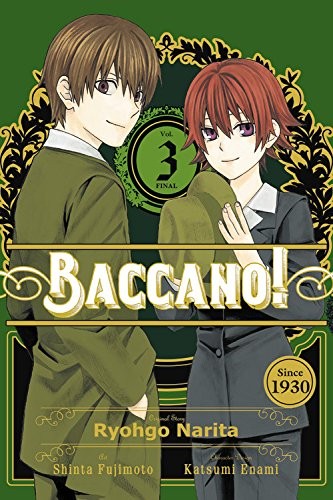
Baccano! Manga Review: A Train Heist Where Everyone Thinks They're the Hero
by Ryohgo Narita (story) / Shinta Fujimoto (art)
Read the first volume. If it doesn't hook you, put it down. It'll hook you.
Buy Baccano! on Amazon →*Affiliate link — I earn a small commission at no extra cost to you.
The first time I saw the Baccano! anime, I was a teenager who still felt invisible — the kid nobody picked for anything. And here was a story with no single hero, where a dozen loud, desperate, ridiculous people all believed at the exact same time that the world revolved around them. Nobody waited their turn. Everybody mattered. I remember thinking: I want to live in a story like that.
So when I found out Shinta Fujimoto had drawn a manga of it — just three volumes, just one arc — I went in nervous. How do you fit thirty people screaming over each other onto a page? But Fujimoto picked the smartest possible piece of Ryohgo Narita's sprawling light novel series to adapt: the train. The Flying Pussyfoot. The one night where everything goes wrong for everyone at once. This is the Baccano! manga I can actually hand to someone, and that's what I'm reviewing here.
Quick Take
- A tight 3-volume adaptation of the "Grand Punk Railroad" arc — the famous Flying Pussyfoot train hijacking of 1931.
- Three rival gangs board the same transcontinental express on the same night, none of them knowing about the others.
- Rated M (Mature) — this is genuinely gory, with torture, dismemberment, and a body count that climbs fast.
Story Overview
It's December 1931. The Flying Pussyfoot, a luxury transcontinental express, leaves Chicago for New York. By the time it arrives, it's a rolling crime scene.
Three groups board with three completely separate plans. The Lemures, a cult, want their leader Huey Laforet freed from prison and threaten to kill passengers as leverage. Ladd Russo and his White Suits plan to murder a senator's family and crash the train for ransom — though Ladd mostly just wants the killing. And seven members of Jacuzzi Splot's gang sneak aboard to steal a shipment of explosives that the boy Czeslaw Meyer is moving for the Runorata mafia.
None of these groups knows the others exist. They all make their move the same night. And then something else starts moving through the train cars — something the crew whispers about as the Rail Tracer, a monster that supposedly eats passengers off moving trains. One by one, the hijackers start disappearing, dragged into the dark, leaving smears of blood. The manga turns the whole train into a locked box where predators discover they're prey, and the structure pays off when you realize who the "monster" actually is.
Characters
Ladd Russo is the engine of the chaos — a hitman in a white suit who is gleefully, openly in love with killing, specifically killing people who think they can't die. He's also genuinely devoted to his fiancée Lua, which makes him scarier, not softer. When he finds one of his own men butchered, he doesn't mourn; he gets fascinated, and ends up dancing in the gore. His arc is the slow horror of a man who loves death meeting things that won't give it to him.
Claire Stanfield — also called Vino — is a freelance assassin raised as an unofficial fourth brother of the Gandor crime family. On this train he's working as a conductor, and he takes on the identity of the Rail Tracer, the urban-legend monster, to hunt the hijackers and protect the passengers. He is absurdly confident, weirdly philosophical, and the single most dangerous person aboard.
Jacuzzi Splot is the opposite of everything around him: a gang leader who cries constantly, apologizes for everything, and has a huge sword tattoo across his face that he got after his partner Nice was hurt. His whole arc is finding the courage to stand between violence and the people he loves despite being terrified the entire time. Nice Holystone, his explosives-obsessed childhood friend with an eyepatch (she lost an eye in an accident), is the steel to his nerves.
Czeslaw Meyer is the gut-punch of the cast: an immortal who has been a ten-year-old boy for over two hundred years, frozen since 1711. He's also been tortured for much of that time by a guardian who experimented on his deathlessness — which is why he's terrified of other immortals and trusts no one. Chane Laforet, a mute swordswoman utterly devoted to her father Huey, rounds out the train's most haunting figures.
Art Style
Fujimoto's line work is loose and kinetic, which is exactly right for this story. The comedy beats — Isaac and Miria's gestures, Jacuzzi's panicked tears — are cartoony and elastic, and then the violence snaps into sharp, ugly, high-contrast black. Because the whole arc happens at night on a train, the pages lean heavily on shadow, and the Rail Tracer sequences use that darkness to hide exactly as much as they should. You feel the cramped corridors. You feel how nowhere on that train is safe.
What I Love About It
The thing Narita built, and Fujimoto preserves, is that there is no protagonist because every single character is certain they're the protagonist. Ladd thinks the train is his stage. Jacuzzi thinks he's just trying to survive a heist. The Lemures think they're holy. Czeslaw thinks he's the smartest schemer aboard. The manga lets all of these point-of-view bubbles drift through the same corridors, bumping into each other, and the joy is watching them collide without realizing what they've collided with.
And then there's the Rail Tracer. I love that the manga commits fully to the horror framing first. The crew tells the legend. People start vanishing. The hijackers — hardened killers — start getting genuinely scared, and the page treats it like a ghost story before it ever treats it like an action scene. Turning Claire's killing spree into a campfire monster tale is such a confident structural trick, because the reveal recontextualizes every disappearance you'd already read past. That's the Baccano! feeling in miniature: information you saw from one angle snapping into focus from another.
Memorable Scene ⚠️ Spoiler Warning
The reveal of the Rail Tracer is the scene I can't shake. Throughout the early chapters, hijackers keep disappearing off the train, leaving only blood, and the surviving killers convince themselves an actual monster is hunting them — a creature that eats people off moving railcars. The crew feeds the legend; the dread builds like a horror manga.
Then the curtain drops: the monster is Claire Stanfield, the soft-spoken conductor, who has been calmly walking the length of the train picking off the Lemures and the White Suits one by one to keep the passengers safe. He's neither fully "Claire" nor "the conductor" anymore, and he offers his hunters the name Vino — or Rail Tracer — for the time being. The horror story was an action story wearing a costume. What makes it land on the page is that Fujimoto drew the earlier deaths to look supernatural on purpose, so when you flip back, the "ghost" was a man the entire time. It rewrote the book I thought I was reading.
Pros & Cons
Pros:
- A complete, self-contained 3-volume story — no waiting on an endless serialization.
- The Flying Pussyfoot is the single best arc to adapt, dense with payoffs.
- The horror-to-action pivot of the Rail Tracer is genuinely thrilling on the page.
Cons:
- The ensemble is hard to track early — names and factions pile up fast.
- The gore is real: torture, dismemberment, immortals being hurt in ways that don't kill them.
- It adapts one arc of a much larger saga, so it ends without the full Baccano! picture. If you want a clean single protagonist and a tidy throughline, this controlled chaos won't work for everyone.
Is the Baccano! Manga Worth Reading?
Yes — especially if you want a finished, three-volume crime thriller you can read in a weekend. It throws a dozen self-styled heroes onto one doomed train and lets a fake monster hunt them, and the Rail Tracer reveal alone justifies the read. Just go in knowing it's bloody and ensemble-driven, not a single-hero story.
Similar Manga
| Title | Its Approach | How Baccano! Differs |
|---|---|---|
| Durarara!! | Same author, sprawling modern Ikebukuro ensemble with no fixed lead | Baccano! is period crime (1930s America) and supernatural via immortality, not urban legend |
| 91 Days | Grim, focused Prohibition-era revenge story | Baccano! is chaotic and multi-threaded, balancing horror, comedy, and gangster violence at once |
| Gangsta. | Gritty crime city with enhanced "Twilights" | Baccano! ties its powers to alchemy and immortality, and leans far more on tonal whiplash |
Where to Buy
Read the first volume. If it doesn't hook you, put it down. It'll hook you.
This post contains affiliate links. If you purchase through these links, I may earn a small commission at no extra cost to you. As an Amazon Associate, I earn from qualifying purchases.
*Affiliate link — I earn a small commission at no extra cost to you.
More Manga You Might Like
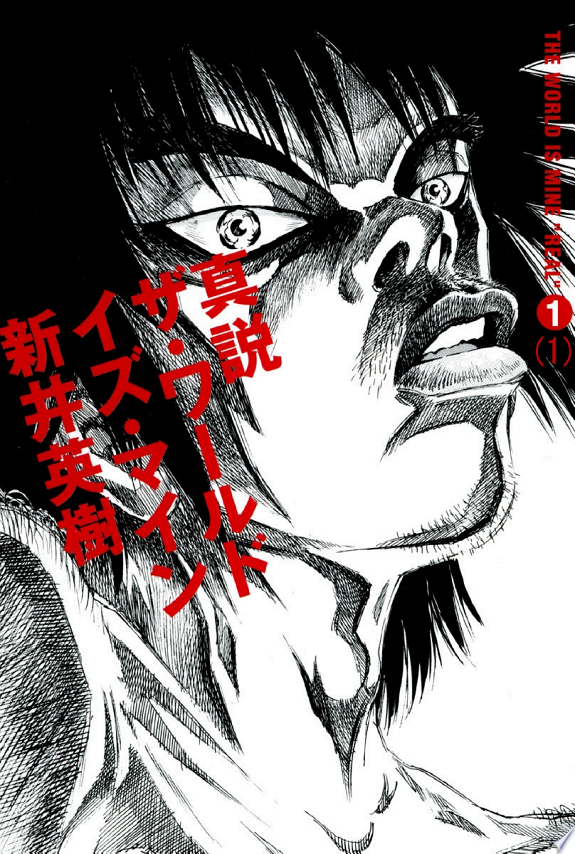
Action / Crime
The World Is Mine
The World Is Mine follows two criminal partners — the unpredictable Mon and the calculating Toshi — on a violent crime spree across Japan, alongside a separate thread about a mysterious monster emerging in the wilderness.
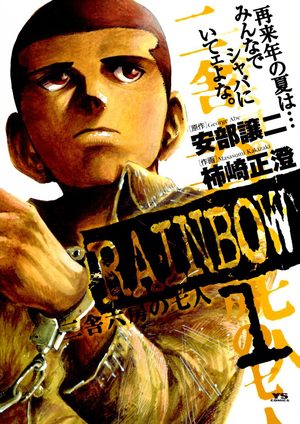
Action / Drama
Rainbow: Nisha Rokubō no Shichinin
Yu's review of Rainbow — six juvenile delinquents are sent to a brutal reformatory in 1955 Japan and placed in Cell 6, where they bond with their cellmate Rokurouta Sakuragi, a former boxer who teaches them what it means to survive with dignity.
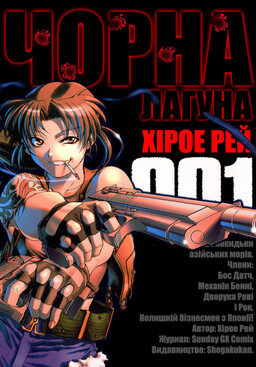
Action / Crime
Black Lagoon
Yu's review of Black Lagoon by Rei Hiroe — Rokuro 'Rock' Okajima, a Tokyo salaryman, is taken hostage by the mercenary crew of the torpedo boat Black Lagoon; when his company writes him off rather than pay ransom, he joins them in the lawless Thai port city of Roanapur.
Action / Drama
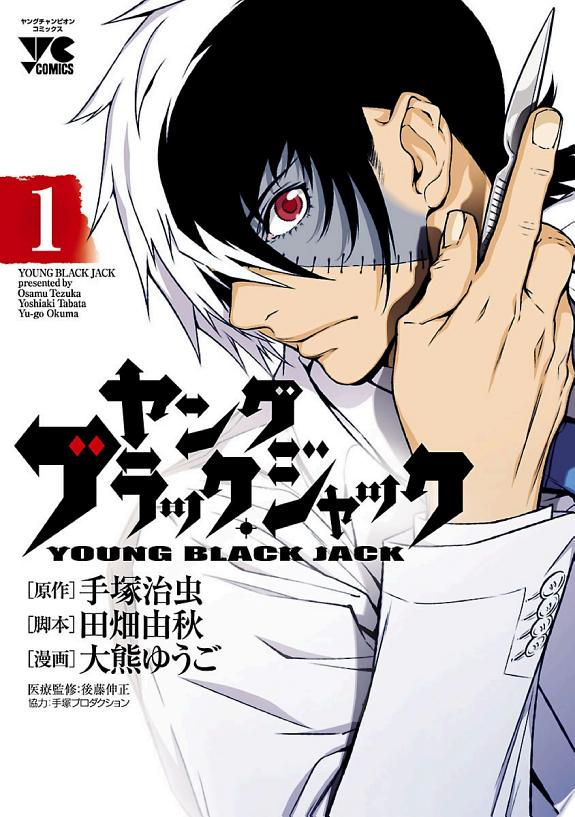
Young Black Jack
A review of Yoshiaki Tabata and Yugo Okuma's Young Black Jack — 16 volumes in Weekly Young Champion. Young Hazama Kuroo — the future Black Jack — as a medical student in 1960s Japan, performing extraordinary surgeries in an era of political upheaval and moral complexity. No official English edition.
Action / Crime
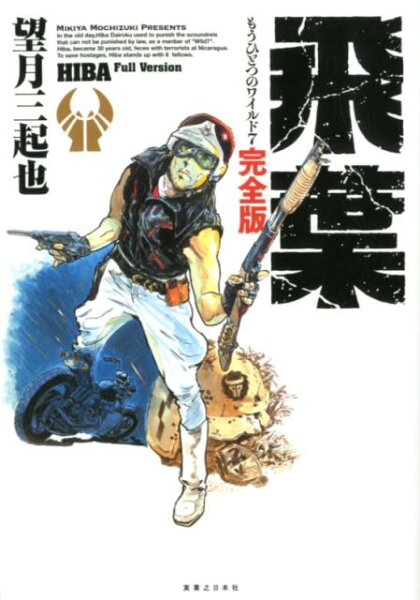
Wild 7
Wild 7 follows a special police unit composed of convicted criminals given a second chance — authorized to use lethal force against criminals the law cannot otherwise reach, operating on motorcycles and outside the normal rules of law enforcement.

Action / Historical
Souten Kouro
A review of Souten Kouro, the manga about the Three Kingdoms era that makes Cao Cao the protagonist — the villain of most versions — and argues he was the era's greatest mind.
Written by
Yu
Manga Enthusiast from Japan
I grew up in Japan and manga literally saved me during a tough time in elementary school. My English isn't perfect, but my love for manga is real — and I want to share it with you.
Disclosure: This post contains affiliate links. As an Amazon Associate, I earn from qualifying purchases at no extra cost to you.