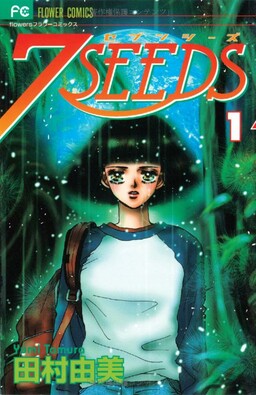
7SEEDS Review: The Survival Epic Where Nobody Volunteered to Be a Hero
by Yumi Tamura
Read the first volume. If it doesn't hook you, put it down. It'll hook you.
Buy 7SEEDS on Amazon →*Affiliate link — I earn a small commission at no extra cost to you.
I read a lot of survival manga where the protagonist is already brave on page one. They wake up in a ruined world and immediately know how to make fire, how to fight, how to lead. I used to like those stories. Then I read 7SEEDS, and they all started to feel like lies.
Because the first thing Natsu does when she wakes up — soaked, alone, dropped into a stormy sea in a future she didn't agree to — is panic. She's sixteen. She's the kind of girl who apologizes for existing. She is, by her own admission, useless. And Yumi Tamura makes you spend 35 volumes with her anyway, and somewhere along the way you realize that watching a coward slowly become brave is so much harder to write, and so much more moving, than watching a hero be a hero. When I was a kid hiding from people, I needed Natsu more than I needed Naruto. I just didn't have her yet.
Quick Take
- A 35-volume post-apocalyptic survival epic with a huge cast — and unlike most survival manga, the people here were chosen for being ordinary, not heroic
- Five teams (Spring, Summer A, Summer B, Autumn, Winter) wake up scattered across a transformed Japan, and the story braids their arcs together over fifteen in-world years
- M (Mature) — graphic survival violence, death, suicidal ideation, and disturbing backstories run throughout; this is not a gentle read
Story Overview
The premise is quietly horrifying. Scientists confirm a meteor will strike Earth and end civilization. Governments around the world react in secret. Japan's answer is the 7SEEDS Project: select healthy young people, put them into cryogenic sleep, and program them to be revived by the planet itself only once the world is survivable again. Nobody tells the candidates the full truth. Many of them are simply taken.
When the story opens, the catastrophe has already happened. The young people wake — five teams, each named for a season, scattered across the country with a single adult guide apiece — into a Japan they don't recognize. The land has heaved into new shapes. Plants and animals have mutated into things that bite, sting, and hunt. There is no instruction manual, no rescue, and at first, no awareness that any other team even exists.
The structure is the genius of it. We follow Summer Team B first — the misfits, the throwaways — and only gradually discover the other teams: the elite, manufactured Summer Team A; the survivalist Spring; the steady Autumn; and the near-empty Winter. The teams find supply caches called the Seven Fuji, uncover the truth of the project, and stumble into the Ryugu Shelter — an underground "theme park" where an earlier group of survivors starved and then died of a sealed-in infection, the Acari X virus. The final arc is a derelict ghost ship whose long-dead captain set its missiles to fire at Japan on an automatic countdown, and the surviving kids — every team, every skill — have to cooperate to stop it before the clock hits zero. They do, just barely, as the ship's own metal-eating bacteria eat it out from under them. The ending isn't triumph. It's acceptance: this broken world is theirs now, and they choose to live in it together.
Characters
Natsu Iwashimizu (Summer B) — The heart of the series. A withdrawn sixteen-year-old who genuinely believes she has no value. Her entire arc is the slow accumulation of small courages, until by the ghost-ship climax she's operating a crane to haul trapped teammates out of danger — the same girl who once couldn't speak up in a classroom, now risking her life on purpose.
Arashi Aota (Summer B) — Calm, decent, and quietly heartbroken. He wakes up still in love with his girlfriend Hana, not knowing she's alive on a different team. When Natsu finds a note Hana left for him, she hesitates to even show it to him. Arashi's journey is learning to love the world he's actually in, not the one he lost.
Hana Sugurono (Spring) — Daughter of Professor Takashi, one of the project's architects. Trained in survival by her father, she's the most physically capable of the leads — and the most betrayed, since her own father built the machine that took everyone's lives away. She nearly dies more than once and carries the weight of her family's guilt without having chosen any of it.
Ango (Summer A) — The one who broke my heart. Bred and raised on a secret island to be a perfect survival specialist, Ango carries the trauma of the final selection test, where his best friend Shigeru died to save him. He emerges bitter, aggressive, and at times suicidal, lashing out — even shoving Hana into rushing water — because he hates himself for surviving. His redemption, learning to value the "useless" Summer B kids he once despised, is one of the series' longest and most earned arcs.
What I Love About It
What I love is that 7SEEDS refuses to flatter anyone. Most survival stories quietly tell you that the strong deserve to live. Tamura tears that idea apart on purpose. The "elite" Summer Team A — manufactured human beings, raised in a lab, optimized for exactly this apocalypse — are the most damaged people in the story. The "useless" Summer B kids, chosen almost by accident, are the ones who actually keep each other alive. The manga keeps asking: what is a person for? And it answers not with strength, but with the willingness to stay close to other people long enough to care about them.
That's why Natsu's arc lands so hard for me. She is not exceptional. She never becomes exceptional in the way shonen protagonists do. She just keeps choosing, in small terrified increments, not to give up — and the manga treats that as the most heroic thing a human can do. By the time she's at the controls of that crane in the final arc, the payoff isn't a power-up. It's fifteen years of a frightened girl deciding, over and over, that she's worth keeping. I've reread her early chapters several times, and knowing where she ends up makes her panic on page one almost unbearable to watch — in the best way.
Memorable Scene ⚠️ Spoiler Warning
The flashback to Ango's selection test is the scene that haunts the whole series.
Summer Team A weren't recruited — they were made. Created from selected cells, raised on a hidden island, and put through a survival program that quietly killed off the candidates who weren't good enough. The final test sends Ango, his best friend Shigeru, and Ryo into the mountains roped together. The instructor, Takashi, deliberately cuts their main rope to force them up the cave walls. Then Shigeru is injured, Ango panics and tries to take the lead, his rushed movement loosens the anchor, and both boys fall.
Ryo, free-climbing alone, manages to catch the middle of the rope — but he can't hold both of them. And at that exact moment, Shigeru cuts his own line. He chooses to fall so that Ango can live.
What makes the sequence unforgettable isn't the death itself — it's that Tamura makes you sit inside the survivors' guilt for volumes afterward. During the Minor Heat arc, both Ango and Ryo are forced to relive that moment in different forms before they can finally accept it. The manga understands something most survival stories don't: being saved by someone's sacrifice is not a gift. It's a wound. Ango spends the entire series carrying a friend who died telling him he was worth saving, and not believing it. Watching him slowly, painfully start to believe it is the emotional spine of the whole 35 volumes.
Pros & Cons
Pros
- One of manga's most ambitious large-cast survival epics, with genuine, earned character development across all five teams
- The premise — ordinary people chosen not for heroism — gives it a moral depth most survival manga never reach
- World-building rendered with real botanical and zoological imagination; the transformed Japan feels frighteningly specific
- It's complete at 35 volumes, with a real ending
Cons
- 35 volumes is a serious commitment, and the large rotating cast takes effort to track
- The art is shojo/josei in style — expressive and a little dated to some eyes — which can clash with the brutal content for new readers
- Mature, often bleak: death, trauma, and suicidal ideation throughout
- There's still no official licensed English edition, so reading it legitimately means importing the Japanese volumes — that's either a dealbreaker or an adventure, depending on you
Is 7SEEDS Worth Reading?
If you want survival fiction that treats fear and ordinariness as the real subject — not an obstacle to be powered through — then yes, absolutely. It's a long, demanding, emotionally heavy read with one of the most rewarding ensemble payoffs in manga. If you need a quick thrill or a conventional hero, look elsewhere. 7SEEDS is for readers who'll trade 35 volumes of patience for the rare experience of watching frightened people become brave together.
Cultural Context
7SEEDS ran in Bessatsu Shōjo Comic and then Monthly Flowers from 2001 to 2017 — sixteen years. It won the Shogakukan Manga Award for the shōjo category, and in 2019 Netflix adapted it into an anime by studio Gonzo. The anime is a useful taste, but it compresses the enormous cast badly; the manga is where the story actually lives.
Similar Manga
| Title | Its Approach | How 7SEEDS Differs |
|---|---|---|
| Nausicaä of the Valley of the Wind | Post-collapse ecology with a visionary, exceptional heroine | 7SEEDS centers ordinary, frightened people rather than a chosen savior |
| Girls' Last Tour | Quiet, minimalist wandering through a dead world | 7SEEDS is a sprawling, plot-driven ensemble with active survival stakes |
| Dr. Stone | Rebuilding civilization through science and optimism | 7SEEDS is bleaker and more psychological, focused on trauma and acceptance over progress |
Official English Translation Status
There is no official licensed English edition of 7SEEDS. A French release by Pika Édition stopped at volume 10 in 2011, and VIZ has published other Yumi Tamura titles (Basara, Chicago) but not this one. The 2019 Netflix anime is subtitled in English, but the manga itself remains unlicensed in English. The Japanese print and digital volumes from Shogakukan are the only legitimate way to read the complete story.
Where to Buy
No English release yet. That just means you find it before everyone else does.
The complete Japanese edition (35 volumes) is available from Amazon Japan:
This post contains affiliate links. If you purchase through these links, I may earn a small commission at no extra cost to you. As an Amazon Associate, I earn from qualifying purchases.
*Affiliate link — I earn a small commission at no extra cost to you.
More Manga You Might Like
Sci-Fi / Survival
Seven Seeds
Yu's review of Seven Seeds — the Japanese government preserved groups of young people in cryosleep as humanity's last hope; they wake in a post-catastrophe future Japan, separated and uncertain, and must survive and eventually connect.
Sci-Fi / Action
Eden: It's an Endless World!
Yu's review of Eden: It's an Endless World! — a plague destroyed most of humanity; a boy named Elijah grows up in the aftermath, in a world run by the Propater organization and his father's network of resistance, becoming something neither of them intended.
Sci-Fi / Horror
Brynhildr in the Darkness
Yu's review of Brynhildr in the Darkness — from Elfen Lied creator Lynn Okamoto, a sci-fi horror about lab-made witches who survive only on daily death-suppressant pills, the boy who tries to save them, and the harness implant that liquefies any witch the moment it's removed.

Sci-Fi
World's End Harem
Yu's review of World's End Harem — Reito Mizushima was cryogenically frozen to await a cure for his illness; when he wakes, a plague called the MK Virus has killed 99.9% of the world's male population; he is one of a small number of surviving men tasked with repopulating humanity while navigating a society radically transformed by the near-absence of men.
Sci-Fi / Survival Action
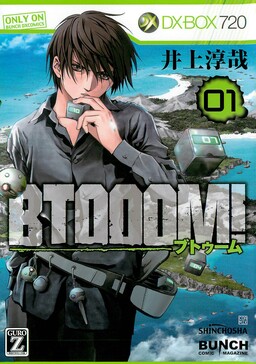
Btooom!
Yu's review of Btooom! — Ryota Sakamoto, Japan's top player of an online bomb-combat game, wakes up abducted on a deserted island forced to play it for real, fighting other players with live BIM explosives to collect the chips that let one person leave.
Sci-Fi / Political
Sanctuary
Yu's review of Sanctuary — two survivors of the Cambodian killing fields make a pact to change Japan from the inside: one through legitimate politics, one through the yakuza; a politically serious manga by the creators of Crying Freeman and Mai the Psychic Girl about power, ambition, and what it costs to change a corrupt system.
Written by
Yu
Manga Enthusiast from Japan
I grew up in Japan and manga literally saved me during a tough time in elementary school. My English isn't perfect, but my love for manga is real — and I want to share it with you.
Disclosure: This post contains affiliate links. As an Amazon Associate, I earn from qualifying purchases at no extra cost to you.