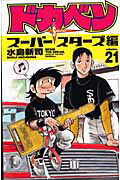
Dokaben Super Stars Review: The Manga That Let Me Grow Old With Yamada Taro
by Shinji Mizushima
Read the first volume. If it doesn't hook you, put it down. It'll hook you.
Buy Dokaben Super Stars on Amazon →*Affiliate link — I earn a small commission at no extra cost to you.
I grew up with my grandfather's Dokaben volumes stacked in the corner of his tatami room, and the thing that always stayed with me was how long the story was. Yamada Taro started as a chubby kid in middle school and just kept going — high school, the draft, the pros. When I finally caught up to Super Stars-hen, I realized I had been following one fictional man for almost his entire baseball life. Not many manga let you do that. Reading the Yamada generation declare free agency and walk into a team that did not even exist the year before felt like watching old friends start over in their thirties. It is a strange, warm feeling, and I do not think any other sports manga has given it to me.
Quick Take
- The professional continuation of Dokaben — Yamada Taro and his old teammates split across two new 2004 expansion teams
- A genuine crossover where characters from Mizushima's other baseball manga step onto the same field
- 45 volumes, rated All Ages, best read after the earlier Dokaben arcs
Story Overview
Super Stars-hen picks up after the Pro Yakyu-hen arc, when the so-called "Yamada generation" of stars all declare free agency at once. To keep these players from leaving Japan, two brand-new Pacific League teams are created in 2004: the Tokyo Super Stars, managed by Doigaki Shoichi, and the Shikoku Iron Dogs, managed by Inukai Kojiro. Yamada Taro signs with Tokyo, alongside familiar names like Iwakite, Sato Satoru, Tonoma, and Bisho. Old rivals Shinobi Mamoru and Tomon Gosuke head to Shikoku. So the very first pitch of the series is loaded with history.
The turning point that surprised me most is the 2005 Japan Series, where the Tokyo Super Stars face the Sapporo Hanao Mets — a team from a different Mizushima manga running in a different publisher's magazine. The two series ran the same games from opposite dugouts, which is the kind of stunt only a creator who built an entire shared baseball universe could pull off.
The series runs for years of in-story seasons and resolves not on a championship but on people's lives. By the end, Sato Satoru has married Yamada's younger sister Sachiko, Iwakite has reconciled with Natsukawa Natsuko, and the final chapter is Yamada Taro's own wedding. After more than thirty years of publication, Mizushima closed Super Stars-hen by marrying off the kid we met in middle school — and then immediately rolled into the next arc, Dream Tournament-hen.
Characters
Yamada Taro — The heart of the whole Dokaben universe. In Super Stars-hen he is a veteran star, no longer the wide-eyed catcher but the leader of an expansion club. His emotional peak as a player comes in 2007 when he records his 2000th career hit — and does it as a home run off real-life pitcher Masahiro Tanaka.
Iwakite Masami — A longtime Yamada teammate who follows him to Tokyo. His arc here is less about baseball and more about life: he reconnects with Natsukawa Natsuko, a girl from his past, and they marry in 2008. Mizushima gives him an unusually domestic ending for a sports manga.
Sato Satoru — Another of the Tokyo Super Stars core. His personal story closes when he marries Sachiko, Yamada Taro's much-younger sister, during the 2008 off-season — quietly folding the Yamada family deeper into the team.
Doigaki Shoichi — Once a player in the earlier arcs, now the manager who assembles and steers the Tokyo Super Stars. Seeing a former teammate become the boss is part of the generational shift the series is built on.
What I Love About It
What I love is the 2005 Japan Series, where Dokaben crosses over with Mizushima's other baseball series and the same games are told from two different magazines at once. The Tokyo Super Stars play the Sapporo Hanao Mets, and depending on which manga you are reading, the "home team" flips. Champion-side readers root for Yamada's Super Stars; the rival publication frames the Mets as the heroes. I had never seen anything like it. It is not a guest cameo — it is two complete stories sharing one fictional World Series.
The reason it hit me is that it only works because Mizushima spent decades treating all his baseball manga as one continuous world. A casual reader sees a fun gimmick. Someone who grew up on these books sees the payoff of a lifetime of worldbuilding — the moment where the author quietly admits that all these players, across all these series, were always living in the same league. For me it turned reading Dokaben from "a long series" into "a world I had been a citizen of," and I think that is a rarer thing than a championship game.
Memorable Scene ⚠️ Spoiler Warning
The one I cannot shake is Yamada Taro's 2000th career hit. In 2007, in just the third game of the season at the Tokyo Dome, he comes up against Masahiro Tanaka — a real, then-rookie pitcher — and turns the milestone hit into a home run. Mizushima loved dropping actual NPB players into his fiction, and here he uses it to crown his oldest character. The page does not feel like a stat being checked off; it feels like the manga telling you that the boy from the original Dokaben really did become one of the greats, measured against real baseball. After a lifetime of following Yamada, watching the number 2000 land as a homer off a real future ace is the kind of full-circle moment that made me close the volume and just sit for a minute.
Pros & Cons
Pros
- A real payoff for anyone who followed Yamada Taro across the earlier Dokaben arcs
- The 2005 dual-publisher crossover is a genuinely unique structural experiment
- Mizushima's warm, character-first baseball storytelling is fully intact across 45 volumes
- The personal endings — marriages, reconciliations — give the ensemble real closure
Cons
- No licensed English edition exists, for this arc or the originals
- It assumes you already know these characters; as a standalone it loses most of its weight
- Professional-season pacing is looser than the do-or-die high school tournaments — that is either the appeal or a letdown depending on you, and it won't work for everyone
Is Dokaben Super Stars Worth Reading?
For Dokaben readers, absolutely — this is where Yamada Taro's story finally pays off, complete with his 2000th hit and his wedding. For newcomers, start with the original Dokaben first; the emotional weight of Super Stars-hen lives entirely in the history you bring to it. As a pure sports thriller for someone with no investment in the characters, it is the wrong entry point.
Where to Buy
No English release yet. That just means you find it before everyone else does.
If you read Japanese, the print and digital volumes are on Amazon Japan:
Search Dokaben Super Stars-hen on Amazon.co.jp →
This post contains affiliate links. If you purchase through these links, I may earn a small commission at no extra cost to you. As an Amazon Associate, I earn from qualifying purchases.
*Affiliate link — I earn a small commission at no extra cost to you.
More Manga You Might Like
Sports
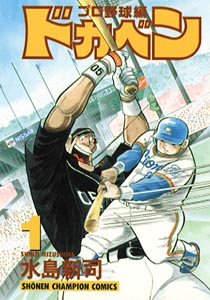
Dokaben Pro Yakyuhen
Dokaben Pro Yakyuhen takes Yamada Taro and his old high school rivals into the real NPB — Seibu, the Hawks, Orix, Lotte, the Giants — and famously got Shinji Mizushima sued by an actual pro pitcher over one panel.
Sports
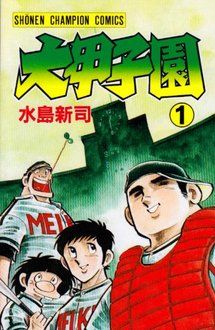
Dai Koshien
Dai Koshien is Shinji Mizushima's dream crossover — a sequel to Dokaben that pulls Yamada Taro and heroes from his other baseball manga into one summer Koshien tournament, climaxing in an 18-inning semifinal for the ages.
Sports / Slice of Life
Absan
Absan follows Yasutake Kageura, a sake-drinking slugger for the Nankai / Daiei / SoftBank Hawks who entered as an undrafted pinch-hitter and retired 37 years later at 61, a 107-volume baseball manga by Shinji Mizushima that ran for over four decades.
Sports
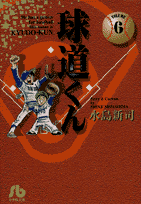
Kyudo-kun
Kyudo-kun follows Kyudo Narao, a young pitcher from Osaka with natural talent and a deep connection to the game through his father — a baseball story about inheritance, pressure, and what it means to throw yourself completely into what you love.
Sports
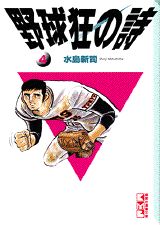
Yakyuukyo no Uta
Yakyuukyo no Uta follows an aging pitcher for a fictional Tokyo team as he fights to stay in the game, but the series is best remembered for introducing Yuki Mikami — Japan's first fictional female professional baseball pitcher — into a sport that had never imagined her.
Sports / Drama
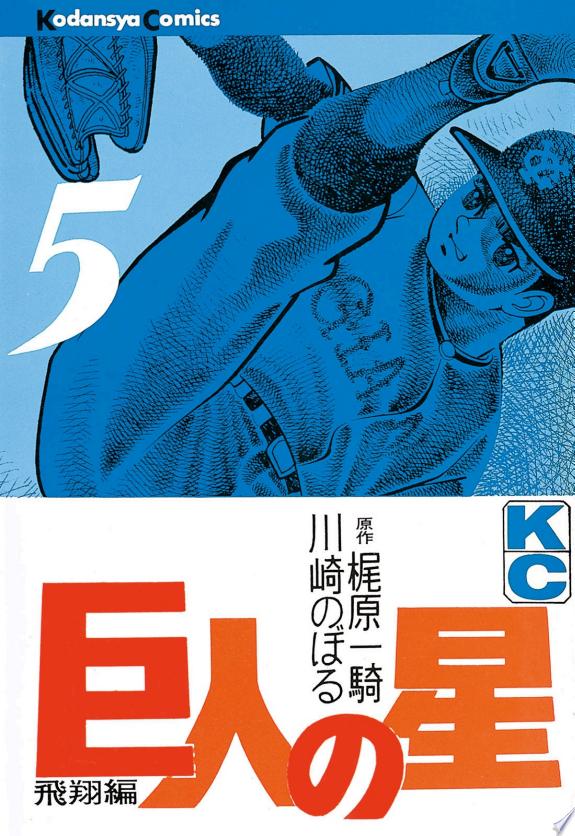
Kyojin no Hoshi
Kyojin no Hoshi follows Hyuma Hoshi, whose father — a former baseball player who never achieved his dream — has raised him from childhood to be a star pitcher for the Yomiuri Giants, through training that borders on abuse and produces a player who may be the greatest — at tremendous personal cost.
Written by
Yu
Manga Enthusiast from Japan
I grew up in Japan and manga literally saved me during a tough time in elementary school. My English isn't perfect, but my love for manga is real — and I want to share it with you.