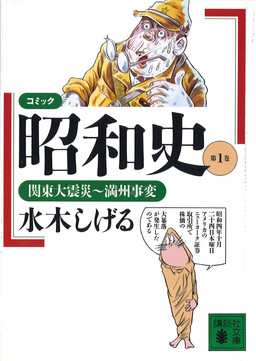
Showa 1926-1939 Review: Shigeru Mizuki's Graphic History of Japan's Most Turbulent Era
by Shigeru Mizuki
*Affiliate link — I earn a small commission at no extra cost to you.
Quick Take
- One of the most important historical manga in English — Shigeru Mizuki's lifetime achievement, drawing Japan's darkest era from inside and out
- The combination of historical record, personal memoir, and the specific visual language Mizuki developed for non-Kitaro work makes this essential reading
- 4 volumes complete; a lifetime in four books
Who Is This Manga For?
- Readers interested in Japanese history, especially the prewar and wartime period
- Anyone who wants to understand how Japan arrived at World War II from the perspective of a Japanese artist who lived through it
- Fans of graphic history and memoir
- Readers who want to understand Shigeru Mizuki beyond his Kitaro work
Content Warnings & Age Rating
Age Rating: T+ (Older Teen) Content Warnings: Prewar and wartime Japanese history; military violence and politics; poverty; historical atrocities referenced and depicted
T+ rating — historical content appropriate for older teen readers with context.
Yu's Rating
| Category | Score |
|---|---|
| Story Depth | ★★★★★ |
| Art Style | ★★★★★ |
| Character Development | ★★★★★ |
| Accessibility for Non-Japanese Readers | ★★★★☆ |
| Reread Value | ★★★★★ |
Story Overview
The Showa era — Japan from 1926 to 1989, named for Emperor Hirohito's reign — contains the most dramatic transformation in Japanese history. Mizuki's four-volume history covers the first segment: 1926-1939, the years from Hirohito's ascension through Japan's increasingly violent militarism and the beginning of its imperial expansion.
The history alternates between two registers: the historical record (political events, military decisions, social conditions, international context) and autobiographical memory (young Shigeru Mizuki's experience of these years as a child in a small town). The interweaving shows how global and national events felt from inside a specific Japanese life.
Mizuki does not excuse or sentimentalize. He shows how ordinary Japanese people arrived at a war that would devastate the country, and he does so with the specificity of lived experience.
Characters
Young Shigeru Mizuki — The autobiographical thread; a child's experience of the prewar period, rendered with the honesty of retrospective understanding.
Historical figures — Politicians, military leaders, and ordinary people depicted with consistency and specificity.
Art Style
Mizuki's historical art is different from his Kitaro work — more realistic backgrounds, more careful historical detail, character designs that read as historical portraits rather than fantasy characters. The visual language is appropriate to the subject.
Cultural Context
Showa is Mizuki's masterwork — the book he could only write after a lifetime of witnessing Japan's transformation. Having survived the war as a soldier (and lost his arm in the Pacific), his authority as a witness gives the history its specific weight.
What I Love About It
The street-level perspective on history. The political decisions that led Japan to war are shown alongside what those decisions meant in the daily life of ordinary people — the propaganda, the economic pressure, the social conformity that war demands. This dual perspective is what distinguishes Showa from conventional historical accounts.
What English-Speaking Fans Say
Western readers describe Showa as one of the most important manga ever translated into English — specifically noted for Mizuki's authority as a witness, for the dual perspective being essential to understanding how ordinary people participate in history, and for the art being exceptional throughout. Frequently cited alongside Art Spiegelman's Maus as essential graphic history.
Memorable Scene ⚠️ Spoiler Warning
The moments where young Mizuki encounters the ideological pressure of prewar Japan — where the gap between what he sees and what he is told he should see — is the series' most personally revealing content.
Similar Manga
- A Drifting Life — Tatsumi's memoir of the same postwar period
- Onward Towards Our Noble Deaths — Mizuki's war memoir
- In This Corner of the World — Kono Oto Tomare's different approach to the same period
- Barefoot Gen — Another firsthand account of wartime Japan
Reading Order / Where to Start
Volume 1 (1926-1939) — the first of four volumes covering the complete Showa era.
Official English Translation Status
Drawn & Quarterly published the complete four-volume English translation. All volumes available.
Pros & Cons
Pros
- Essential historical record from a primary witness
- Dual perspective (history + memoir) is unique
- Art is exceptional
- Complete in four volumes
Cons
- Historical density requires engagement
- Some prewar Japanese political context may need supplementary reading
- Not light reading
Format Comparison
| Format | Notes |
|---|---|
| Individual Volumes | Drawn & Quarterly; 4-volume set |
| Digital | Available |
Where to Buy
Get Showa 1926-1939 on Amazon →
This post contains affiliate links. If you purchase through these links, I may earn a small commission at no extra cost to you. As an Amazon Associate, I earn from qualifying purchases.
*Affiliate link — I earn a small commission at no extra cost to you.
Written by
Yu
Manga Enthusiast from Japan
I grew up in Japan and manga literally saved me during a tough time in elementary school. My English isn't perfect, but my love for manga is real — and I want to share it with you.
Disclosure: This post contains affiliate links. As an Amazon Associate, I earn from qualifying purchases at no extra cost to you.