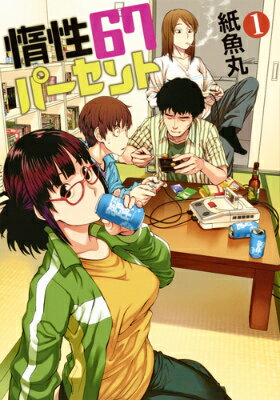
Dasei 67% Review: The Art-School Hangout Comedy That Runs on Pure Inertia
by Shimimaru
Read the first volume. If it doesn't hook you, put it down. It'll hook you.
Buy Dasei 67% on Amazon →*Affiliate link — I earn a small commission at no extra cost to you.
I have a friend whose apartment, in college, became the place. Nobody decided this. It just happened — it was closest to campus, so people drifted in between classes, and then they never really left. We weren't doing anything. We talked about nothing, ate convenience-store food, fell asleep on the floor. When I look back, almost none of those afternoons had a "point." But they are some of the warmest memories I own. Dasei 67% is the first manga I have read that understands exactly that feeling, and refuses to be embarrassed about it.
Quick Take
- A college slice-of-life comedy about four art-school students who do basically nothing in one cramped apartment, and somehow it is impossible to put down
- The title is the joke and the philosophy: this is a group that never gives more than about 67% effort to anything, and is completely fine with that
- This is an M (Mature) seinen series — the humor is constantly crude and sexual, with nudity and drinking, so it's not for younger readers
Story Overview
Minami Yoshizawa is an art-school student living alone in a tiny one-room apartment. The whole series starts from one very specific, very funny premise: she draws manga, including adult manga, and she ropes in the people around her for "advice." That awkward beginning is how the group forms.
Her friend Moe Kitahara, a design-department student, brings two guys into the orbit — Nishida, a good-looking animation student, and Ito, the resident weird-knowledge nerd. The reason they end up at Minami's place every single day is gloriously unromantic: her apartment is simply the closest one to campus. So they gather. And gather. And the manga becomes the chronicle of a friend group hanging out in a six-tatami room, talking mostly about nonsense and sex, drifting through their twenties.
There is no overarching plot in the dramatic sense, and that is deliberate. The "story" is the slow accumulation of a shared life — New Years spent together, dumb arguments, small jealousies, the quiet way Nishida starts noticing Minami as more than a friend. Across nine volumes it never explodes into melodrama. It just lets these four grow a little, at about 67% speed, until graduation looms and you realize you've watched a real friendship form out of pure laziness.
Characters
Minami Yoshizawa — The center of everything. She's a slovenly, lazy, gloriously unbothered art student who draws manga (some of it adult) and treats her own body and dignity with zero ceremony. She's the "fan-service" character by design, but the writing gives her real interiority: she's broke, a bit aimless, and far more self-aware about her own inertia than she lets on.
Moe Kitahara — Minami's "bad influence" best friend from the design department. She's the one who escalates situations, drags Minami into the crude bits, and keeps the group's energy chaotic. She's the engine of a lot of the comedy.
Nishida — The handsome animation student, and quietly the emotional anchor. Over the series he's the one who increasingly sees Minami as a woman, not just a friend, and his restrained, almost too-pure feelings give the back half of the series its gentle will-they-won't-they undercurrent.
Ito — The hands-on, weird-trivia nerd of the group, good with crafts and odd facts. He's the deadpan straight man who reacts to everyone else's nonsense, and a lot of the funniest panels are just his appalled face.
What I Love About It
What I love most is how honestly this manga defends doing nothing. The title — "67% inertia" — isn't a sad statement. It's a thesis. These characters never give 100%. They give about two-thirds, to friendship, to school, to their own desires, and the manga treats that not as a failure to fix but as a perfectly valid way to be young. I have read so many stories that insist youth must be passionate, productive, full of growth. This one says: sometimes you just sit in a friend's room and that's enough, and it means it.
The second thing is the tone balance, which is harder than it looks. The jokes are relentlessly crude — this is openly an ecchi comedy — but it never curdles into something mean or leering. The four of them are genuinely comfortable with each other, and the raunchy humor reads as the in-jokes of people who have stopped performing for one another. That's what got me. Underneath the dirty jokes is a portrait of a friendship so secure that nothing is off-limits, and that intimacy is the actual subject. The "ecchi" is the surface; the comfort is the heart.
Memorable Scene ⚠️ Spoiler Warning
The scene that sums up the whole manga for me is the New Year's Eve. The group is drinking in Minami's apartment, and a thoroughly drunk Minami declares she's going to demonstrate how you can take a bra off without removing your clothes. Moe is right there to escalate it. Panicking, Ito grabs Nishida and physically hauls him out onto the balcony to escape — and the two guys end up ringing in the new year stuck outside on the balcony, in the cold, while the girls carry on inside.
It's a throwaway gag, and that's exactly why it's perfect. There's no big resolution. The new year arrives and they're just where they are: girls being chaotic indoors, boys exiled to the balcony, everyone slightly drunk and going nowhere. It made me laugh out loud, and then it made me a little wistful, because it's such a precise picture of a certain kind of friendship — the kind that doesn't celebrate milestones so much as stumble through them together, at about 67% effort, exactly as planned.
Pros & Cons
Pros
- A genuinely warm, funny portrait of low-stakes college friendship that few manga attempt
- Shimimaru's art is excellent — strong fundamentals, expressive faces, character designs that sell every joke
- Complete at nine volumes, so it tells a full arc from first meeting toward graduation
- The crude humor never turns cruel; the affection between the four is real
Cons
- This is openly an ecchi seinen comedy — constant sexual jokes and nudity that some readers will find tiresome or off-putting
- There's no real plot engine, so if you need momentum and stakes, the deliberate aimlessness will frustrate you
- No official English release, so right now Japanese is the only way to read it
- A hangout comedy about doing almost nothing, told mostly through dirty jokes, simply won't work for everyone.
Is Dasei 67% Worth Reading?
If you've ever had a friend group that ran on inertia and convenience-store snacks, yes — this is a warm, very funny, surprisingly tender chronicle of exactly that, carried by genuinely great art. If you need plot, growth arcs, and clean humor, the aimless, crude register will lose you fast. Go in for the friendship, not the fan service, and the fan service stops mattering.
Where to Buy
No English release yet. That just means you find it before everyone else does.
The Japanese print and digital editions are the only legitimate way to read it right now. If you read Japanese (or just want the art), you can find all nine volumes on amazon.co.jp.
Search Dasei 67% on Amazon.co.jp →
This post contains affiliate links. If you purchase through these links, I may earn a small commission at no extra cost to you. As an Amazon Associate, I earn from qualifying purchases.
*Affiliate link — I earn a small commission at no extra cost to you.
More Manga You Might Like

Slice of Life / Comedy
Wagnaria!! (Working!!)
Yu's review of Wagnaria!! — Souta Takanashi starts working at a family restaurant because a tiny girl asked him to; his coworkers include a woman with androphobia, a katana-carrying floor chief, an invisible manager, and a girl who thinks she might be in love with him; chaos is the default state.
Slice of Life / Comedy
Hinamatsuri
Yu's review of Hinamatsuri — a metal pod drops a deadpan telekinetic girl named Hina onto a yakuza man's head, and the deadpan comedy slowly turns into one of the most quietly moving found-family manga I've ever read.
Slice of Life / Comedy
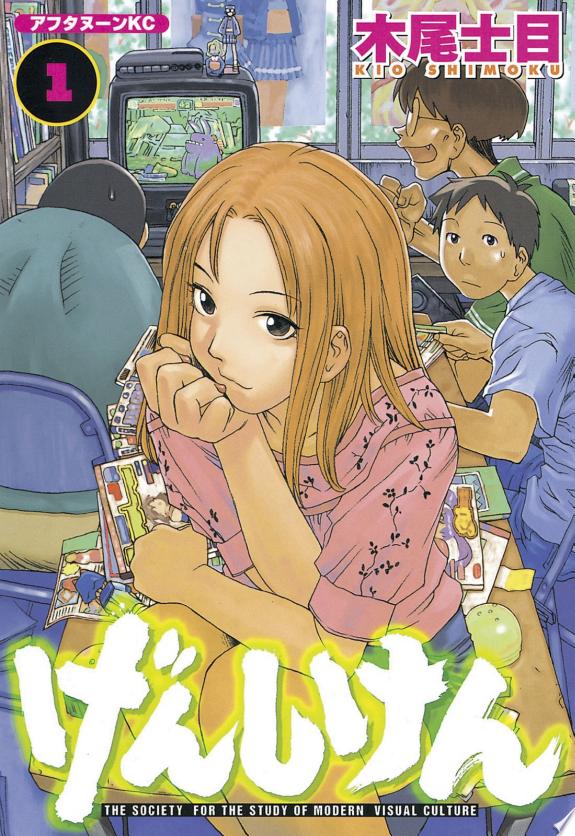
Genshiken
Yu's review of Genshiken — the Society for the Study of Modern Visual Culture is a university otaku club, and across nine volumes Shimoku Kio follows Sasahara, Madarame, Saki, Ohno, Tanaka and Ogiue as they graduate, fall in love, make a doujinshi, and figure out what being a fan costs and gives you.
Slice of Life / Romance
Tsurumoku Dokusin-ryo
Tsurumoku Dokusin-ryo follows young workers living in their company's bachelor dormitory — a comedy of closeness, romantic complications, and the specific texture of young adult working life in Japan when everyone you know also lives where you work.
Slice of Life / Comedy
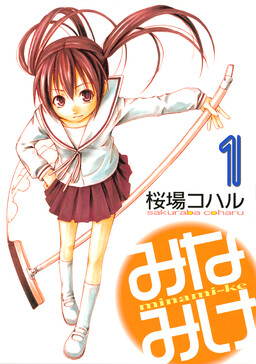
Minami-ke
Yu's review of Minami-ke — three sisters at different schools (eldest Haruka in high school, middle Kana in middle school, youngest Chiaki in elementary) share an apartment and their daily life generates endless comedy from their completely different personalities and the rotating cast of friends, admirers, and chaos that follows them home.

Slice of Life / Comedy
Himouto! Umaru-chan
Yu's review of Himouto! Umaru-chan — Umaru Doma is the school's flawless honor student, but the moment she's home she shrinks into a chibi gremlin in a hamster hoodie demanding chips, cola, and games from her tired brother Taihei. Twelve complete volumes from Seven Seas, and the warmth under the gags is what kept me reading.
Written by
Yu
Manga Enthusiast from Japan
I grew up in Japan and manga literally saved me during a tough time in elementary school. My English isn't perfect, but my love for manga is real — and I want to share it with you.