
Is the Order a Rabbit? Review: The Café Comfort Manga Where the House Rabbit Is Someone's Grandfather
by Koi
Read the first volume. If it doesn't hook you, put it down. It'll hook you.
Buy Is the Order a Rabbit? on Amazon →*Affiliate link — I earn a small commission at no extra cost to you.
The first time I read Is the Order a Rabbit?, I was having a genuinely bad month. Work was crushing me, I wasn't sleeping, and I picked it up the way you reach for warm tea instead of coffee at midnight — not because you want anything to happen, but because you want something gentle to be true for a little while. And that's exactly what this manga is. Nothing terrible happens. Nobody is cruel. A girl moves to a new town, walks into a café looking for directions, and walks straight into a family she didn't know she was going to get.
I want to be honest with you up front: if you need plot, tension, or stakes, this is not your manga. But if you have ever wanted a place that feels safe to come back to, Gochuumon wa Usagi Desu Ka? — Gochiusa, as everyone calls it — is one of the most reliable comfort reads I own.
Quick Take
- A near-perfect example of CGDCT (cute girls doing cute things) — Koi builds a tiny, cozy world out of a café, good coffee, an idealized European town, and five girls with distinct personalities who slowly become each other's family
- Quiet Chino and relentlessly warm Cocoa are the emotional engine; the running gag that the house rabbit Tippy is secretly Chino's grandfather is somehow both a joke and the most heartfelt thing in the book
- 13 volumes in Japan and ongoing; rated All Ages and genuinely appropriate for any reader
Story Overview
Cocoa Hoto, a first-year high schooler from a family that runs a bakery, moves to a new town to attend school and is supposed to board with a host family. The catch — which she misreads in the best possible way — is that the host family runs a café called Rabbit House. Cocoa, who has always wanted a little sister, arrives picturing a place full of rabbits.
There is exactly one rabbit. Tippy, a large white Angora, sits on the head of Chino Kafū, the café's soft-spoken middle-school granddaughter and a serious barista-in-training. Cocoa more or less immediately appoints herself Chino's big sister, and most of the early series is the friction-then-warmth of a quiet, self-contained girl being adopted by a loud, loving one she never asked for.
From there the world widens. Cocoa starts working at the café despite having no palate for coffee. She befriends Rize, Chiya, and Syaro, and the series settles into its real shape: seasons turning, part-time shifts, school events, festivals, and the small daily rhythms of a town where a Japanese-style sweets café and the Rabbit House sit close enough to be friendly rivals. There's no overarching plot to spoil. The "arc," if you want to call it that, is Chino slowly thawing — and the gradual reveal of what Tippy actually is.
Characters
Cocoa Hoto — A first-year from a baker's family, all warmth and forward motion. She's "natural" in the Japanese sense — a bit of an airhead — but quietly good at math and science, and over the series she commits to becoming a baker herself. Her defining want is a little sister, which is why she latches onto Chino so hard. Her arc isn't about changing; it's about how much her unconditional warmth changes everyone around her.
Chino Kafū — A second-year middle schooler and the face of Rabbit House. She knows coffee inside out and wants to be a real barista. Cool, precise, and resistant to Cocoa's affection at first, she gradually smiles more and builds genuine trust. The most telling thing about her arc: by later volumes, she visibly flinches at any suggestion that Cocoa might someday leave. The girl who needed no one ends up the one most afraid of losing someone.
Rize Tedeza — A second-year high schooler and part-timer at the café, daughter of a former soldier, with sharp reflexes and a disciplined, military edge. The recurring joke — and the soft center underneath it — is that this drilled, capable girl secretly loves cute things.
Chiya Ujimatsu — Cocoa's classmate and the daughter of Ama Usa An, a Japanese-style sweets café that's the friendly local "rival" to Rabbit House. She's a scatterbrained early-jumper who's nonetheless deeply caring, and gifted at making wagashi.
Syaro Kirima — Another of Cocoa's classmates, from a poor household, juggling multiple part-time jobs while keeping a graceful, ladylike front. She got into her school as a top-scoring scholarship student, and she quietly admires Rize.
What I Love About It
The thing I keep coming back to is how Koi uses Tippy. On the surface it's an absurd running gag: the fluffy mascot rabbit perched on Chino's head occasionally speaks in a low, manly voice when nobody else is around. The reveal — confirmed gradually across the series — is that Tippy carries the spirit of Chino's late grandfather, the former owner of Rabbit House, and that only Chino and her father Takahiro know. The series even hints, with a light touch, that Cocoa's silly little good-luck "spell" might have something to do with it.
What gets me is that the joke and the grief are the same object. Chino lost her grandfather, and in the gentlest possible move, the manga refuses to make that a tragedy — it makes him the rabbit on her head, still watching over the café, still part of every quiet morning. So when Cocoa barges into Chino's controlled little world and starts filling it back up with noise and warmth, the whole thing reads as a story about a kid relearning how to let people close. The comedy never undercuts that. It protects it. That's a harder thing to write than most slice-of-life gets credit for.
Memorable Scene ⚠️ Spoiler Warning
The moment that stuck with me is when Cocoa finally clues in to what Tippy really is. For a long stretch she's the one person living in the house who doesn't know — she pictures rabbits, she talks to Tippy, she misses the obvious — and it's only after an incident (the BUNNY ARCADE bit) that the truth lands for her. What I love is that the manga doesn't play it as a shock twist. By the time Cocoa gets it, you, the reader, have known for ages, so the scene isn't about the secret. It's about Cocoa being let into the family's real secret, the thing Chino and Takahiro have quietly carried alone. The warmth of that — being trusted with someone's grief and grandfather all at once — is Gochiusa doing exactly what it's best at.
Art Style
Koi's art is the other reason this works. The character designs are instantly likable and the café is rendered with real care — warm wood, soft light, latte art, the food drawn appetizingly enough to make you hungry. The town's idealized European look, all cobblestones and shopfronts, gives the whole thing a storybook register. It's no surprise the anime adaptation landed so well; the manga was already "cinematic" in its coziness before it ever moved.
Pros & Cons
Pros
- Among the most reliably comforting manga you can buy — zero darkness, zero cruelty
- The Tippy concept turns a gag into genuine, understated heart
- Cocoa and Chino's big-sister/little-sister dynamic generates both consistent comedy and real affection
- Gorgeous, appetizing café art; truly all-ages
Cons
- No plot progression — if you want story arcs or stakes, they aren't here
- Still ongoing, so there's no "ending" to reach
- The CGDCT format has a low ceiling for readers who want complexity — slow, plotless coziness is either the whole point or a dealbreaker, depending entirely on you
Is Is the Order a Rabbit? Worth Reading?
If you want a warm, plotless, gorgeously drawn café manga full of girls who become each other's family — with a running gag about a grandfather-rabbit that quietly doubles as the most touching thing in the book — then yes, absolutely. If you need conflict and forward momentum, skip it. It's comfort food, and it's very, very good at being comfort food.
Similar Manga
| Title | Its Approach | How Is the Order a Rabbit? Differs |
|---|---|---|
| K-On! | Music-club girls doing cute things, tea and warmth | Gochiusa swaps the club room for a café and adds the grandfather-rabbit emotional thread |
| Kiniro Mosaic | Gentle friendship comedy across a cultural gap | Gochiusa is more grounded in one workplace — the café and its found family |
| New Game! | Workplace CGDCT with slightly older characters | Gochiusa is younger and more domestic, built around living together, not just working together |
Official English Translation Status
Yen Press publishes the English edition (translation by Giuseppe di Martino), with the first volume released in October 2024 and six volumes out so far. The series is ongoing in both Japanese and English. An earlier English release was previously handled by Sol Press.
Where to Buy
Read the first volume. If it doesn't hook you, put it down. It'll hook you.
This post contains affiliate links. If you purchase through these links, I may earn a small commission at no extra cost to you. As an Amazon Associate, I earn from qualifying purchases.
*Affiliate link — I earn a small commission at no extra cost to you.
More Manga You Might Like

Slice of Life
Blend S
Yu's review of Blend S — Maika Sakuranomiya's smile looks terrifying even when she's being kind, so a café manager hires her to play the 'sadistic' waitress. The gap between her gentle heart and her scary face is the whole joke, and it never gets old.

Slice of Life / Comedy
Slow Start
Yu's review of Slow Start — Hana Ichinose started high school a year late due to illness, making her a year older than her classmates; the series follows her trying to fit in with her new friends while carrying the secret that she is different, in Tokumi Yuiko's characteristic warm and gentle 4-koma style.
Slice of Life / Comedy
Penguin & House
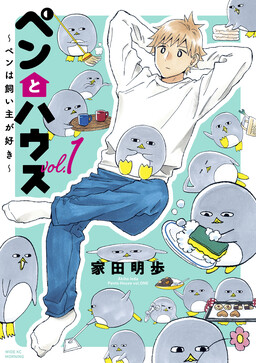
Yu's review of Penguin & House — Pen-chan is a penguin who arrives at a young salaryman's apartment and decides to stay; the series follows their daily cohabitation, the small adjustments both make, and the warmth that accumulates in an otherwise solitary life.

Slice of Life / Comedy
Monthly Girls' Nozaki-kun
Yu's review of Monthly Girls' Nozaki-kun — Chiyo Sakura confesses to her crush Umetaro Nozaki and he hands her his autograph; she discovers he is the author of a popular shojo manga and accidentally becomes his assistant; the series is a comedy about manga creation that uses the genre conventions of shojo manga as its comedic material.

Slice of Life / Comedy
Gabriel DropOut
Yu's review of Gabriel DropOut — Gabriel White Tenma graduates top of her angel class, gets sent to Earth to guide humans toward happiness, discovers online games, and rots into a slovenly NEET. Her demon classmate Vignette is the responsible one; demon Satania keeps losing her melon bread to a dog; angel Raphiel just enjoys watching everyone suffer.

Slice of Life
Sansha Sanyou
Yu's review of Sansha Sanyou — Youko Nishikawa (formerly wealthy), Futaba Odagiri (enthusiastic eater), and Teru Hayama (smiling sadist) are three incompatible high school girls who end up eating lunch together and become friends; Cherry Arai's gentle comedy about the friendships that form despite personality differences.
Written by
Yu
Manga Enthusiast from Japan
I grew up in Japan and manga literally saved me during a tough time in elementary school. My English isn't perfect, but my love for manga is real — and I want to share it with you.
Disclosure: This post contains affiliate links. As an Amazon Associate, I earn from qualifying purchases at no extra cost to you.