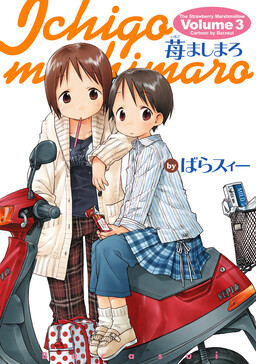
Ichigo Mashimaro Review: The Comedy Where a British Girl Forgets Her Own English
by Barasui
Read the first volume. If it doesn't hook you, put it down. It'll hook you.
Buy Ichigo Mashimaro on Amazon →*Affiliate link — I earn a small commission at no extra cost to you.
I came to Ichigo Mashimaro for the wrong reason. I'd just finished Azumanga Daioh and wanted more of that gentle, nothing-happens school comedy, and somebody online told me this was the closest thing. What I didn't expect was a joke that I still think about more than any single gag in Azumanga: a British girl who moved to Japan, fell completely in love with being treated as exotic, and then quietly forgot how to actually speak English. That's Ana Coppola. And the manga is too kind to ever fully let her off the hook for it.
I read it slowly, a chapter at a time, usually late at night when I didn't want anything with stakes. Barasui publishes this thing on his own irregular schedule — sometimes years between volumes — so reading it feels appropriately unhurried, like the manga itself is in no rush to grow these kids up.
Quick Take
- Miu Matsuoka is one of the great comedy engines in slice-of-life manga — a troublemaker whose schemes reliably blow up in her own face
- Ana Coppola, the British girl who forgot her English, gives the series a sharper, more ironic edge than most "cute girls doing cute things" comedies
- T (Teen) — gentle content, the only mild flag being Nobue's comedic chain-smoking; nothing graphic
Story Overview
There's no plot here, and that's the point. Nobue Itoh is sixteen, perpetually job-hunting, and perpetually trying (and failing) to quit smoking. She's loosely in charge of the neighborhood kids: her own younger sister Chika, Chika's friends Miu and Matsuri, and the British transplant Ana Coppola. They're roughly eleven to twelve; Nobue hovers over them somewhere between babysitter and bad influence.
The manga follows their ordinary days in Hamamatsu — the real, specific, mid-sized Shizuoka city Barasui clearly knows. Seasons turn. The kids do summer homework at the last minute, walk to buy canned coffee, throw small parties, suffer through Miu's latest scheme. The structure is closer to loosely-connected vignettes than four-panel strips, but it shares that rhythm: setup, escalation, a punchline that usually ends with Miu face-down on the floor having been smacked by Nobue or Chika.
The closest thing to an ongoing thread is Ana. She transferred in pretending she could barely speak Japanese and was a proud native English speaker — and has spent the series quietly terrified that everyone will discover both halves of that are now lies. That tension is the engine that keeps the slice-of-life from going totally weightless.
Characters
Miu Matsuoka — The comic motor of the whole series. She's a troublemaker who teases Matsuri and Ana mercilessly, lies constantly, and overreaches on every scheme until it collapses on her — at which point she ends up sprawled face-down on the floor, having earned a smack. What the manga slowly reveals is that the real Miu is a clingy kid who wants Nobue's attention and gets jealous of Ana and Matsuri for getting it. The chaos is, underneath, a bid for affection.
Ana Coppola — Originally from Cornwall, England; moved to Japan as a small child. Her whole identity is a trap she built herself: she's fluent in Japanese but pretended otherwise on arrival, and meanwhile she's genuinely forgotten almost all her English. She has a deep complex about her real, very foreign-sounding surname. Miu, naturally, weaponizes this — assigning Ana the joke kanji "穴骨洞" for her name. Ana is the series' most layered character precisely because her comedy comes from shame.
Matsuri Sakuragi — Timid, glasses-wearing, easily frightened, and Miu's most frequent target. She and Ana are close, and in the cruelest irony of the series, when Ana ropes Matsuri into studying English together so Ana can "keep up appearances," it's Matsuri who absorbs it fast — leaving the supposedly-British girl quietly outpaced by her own student.
Nobue Itoh — The sixteen-year-old (de)responsible party. She smokes, she's broke, she's always chasing the next part-time job, and she alternately spoils and disciplines the kids. She's the adult-adjacent anchor the comedy bounces off of.
Chika Itoh — Nobue's level-headed younger sister, the sensible one who bakes and reins things in. Deliberately written as "the normal one," which makes her the straight man the others orbit.
What I Love About It
The Ana running joke is, to me, one of the smartest premises in the entire genre. On the surface it's a simple gag: a foreigner who can't speak her own native language. But Barasui keeps finding new angles on it. Ana lies on day one to make herself interesting, and then has to spend the rest of her life maintaining a fiction she can't actually back up. So she studies English in secret to make the lie retroactively true — and recruits Matsuri to study with her — and Matsuri, being a quicker learner, sails right past her. The supposed native speaker is now the worst English student in the room. It's a joke about how the personas we invent to be liked become cages, and it's delivered with a totally straight face.
What keeps it from being mean is that the manga never humiliates Ana for an audience's cruelty — it sympathizes. You can feel the small-child logic of why she did it: she moved to a strange country, being "the exotic English girl" was the one thing that made her special, and she clung to it. That's a real feeling, rendered as comedy. I didn't expect a moe slice-of-life to have that much going on under a gag, and I've never quite shaken it.
Memorable Scene ⚠️ Spoiler Warning
The bit that defines the series for me is the slow reveal of how completely Ana has trapped herself. The English "lessons" she shares with Matsuri are meant to shore up her cover story — and the recurring punchline is that Matsuri's spoken English steadily improves while Ana's flatlines, so the gap between Ana's reputation and Ana's reality widens with every chapter. Every time the topic of English comes up around the others, you can feel her bracing for exposure.
It stays with me because it's the rare slice-of-life gag with actual dramatic irony baked in. The reader knows the whole truth, Ana knows the whole truth, and the comedy is the suspense of waiting for everyone else to catch up. Miu, who has zero filter and a talent for finding exactly the soft spot, is the constant threat that the bubble pops. That low hum of dread under the cuteness is what makes the manga more than wallpaper.
Pros & Cons
Pros
- Miu is a genuinely excellent comedy character, schemes-and-comeuppance executed with precision
- The Ana premise gives the series real irony and a recurring thread
- Hamamatsu is rendered with affectionate, specific suburban detail
- You can read it in any order, any amount — perfect low-commitment comfort reading
Cons
- It's ongoing on Barasui's famously irregular schedule, with no destination in sight
- Character growth is minimal by design — these kids are not meant to change
- The whole thing is low-stakes; if you need narrative momentum, this won't work for everyone
Is Ichigo Mashimaro Worth Reading?
If you want a warm, deadpan comedy you can dip into for ten minutes and feel calmer afterward, yes. Miu's chaos and Ana's self-inflicted English crisis carry it, and the suburban Hamamatsu warmth is genuine. If you need plot, arcs, or characters who grow up, look elsewhere — this is comfort food, and it's very good at being exactly that.
Official English Translation Status
This is the frustrating part. Tokyopop licensed the series in English as Strawberry Marshmallow and released five volumes before discontinuing it in 2008 due to low sales. Those volumes are long out of print, and no publisher has picked the license back up — so there is no current, in-print English edition, even though the Japanese series continues. If you want to read it today, the Japanese release is the realistic route, with secondhand Tokyopop volumes as a hunt for the lucky.
Where to Buy
No in-print English release right now — Tokyopop's old run is out of print, so the Japanese edition is the dependable way in.
Similar Manga
| Title | Its Approach | How Ichigo Mashimaro Differs |
|---|---|---|
| Azumanga Daioh | Four-panel school comedy with a warm ensemble | Younger cast, looser vignette structure, and a sharper ironic thread in Ana |
| Yotsuba&! | A wonder-filled child in a detailed suburban setting | An ensemble of kids rather than one, and built on running gags instead of discovery |
| Non Non Biyori | Gentle rural slice-of-life with a small cast | Suburban rather than rural, and more reliant on Miu's chaos for its comedy |
This post contains affiliate links. If you purchase through these links, I may earn a small commission at no extra cost to you. As an Amazon Associate, I earn from qualifying purchases.
*Affiliate link — I earn a small commission at no extra cost to you.
More Manga You Might Like
Slice of Life / Comedy
Slow Start
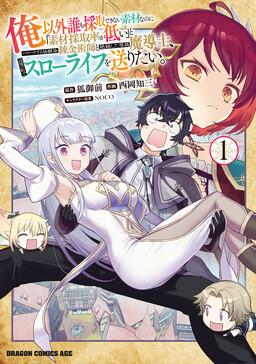
Yu's review of Slow Start — Hana Ichinose started high school a year late due to illness, making her a year older than her classmates; the series follows her trying to fit in with her new friends while carrying the secret that she is different, in Tokumi Yuiko's characteristic warm and gentle 4-koma style.

Slice of Life
Kill Me Baby
A review of Kaduho's Kill Me Baby — ongoing in Manga Time Kirara Carat since July 2008, 16+ volumes in Japan. Sonya is a trained assassin; Yasuna is her completely unfazed school friend. Yen Press publishes the English edition.
Slice of Life
Hinako Note
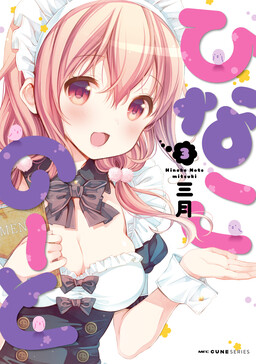
Yu's review of Hinako Note — Hinako Sakuragi is so shy she freezes into a scarecrow pose and attracts birds, so she moves to Tokyo to join a theater club and learn to speak. Mitsuki's four-panel slice-of-life from Comic Cune. No official English edition yet.
Comedy / Slice of Life
D-Frag!
Yu's review of D-Frag! — Kenji Kazama is a delinquent who wants to be feared, and instead gets dragged into the Game Creation Club (provisional) by four girls who are not afraid of him at all. A loud, fast school comedy where the joke is a tough guy who can't scare anyone.
Slice of Life
Blend S
Yu's review of Blend S — Maika Sakuranomiya's smile looks terrifying even when she's being kind, so a café manager hires her to play the 'sadistic' waitress. The gap between her gentle heart and her scary face is the whole joke, and it never gets old.
Slice of Life / Comedy
Yuru Yuri
Yu's review of Yuru Yuri — Akari Akaza, Kyoko Toshinou, Yui Funami, and Chinatsu Yoshida take over their school's former tea ceremony room after the Tea Club disbanded, form the Amusement Club, and spend their time doing very little of anything.
Written by
Yu
Manga Enthusiast from Japan
I grew up in Japan and manga literally saved me during a tough time in elementary school. My English isn't perfect, but my love for manga is real — and I want to share it with you.
Disclosure: This post contains affiliate links. As an Amazon Associate, I earn from qualifying purchases at no extra cost to you.