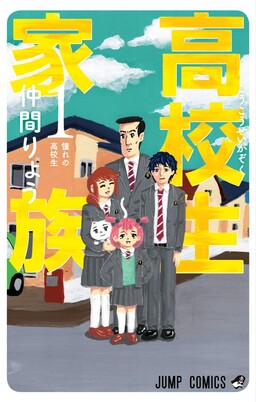
High School Family Review: The Gag Manga Where Dad, Mom, Little Sister and the Cat All Enroll in Your Class
by Ryo Nakama
Read the first volume. If it doesn't hook you, put it down. It'll hook you.
Buy High School Family: Kokosei Kazoku on Amazon →*Affiliate link — I earn a small commission at no extra cost to you.
When I was small and alone, the family in manga was always the thing I quietly wanted. Not the fights, not the power-ups. The dinner table where someone notices you came home. So a gag manga about a family that follows their kid all the way into his classroom should have annoyed me. It is the exact opposite of being left alone. And yet I read all of High School Family with a stupid smile, because under the toilet jokes it understood something I felt: a family that loves you too much is embarrassing, and you would still be lost without them.
Quick Take
- A one-premise gag manga executed with full commitment — Kotaro starts high school and his dad, mom, little sister, and even the family cat enroll as his classmates
- 11 volumes, complete, by Ryo Nakama (who also drew Isobe Isobē Monogatari); short, breezy, built for laughs more than plot
- Rated T (Teen) — clean of real violence or sex, but the humor leans into crude and toilet gags, so it is comedy-first, not a heartfelt drama
Story Overview
Kotaro Ietani passes the entrance exam for Metropolitan Happee High School and walks in expecting the normal, slightly thrilling first year every kid imagines. Then his father Ichiro — a middle-school graduate who spent his whole adult life regretting that he never got a high school youth — announces he passed the same exam and will be in Kotaro's class. So did his mother Shizuka. So did his little sister Haruka, who is elementary-school age. And so, somehow, did Gomez, the family cat, who attends in a uniform.
That is the whole engine. The series never explains it away and never apologizes for it. The school just absorbs the Ietani family as students, and every chapter drops them into an ordinary high school situation — entrance ceremony, club recruitment, sports festival, exams, dealing with the local delinquents — and asks what happens when a grown man, a mom, a little kid, and a cat have to do it as classmates.
Because it ran in Weekly Shonen Jump from 2020 to 2023, the timeline does move: the family advances through the years, and the final volume reaches their third year and the graduation horizon. But this is a gag manga, not a coming-of-age epic. The "plot" is mostly an excuse for the next situation. What carries it is that the four (five, counting Gomez) personalities each break the same situation in a different way.
Characters
Kotaro Ietani — The straight man and the heart of the book. Everything is filtered through his secondhand embarrassment. He wanted one normal thing — a regular high school life — and instead has to sit in class next to his own dad. His exasperation is constant, but the series keeps quietly showing that he is not actually ashamed of his family; he is overwhelmed by how much they love him.
Ichiro Ietani — The father, and the reason the whole thing exists. He only finished middle school and carried a lifelong ache for the high school youth he never had. So he is not crashing Kotaro's life out of cluelessness — he genuinely, earnestly wants to be a high schooler, with all the sincerity of a man getting a second chance. That earnestness is what makes him funny instead of creepy.
Shizuka Ietani — The mother, warm to the point of disaster. Her instinct to mother everyone she meets turns her into a strange kind of class celebrity, and one running thread is the family literally teaching her things a "student" should be able to do, like riding a bike.
Gomez — The cat. He goes to school. The manga commits to this completely: there is a chapter built around Gomez treating the principal's office as a litter box, and a stretch where the local delinquent boys adopt him and he debuts as one of them, coat and all.
What I Love About It
What got me was Ichiro. On paper he is the worst — the dad who will not let his son have his own space. But Nakama plays him as a man who never got to be young and is finally, desperately, doing it right. He raises his hand in class. He takes the dumb school tasks with the seriousness of a salaryman because to him they are not dumb, they are the thing he was denied. And the joke lands every time precisely because he means it. That is the difference between this and a lazy embarrassing-dad comedy. The cringe has a real feeling under it.
The other thing I love is how the manga refuses to be small about it. A weaker version would have one weird student. This one drops an entire household into the room and lets each member ruin the same scene from a different angle — Ichiro from sincerity, Shizuka from warmth, Haruka from being eight, Gomez from being a cat. So a single school event becomes four jokes stacked on top of each other, and Kotaro in the middle dying of embarrassment. When the whole family has to do something built for one solo student, the structure of the book does all the comedy for you. I have read enough gag manga to know how fast a one-joke premise dies. Nakama keeps finding new walls to throw the same family at, and that is harder than it looks.
Memorable Scene ⚠️ Spoiler Warning
The Gomez delinquent stretch is the one that lives in my head. The local yankee boys — the tough, slouching delinquent types — take a liking to the family cat, and Gomez ends up putting on a long coat and making his "debut" as one of the gang. A cat. In a coat. Standing with the school's toughest kids like he belongs there. It is so committed to the bit that it loops back around from stupid to genuinely great, and it is the cleanest example of what this manga does: it takes a completely absurd premise and then refuses to blink, plays it dead straight, and lets the straight face be the joke. The earlier gag of Gomez using the principal's office as a litter box is the same energy, just cruder.
Pros & Cons
Pros
- A single ridiculous premise executed with total, unwavering commitment
- Four-plus distinct family members generate different jokes from the same setup
- Ichiro's sincerity gives the cringe a real emotional floor
- Complete at 11 volumes — short, fast, no bloat, easy to finish
Cons
- It is fundamentally a one-joke manga; if the premise does not click for you, nothing later will fix that
- The humor leans crude and toilet-flavored in places
- Character growth is thin — this is gag comedy, not a coming-of-age story, and the cringe-driven setup won't work for everyone
Is High School Family Worth Reading?
If you want a short, complete, dependable comedy and you are okay with a manga that runs entirely on one absurd idea, yes — it is one of the more fully-committed gag series Jump put out in recent years, and Ichiro keeps the silliness anchored to a real feeling. If cringe comedy and a premise that never deepens past "family invades school" sounds exhausting rather than fun, skip it. There is no slow-burn drama waiting underneath. What you see in volume 1 is what you get for 11 volumes, just executed better and better.
Similar Manga
| Title | Its Approach | How High School Family Differs |
|---|---|---|
| Saiki Kusuo no Ψ-nan (The Disastrous Life of Saiki K.) | Jump gag manga with a deadpan straight-man hero buried in absurd people | High School Family's chaos is one family that loves the hero, not strangers |
| Hinamatsuri | Absurd premise (a girl with powers lands on a yakuza) played straight for comedy | High School Family keeps the unit fully wholesome and school-bound |
| Daily Lives of High School Boys | Finds big comedy in ordinary school life | High School Family imports an entire household into that school setting |
Where to Buy
Read the first volume. If it doesn't hook you, put it down. It'll hook you.
This post contains affiliate links. If you purchase through these links, I may earn a small commission at no extra cost to you. As an Amazon Associate, I earn from qualifying purchases.
*Affiliate link — I earn a small commission at no extra cost to you.
More Manga You Might Like

Slice of Life / Comedy
Slow Start
Yu's review of Slow Start — Hana Ichinose started high school a year late due to illness, making her a year older than her classmates; the series follows her trying to fit in with her new friends while carrying the secret that she is different, in Tokumi Yuiko's characteristic warm and gentle 4-koma style.

Slice of Life / Comedy
Haven't You Heard? I'm Sakamoto
Yu's review of Haven't You Heard? I'm Sakamoto — Sakamoto is the coolest student at his high school; every situation, challenge, or attempt to embarrass him resolves in the coolest possible way; the manga is a pure comedic statement about the concept of cool.
Slice of Life / Comedy
Minami-ke
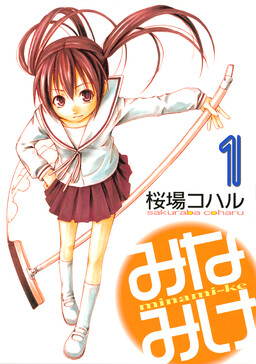
Yu's review of Minami-ke — three sisters at different schools (eldest Haruka in high school, middle Kana in middle school, youngest Chiaki in elementary) share an apartment and their daily life generates endless comedy from their completely different personalities and the rotating cast of friends, admirers, and chaos that follows them home.

Slice of Life / Comedy
Lucky Star
Yu's review of Lucky Star — Konata Izumi, an anime-obsessed high schooler, and her friends Kagami, Tsukasa, and Miyuki talk their way through school life in Kagami Yoshimizu's 4-koma comedy. It starts with a debate about how to eat a chocolate cornet and somehow never needs more plot than that.
Slice of Life
Ichigo Mashimaro
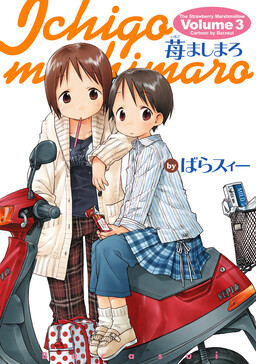
Yu's review of Ichigo Mashimaro — Nobue Itoh and the four grade-schoolers around her (her sister Chika, the chaotic Miu, the timid Matsuri, and British transplant Ana Coppola) drift through ordinary days in suburban Hamamatsu. Barasui's long-running deadpan comedy is built on Miu's relentless schemes and the cruel running joke of Ana forgetting her own English.

Slice of Life / Comedy
Asobi Asobase
Yu's review of Asobi Asobase by Rin Suzukawa — three middle-school girls, Hanako Honda, Olivia, and Kasumi Nomura, run the unofficial Pastimers Club, where ordinary games collapse into grotesque facial expressions and slapstick chaos. A gag comedy that weaponizes the gap between its adorable character designs and what those faces actually do.
Written by
Yu
Manga Enthusiast from Japan
I grew up in Japan and manga literally saved me during a tough time in elementary school. My English isn't perfect, but my love for manga is real — and I want to share it with you.
Disclosure: This post contains affiliate links. As an Amazon Associate, I earn from qualifying purchases at no extra cost to you.