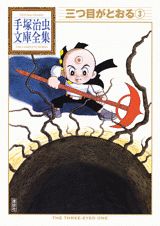
The Three-Eyed One Review: Tezuka's Jekyll-and-Hyde Manga With a Third Eye
by Osamu Tezuka
Read the first volume. If it doesn't hook you, put it down. It'll hook you.
Buy The Three-Eyed One on Amazon →*Affiliate link — I earn a small commission at no extra cost to you.
What if the most dangerous person you know is wearing a bandage on their forehead?
Quick Take
- Tezuka's most playful take on the dual-identity premise — silly and frightening in equal measure
- Sharaku is one of manga's great transforming characters: genuinely sweet without the third eye, genuinely terrifying with it
- The lost-civilization mythology gives the series a unique sci-fi foundation
Who Is This Manga For?
- Tezuka fans who want his lighter adventure register rather than his philosophical epics
- Readers of classic Shonen Magazine exploring its 1970s output
- Fans of dual-identity narratives — Jekyll/Hyde, alter-ego stories — done with manga energy
- Anyone interested in the "lost civilization" adventure subgenre that was popular in Japanese manga and anime of this era
Content Warnings & Age Rating
Age Rating: T (Teen) Content Warnings: Adventure action. Supernatural elements. The contrast between Sharaku's two identities involves some frightening content.
Appropriate for its rating.
Yu's Rating
| Category | Score |
|---|---|
| Story Depth | ★★★★☆ |
| Art Style | ★★★★☆ |
| Character Development | ★★★★☆ |
| Accessibility for Non-Japanese Readers | ★★★★★ |
| Reread Value | ★★★★☆ |
Story Overview
Sharaku Hosuke is, to all appearances, a slightly dim elementary school boy. He is clumsy, cheerful, and not particularly impressive. The bandage on his forehead is just part of his face.
When the bandage comes off, Sharaku becomes someone else entirely. His third eye activates a buried heritage — he is a descendant of a prehistoric civilization with advanced mental powers, and the activated version of Sharaku is cunning, dangerous, and completely indifferent to the feelings of ordinary humans.
Wato, his classmate and the series' secondary protagonist, spends most of the series trying to manage Sharaku — keeping the bandage in place when he needs the harmless version, navigating the chaos when the dangerous version emerges, and trying to understand what Sharaku actually is.
The series follows their adventures through supernatural mysteries, lost artifacts of the ancient civilization, and opponents who want to exploit Sharaku's power for their own purposes.
Characters
Sharaku Hosuke: The dual identity structure gives Tezuka two protagonists in one body — the gentle, funny schoolboy who generates comedy, and the brilliant, amoral ancient who drives the adventure. The contrast between them is the series' central pleasure.
Wato: Sharaku's long-suffering companion, whose job is essentially to be the reasonable person in every situation. Her reactions to Sharaku's alternating personalities provide the series' emotional grounding.
Art Style
Tezuka in adventure mode — expressive and kinetic, with the comedic and dramatic registers shifting rapidly and the art shifting with them. Sharaku's transformation scenes are drawn with the visual contrast that makes the dual identity premise work.
Cultural Context
The "lost civilization with advanced technology" premise reflects a broader interest in alternative ancient history that was popular in Japanese popular culture of the 1970s — influences from erich von Daniken's ancient astronaut theories, interest in Mu and Lemuria, and the Japanese tradition of archaeological nationalism. Tezuka uses the premise for adventure rather than ideology, but the cultural context is visible.
What I Love About It
I love how genuinely unsettling the dangerous Sharaku is.
Most dual-identity stories make the "dark" version clearly monstrous — you know which version to root against. Tezuka doesn't let it be that simple. The dangerous Sharaku is often more competent, more interesting, and more effective than the harmless version. The series makes you uncertain about which Sharaku you actually want.
What English-Speaking Fans Say
Not known in English-speaking markets. Among Tezuka enthusiasts, Three-Eyed One is considered one of his most accessible adventure works — lighter than Black Jack, more focused than Phoenix, and consistently entertaining across its run.
Memorable Scene ⚠️ Spoiler Warning
The first full activation of the third eye — when the gentle schoolboy Sharaku disappears and the ancient intelligence takes over for the first time, and Wato understands for the first time what she's been helping to contain. The scene establishes the series' tonal range in a single chapter.
Similar Manga
- Black Jack: Tezuka's other great character-defined-by-hidden-nature manga
- Unico: Tezuka's gentler fantasy, different register entirely
- Devilman: Different creator, similar dual-nature protagonist premise
Reading Order / Where to Start
Volume 1. The premise is established immediately and the series is episodic enough to be read in sections.
Official English Translation Status
The Three-Eyed One has no official English translation.
Pros & Cons
Pros
- One of Tezuka's most entertaining adventure series
- The dual-identity premise is executed with genuine craft
- Accessible to readers without deep Tezuka knowledge
- Complete at 25 volumes
Cons
- No English translation
- The episodic structure means some arcs are stronger than others
- The "ancient civilization" mythology is developed unevenly
Format Comparison
| Format | Notes |
|---|---|
| Physical | Japanese editions available |
| Digital | Available in Japanese |
| Omnibus | Various compilation formats available |
Where to Buy
No English release yet. That just means you find it before everyone else does.
*Affiliate link — I earn a small commission at no extra cost to you.
More Manga You Might Like
Sci-Fi / Adventure
Ginga no Sannin
Ginga no Sannin is one of Osamu Tezuka's compact science fiction works — a single-volume story about three people across the galaxy whose lives intersect at a critical historical moment, demonstrating Tezuka's ability to compress epic into modest space.
Sci-Fi / Historical
Phoenix
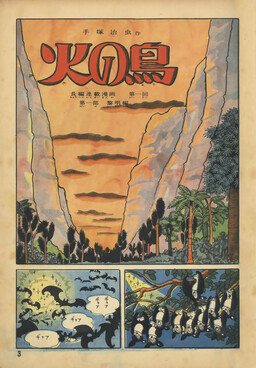
Yu's review of Phoenix — Tezuka Osamu's incomplete masterwork — a series of stories set throughout Japanese and universal history, connected by the Phoenix, a bird whose blood grants immortality; the Phoenix appears in each arc but cannot be caught; the arcs range from ancient Japan to the far future and examine what it means to be human across all of time.
Sci-Fi / Adventure
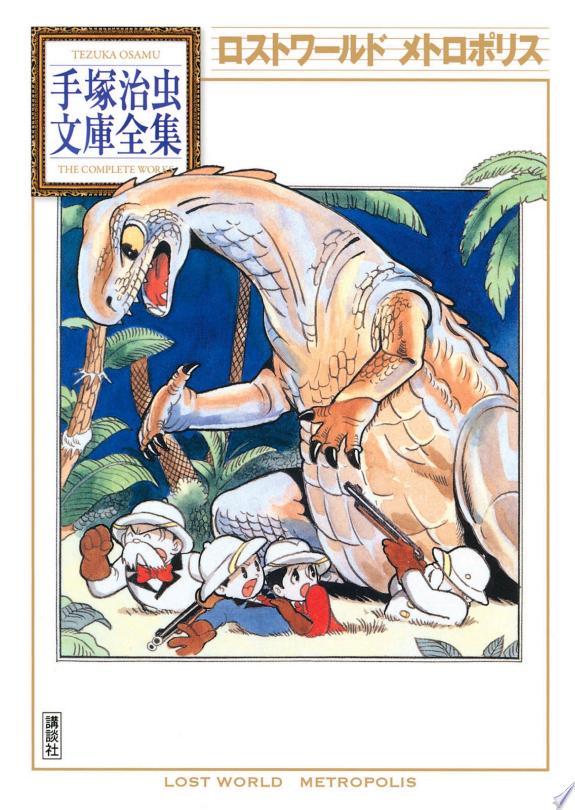
Lost World
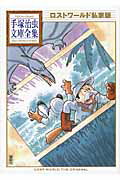
Earth scientists travel to a planet of plant people and prehistoric beasts in Tezuka's foundational early sci-fi.
Sci-Fi / Adventure
Captain Harlock
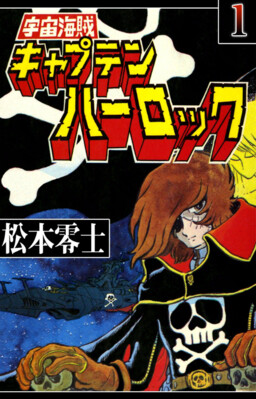
Yu's review of Captain Harlock — in 2977, humanity has grown comfortable and given up. Harlock is the one man who still fights. Aboard the Arcadia he stands against the Mazone, alien women who came back to reclaim the Earth they once seeded.
Sci-Fi / Drama
Metropolis
A review of Osamu Tezuka's Metropolis — serialized in Manga Shōnen in 1949, complete in one volume. A loose adaptation of Fritz Lang's film about a stratified city, an android child named Mitchi, and the question of what makes someone human. VIZ Media's English edition is complete.
Sci-Fi / Drama
Galaxy Express 999
Galaxy Express 999 follows Tetsuro Hoshino, a young boy who boards the legendary space train 999 toward a planet where he can receive a free mechanical body — accompanied by the mysterious Maetel — and encounters, on each planet the train stops at, a different meditation on what it means to be human and whether eternity is worth what it costs.
Written by
Yu
Manga Enthusiast from Japan
I grew up in Japan and manga literally saved me during a tough time in elementary school. My English isn't perfect, but my love for manga is real — and I want to share it with you.