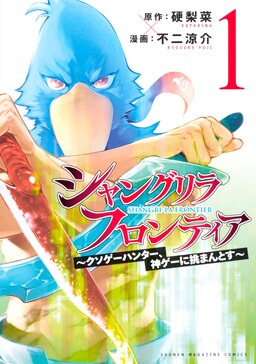
Shangri-La Frontier Review: A Pro Gamer Who Specializes in Terrible Games Enters the World's Best Game
by Ryosuke Fuji (Art) / Katarina (Story)
*Affiliate link — I earn a small commission at no extra cost to you.
Quick Take
- The gaming manga that uses "trash game experience" as a genuine competitive advantage — Rakuro's background playing terrible games has given him skills and problem-solving approaches that conventional Shangri-La Frontier players don't have
- The boss fight design is exceptional — each major boss encounter has internal logic that makes the combat feel like puzzle-solving as much as action
- Ongoing; one of the stronger entries in the recent VR gaming manga wave
Who Is This Manga For?
- Readers who want gaming manga with genuine game design sensibility
- Anyone interested in VR gaming as a manga subject
- Fans of action manga where the protagonist's unconventional approach is a genuine advantage
- Readers who enjoy boss fight design as a narrative subject
Content Warnings & Age Rating
Age Rating: T (Teen) Content Warnings: Game combat violence; competitive gaming intensity; no significant real-world content concerns
The T rating is accurate.
Yu's Rating
| Category | Score |
|---|---|
| Story Depth | ★★★★☆ |
| Art Style | ★★★★★ |
| Character Development | ★★★★☆ |
| Accessibility for Non-Japanese Readers | ★★★★★ |
| Reread Value | ★★★★★ |
Story Overview
Rakuro Hizutome's hobby is playing and completing the worst games available — games so poorly designed that finishing them requires specific skills: patience with broken mechanics, improvised solutions to unforeseen bugs, and the ability to find unintended interactions in flawed systems. He has completed hundreds of these "kusoge" (garbage games) at maximum skill level.
When he enters Shangri-La Frontier — a game so advanced and polished that it represents the opposite of everything he normally plays — his trash game skills turn out to produce unprecedented results. He approaches boss encounters as design problems to be solved rather than challenges to be overcome by raw skill, and his instinct for finding systems' unintended interactions gives him advantages against bosses whose intended strategies are well-known to conventional players.
Characters
Rakuro (Sunraku in-game) — His quality is a specific analytical relationship to game systems — he looks for what the design isn't showing, what the rules don't prohibit, what the boss's behavior pattern actually implies. This is not conventional gaming skill; it is problem-solving as play.
Psyger-0, Arthur, and other high-level players — The encounter with the game's genuine top players forces Rakuro to discover where his unconventional approach has limits and where it exceeds theirs.
Art Style
Fuji's art is where the manga most distinguishes itself — the boss designs are visually extraordinary, with the kind of elaborate detail that suggests a genuine game artist involved in the process. The action sequences during boss fights are dynamic and clear.
Cultural Context
Shangri-La Frontier emerges from the Japanese gaming culture's interest in "hard games" and the specific subculture around completing extremely difficult or flawed games. The "kusoge specialist" protagonist is a specific figure within gaming culture.
What I Love About It
The boss encounter chapters — where Rakuro's analytical approach produces a fight sequence that reads as problem-solving being enacted in real time — are the series' most distinctive achievement. The bosses feel like puzzles being solved, which makes the action sequences work differently from conventional manga fights.
What English-Speaking Fans Say
Western readers who are gamers consistently describe Shangri-La Frontier as the gaming manga that most accurately reflects what high-level game analysis feels like — the boss design sensibility resonates with readers who have engaged with difficult games analytically. Non-gaming readers describe the action as clear and exciting without requiring game knowledge.
Memorable Scene ⚠️ Spoiler Warning
The first major unintended boss interaction sequence — where Rakuro finds something in a boss encounter that other players have never discovered, because his approach to the boss is completely different from what the designers intended — is the series' fullest expression of what makes him exceptional.
Similar Manga
- Sword Art Online — VR gaming, different tone
- Log Horizon — Trapped in game, strategy focus
- No Game No Life — Gaming as competition, different register
- Only I Level Up (Solo Leveling) — Action gaming, Korean manhwa
Reading Order / Where to Start
Volume 1 — Rakuro's introduction and entry into Shangri-La Frontier.
Official English Translation Status
VIZ Media publishes the English edition. Ongoing; check current volume count.
Pros & Cons
Pros
- The boss fight design is genuinely exceptional
- The protagonist's unconventional approach is a real advantage, not a narrative convenience
- Fuji's art is among the best in current action manga
- The gaming knowledge enhances without being required
Cons
- Ongoing — no complete ending
- The gaming premise requires engagement with game design as a subject
- Character depth outside the gaming context is limited in early volumes
Format Comparison
| Format | Notes |
|---|---|
| Individual Volumes | VIZ Media; ongoing |
| Digital | Available |
Where to Buy
Get Shangri-La Frontier Vol. 1 on Amazon →
This post contains affiliate links. If you purchase through these links, I may earn a small commission at no extra cost to you. As an Amazon Associate, I earn from qualifying purchases.
*Affiliate link — I earn a small commission at no extra cost to you.
Written by
Yu
Manga Enthusiast from Japan
I grew up in Japan and manga literally saved me during a tough time in elementary school. My English isn't perfect, but my love for manga is real — and I want to share it with you.
Disclosure: This post contains affiliate links. As an Amazon Associate, I earn from qualifying purchases at no extra cost to you.