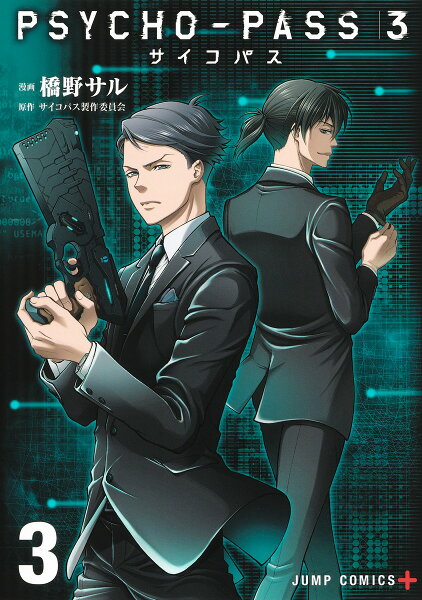
Psycho-Pass Manga Review — In a Future Where Crime Is Measured Before It Happens, a Rookie Inspector Questions What the System Is Actually Catching
by Gen Urobuchi (story) / Hikaru Miyoshi (manga art)
Read the first volume. If it doesn't hook you, put it down. It'll hook you.
Buy Psycho-Pass on Amazon →*Affiliate link — I earn a small commission at no extra cost to you.
I watched Psycho-Pass when it aired in 2012–2013. I read the manga adaptation later. The anime is the canonical version of the story; the manga is the medium-translation. Both have their virtues.
This is the manga review. For the full Psycho-Pass experience, watch the anime first.
Quick Take
- 6-volume manga adaptation by Hikaru Miyoshi of the 2012–2013 Production I.G anime
- Original story by Gen Urobuchi (Madoka Magica, Fate/Zero, Saya no Uta) at the height of his career
- Age rating: M (Mature) — graphic violence, dystopian content, psychological intensity
Manga vs Anime: Which Should You Approach First?
Psycho-Pass was originally an anime. The 2012–2013 first season by Production I.G (22 episodes) is the canonical version of the story. Gen Urobuchi (Madoka Magica, Fate/Zero) wrote the original story. The anime spawned a manga adaptation (6 volumes by Miyoshi), sequel anime seasons, films, novels, and various other media.
For new readers/viewers: watch the 2012–2013 anime first. It is the definitive version of the story this manga adapts. The manga is a competent but secondary experience.
For anime watchers wanting more: the manga is a reasonable companion. The art is good. The adaptation is faithful.
What Is Psycho-Pass About?
Tokyo, 2112. Japan operates under the Sibyl System (シビュラシステム) — a network of integrated artificial intelligence components that monitors every citizen's mental state in real time. Each person has a measurable Crime Coefficient (犯罪係数), expressed numerically, that reflects their psychological propensity toward criminal behavior. Citizens with low Crime Coefficients live freely; those with high coefficients are detained or, if their coefficient exceeds a threshold, eliminated.
The elimination is performed by the Public Safety Bureau's Criminal Investigation Division (CID), using weapons called Dominators. The Dominator measures the target's Crime Coefficient automatically and locks onto a mode — Non-Lethal Paralyzer for moderate threats, Lethal Eliminator for extreme threats. The officer cannot override the Dominator's reading.
The CID is staffed by two types of personnel:
- Inspectors (Junshi): low Crime Coefficient citizens, full police authority
- Enforcers (Shikkokan): high-Coefficient citizens themselves (deemed too criminal to live freely but useful as field operatives), supervised by Inspectors, allowed to use Dominators against more dangerous criminals
Akane Tsunemori is a twenty-year-old rookie Inspector. She has just been assigned to her first CID division. She has unusually stable mental state (her Crime Coefficient remains low under extreme stress). She is morally serious and intellectually curious.
Her Enforcers include:
- Shinya Kogami — the manga's secondary protagonist. Former Inspector demoted to Enforcer after his Coefficient rose during a previous case
- Various other Enforcers — each a former Inspector or other professional whose Crime Coefficient eventually disqualified them
Across 6 volumes, Akane and her team pursue a serial killer who is, somehow, operating in the Sibyl-monitored society without being caught by the system. The investigation gradually reveals what the Sibyl System actually is and what it has been hiding from the population it monitors.
The manga's central question: is a society that prevents crime by eliminating people who might commit crime actually a society worth defending?
Who Is This Manga For?
- Anime watchers wanting a companion adaptation
- Dystopian sci-fi readers (Minority Report, etc.)
- Urobuchi fans wanting his work in manga form
- Cyberpunk-adjacent fiction enjoyers
- Not for: readers without the anime context (start with the anime)
Content Warnings & Age Rating
Age Rating: M (Mature) — 18+ Content Warnings: Graphic violence (Dominator eliminations are visually intense); dystopian content (surveillance, predictive criminal justice); psychological horror (some antagonists' methods are disturbing); body horror in specific sequences
The M rating is the floor. Some sequences in the manga are visually intense.
Characters
Akane Tsunemori — The protagonist. Twenty years old. Rookie Inspector. Her unusual mental stability (Crime Coefficient remains low under stress that destabilizes other Inspectors) is the manga's plot driver and character question. Akane is morally serious in a way the Sibyl System's structure does not encourage.
Shinya Kogami — Enforcer. Former Inspector. Driven by personal motivation to catch a specific criminal whose actions caused his Coefficient to rise. The Kogami-Akane dynamic is the manga's central character relationship.
Nobuchika Ginoza — Senior Inspector partnered with Akane. By-the-book; resents Enforcers; has his own complicated relationship with Kogami.
Tomomi Masaoka — Older Enforcer; former pre-Sibyl-era detective; provides historical perspective on the system.
Shogo Makishima — The antagonist. A man whose Crime Coefficient inexplicably remains low regardless of the crimes he commits. The manga's central mystery character.
Art Style
Hikaru Miyoshi's adaptation art is clean and competent. Character designs reflect the anime's visual identity. Action sequences are clear. The Dominator elimination scenes are appropriately visceral.
Miyoshi's strength is in atmospheric urban Tokyo settings — the manga's depiction of 2112 Tokyo is detailed and consistent with the anime's design vision.
Cultural Context
Psycho-Pass is one of the major dystopian sci-fi anime of the 2010s. The franchise includes:
- TV anime seasons 1 (2012–2013), 2 (2014), 3 (2019)
- Theatrical films
- Light novels and the 6-volume manga adaptation
- Live-action and stage adaptations
Gen Urobuchi is one of Japan's most influential contemporary anime/light novel writers. His work — including Madoka Magica, Fate/Zero, Saya no Uta, and Psycho-Pass — is known for psychological darkness, philosophical depth, and willingness to commit to dark conclusions.
The Sibyl System concept draws on real philosophical debates about predictive criminal justice, surveillance states, and utilitarian ethics. The manga is in dialogue with works like Minority Report, 1984, and Brave New World.
What I Love About It
The Sibyl System's logic.
What makes Psycho-Pass philosophically interesting is that the Sibyl System is not obviously evil. It actually does prevent crime. Citizens of the Sibyl-monitored Japan live in genuinely safer society than pre-Sibyl Japan. The system's predictions of criminal behavior are accurate enough that it does, in fact, identify dangerous individuals before they harm others.
The question Urobuchi asks: is this enough?
The manga (and anime) refuses to answer simply. The system catches some people who would have committed crimes. It also catches some people whose Coefficients rose for reasons the system cannot fully analyze (trauma, anxiety, victims of violent crime developing high coefficients themselves). Some of the people the system eliminates would not have actually committed crimes. The system cannot tell the difference because it cannot see inside human minds beyond what its numerical analysis allows.
What I love is the manga's commitment to letting the question stay open. Akane is the manga's moral center, and she does not have a clean answer. The manga's villain is the most morally challenging character — Makishima's actions are unambiguously terrible, but his critique of the Sibyl System is also unambiguously correct in specific ways the manga refuses to soften.
Urobuchi's gift, as a writer, is staying in the discomfort. The manga preserves this gift in adapted form.
What English-Speaking Fans Say
Psycho-Pass has a substantial English-language fanbase, primarily from the anime. The manga adaptation is well-received but considered secondary to the anime experience.
The most-discussed element is the Sibyl System's moral architecture — the franchise has been cited in academic philosophy of technology discussions, criminology essays, and surveillance-state critiques.
Memorable Scene ⚠️ Light Spoiler
The first Dominator elimination Akane witnesses.
I won't spoil specifics. Early in the manga, Akane witnesses her first elimination — a citizen whose Crime Coefficient has spiked. The target is not a hardened criminal. The target is a victim of crime themselves whose trauma has elevated their Coefficient above the threshold.
The Dominator locks on Lethal Eliminator. Kogami fires. The elimination happens.
What Miyoshi draws is Akane's face after. She has just witnessed the system she joined to serve eliminate someone who was, in any human sense, more victim than criminal. The system worked. The procedure was followed. The numerical reading was correct. And someone is dead who, in any moral framework not measured by Sibyl, did not deserve to die.
The scene is the manga's whole thesis. The Sibyl System works. The Sibyl System is also wrong. Both facts have to be held simultaneously.
That moment is what makes Psycho-Pass philosophically serious sci-fi rather than just dystopian thriller.
Similar Manga / Anime
| Title | Its Approach | How Psycho-Pass Differs |
|---|---|---|
| Death Note | Genius-protagonist morality tale | Death Note is one-on-one; Psycho-Pass is systemic |
| Minority Report (Philip K. Dick / film) | Predictive criminal justice | Psycho-Pass is the manga/anime equivalent |
| Ghost in the Shell | Cyberpunk Japan with philosophical themes | GitS is more about consciousness; Psycho-Pass is more about justice |
| Madoka Magica (Urobuchi) | Same writer's dark fantasy | Same moral seriousness in different genre |
Reading Order / Where to Start
Watch the 2012–2013 anime first (22 episodes, Production I.G, on streaming services). Then read the manga as supplement.
If you must start with manga: volume 1. Six volumes; weekend read.
Official English Translation Status
VIZ Media published all 6 volumes of the manga in English in print and digital. The series is complete. The original 2012–2013 anime is on Crunchyroll and other services with English subtitles and dubs. Sequel anime seasons and films are also available.
Pros & Cons
Pros
- Strong adaptation of one of the great modern dystopian sci-fi anime
- Urobuchi's writing is philosophically serious
- Miyoshi's art is good
- 6 volumes complete; manageable commitment
- Anime supplement / companion that retains the source's strengths
Cons
- Anime is the canonical version; manga is secondary
- The manga adaptation does not cover sequel anime content
- Heavy content
- The cerebral dystopian register is an acquired taste. It won't land for everyone, especially readers wanting action-focused thriller.
Is Psycho-Pass (Manga) Worth Reading?
For anime fans wanting a companion: yes. For new readers: watch the anime first.
Format Comparison
| Format | Notes |
|---|---|
| Anime (Production I.G, 2012–2013) | Season 1, 22 episodes; primary work |
| Physical Manga (VIZ) | 6 volumes; complete in English |
| Digital Manga | Available via VIZ digital, Kindle |
| Sequel anime (Season 2, 3, films) | Available on streaming with English subtitles |
Where to Buy
Read the first volume. If it doesn't hook you, put it down. It'll hook you.
This post contains affiliate links. If you purchase through these links, I may earn a small commission at no extra cost to you. As an Amazon Associate, I earn from qualifying purchases.
*Affiliate link — I earn a small commission at no extra cost to you.
More Manga You Might Like

Sci-Fi / Thriller
Summer Time Rendering
Yu's review of Summer Time Rendering — Shinpei Ajiro returns to Hitogashima island for the funeral of his childhood friend Ushio; something is wrong; the shadows of people on the island are not quite right; Shinpei discovers a supernatural threat that copies humans through their shadows and a time loop mechanic that allows him to restart from the same point when he dies.
Sci-Fi / Political
Sanctuary
Yu's review of Sanctuary — two survivors of the Cambodian killing fields make a pact to change Japan from the inside: one through legitimate politics, one through the yakuza; a politically serious manga by the creators of Crying Freeman and Mai the Psychic Girl about power, ambition, and what it costs to change a corrupt system.

Sci-Fi / Historical
Ōoku: The Inner Chambers
Yu's review of Ōoku: The Inner Chambers — an alternate Japan where a mysterious plague killed 75% of men over a century, women rose to political power, and the Shogunate is run by women while men are rare and precious; a historical alternate-universe manga that examines power, gender, and what history would look like if it went differently.

Sci-Fi / Thriller
Mardock Scramble
Yu's review of Mardock Scramble — Rune Balot, a teenage prostitute, is murdered by casino mogul Shell Septinos; resurrected under Mardock Scramble 09, an emergency law that allows dead people to be brought back as cyborgs to testify, she must survive long enough to bring Shell to justice with the help of her partner Oeufcoque.

Sci-Fi / Mystery
Heavenly Delusion
Yu's review of Heavenly Delusion (Tengoku Daimakyou) — two teenagers travel through a destroyed Japan searching for 'heaven,' while inside a mysterious sealed facility, children are raised with no knowledge of the outside world; the two storylines converge toward answers neither group fully understands yet.

Sci-Fi / Military
86—EIGHTY-SIX
The Republic of San Magnolia tells its citizens the war is fought by unmanned drones. The drones have pilots — children stripped of citizenship and conscripted to die in squadrons the republic refuses to count. Lena is a military officer who refuses to lie. Shin is the squadron leader who has stopped expecting to live. The manga adaptation of Asato Asato's light novel ran 3 volumes (2018–2021) before being suspended due to the artist's health; the LN and anime cover the full story.
Written by
Yu
Manga Enthusiast from Japan
I grew up in Japan and manga literally saved me during a tough time in elementary school. My English isn't perfect, but my love for manga is real — and I want to share it with you.
Disclosure: This post contains affiliate links. As an Amazon Associate, I earn from qualifying purchases at no extra cost to you.