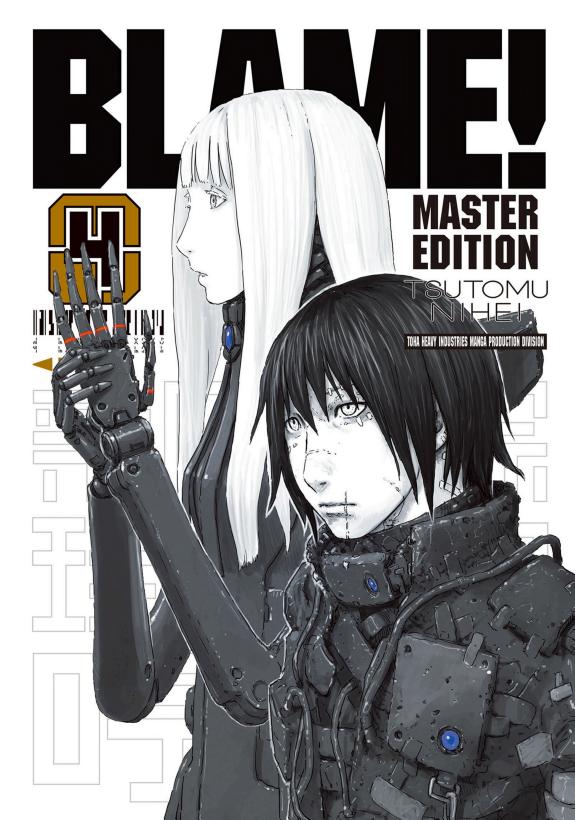
Blame! Review: A Silent Man, an Infinite City, and One Gene Worth Walking Forever For
by Tsutomu Nihei
Read the first volume. If it doesn't hook you, put it down. It'll hook you.
Buy Blame! on Amazon →*Affiliate link — I earn a small commission at no extra cost to you.
I read most of Blame! on a night train, which felt right. Outside the window, Japan turned into an endless smear of concrete — overpasses, pylons, sound walls, more overpasses — and inside I was looking at Tsutomu Nihei's drawings of the same thing scaled up until it ate the solar system. I remember turning a page and realizing I'd gone four or five spreads without a single word of dialogue, and I hadn't even noticed, because the architecture was talking the whole time.
I want to be honest with you, because this site is supposed to be honest. Blame! is not a manga you "follow" the way you follow Naruto. There are pages where I had no idea what had just happened. There are characters who appear, get destroyed, and come back wearing a different body, and the manga does not stop to explain. The first time I finished it I was a little annoyed. The second time I read it, slower, it became one of my favorite books I own — full stop, not just one of my favorite manga.
Quick Take
- A near-silent gunman walks an infinite, dying megastructure searching for one human who still carries the gene that could shut the city's expansion off
- The most architecturally staggering manga I've ever held — Nihei renders empty space at a scale no other comic has matched
- 10 original volumes, complete; the English Master Edition collects everything in 6 large-format books. Age rating: M (Mature) for graphic violence and body horror
Story Overview
The City — the Megastructure — has been building itself for so long that no one remembers it starting. It expands outward through automated construction robots called Builders, filling space between worlds. Long ago, a group called the Order deleted the Net Terminal Gene from humanity. That gene was the key that let humans connect to the Netsphere, the control network that governs everything. Without anyone able to log in and say "stop," the Builders keep building forever, and the Safeguard — the City's security system — hunts down and exterminates any human who can't prove authorized access. Which, now, is all of them.
Killy walks. He carries a Gravitational Beam Emitter, a weapon that can punch a clean cylinder through almost any matter, and he is looking for a single living human who still carries the Net Terminal Gene. He has been walking, the manga implies, for an unimaginably long time.
The middle of the story is where it opens up. Killy reaches the Electro-Fishers, a tribe of humans descended from people locked out of Toha Heavy Industries generations ago. There he meets Cibo, a brilliant scientist reduced to a torso kept alive by machinery, and she becomes his partner and the source of almost all the exposition the book ever gives you. He also meets a quiet girl named Sanakan — and that meeting turns into one of the manga's defining betrayals. From there the story escalates into a war over Cibo's body, the Net Terminal Gene, and the Silicon Life that want it for themselves.
Characters
Killy — One of the most silent protagonists in the medium. You learn who he is entirely from what he does: keeps walking, keeps firing, keeps protecting people who can't protect themselves even when it costs him everything. His total dialogue across the series could fit on a few pages. His arc is subtle — he slowly stops treating every Silicon Life creature as something to destroy on sight.
Cibo — The most transformed character in the book. She starts as an imprisoned scientist kept alive as an upper torso, transfers her mind into new bodies, dies more than once, ends up sharing a body with Sanakan's consciousness, and finally has a Level 9 Safeguard — the highest class — illegally downloaded into her. By the end she is effectively carrying the Net Terminal Gene embryo, and she is destroyed protecting it. She is the emotional spine of a manga that pretends not to have one.
Sanakan — Introduced as a frail girl among the Electro-Fishers, then revealed as a high-level Safeguard carrying a GBE much like Killy's. Her turn from exterminator to guardian is the manga's quiet tragedy: assigned to retrieve the transformed Cibo, she ends up defending the gene and dying for it.
The Silicon Life — Cyborg antagonists who also want the gene, led by figures like Davine Lu Linvega. Each one is a fresh piece of Nihei's visual imagination. They're not "monsters of the week" so much as proof that the City has been generating its own life, on its own terms, for far too long.
What I Love About It
The architecture. I know that sounds like a strange thing to love about a story, but in Blame! the architecture is the story. Nihei trained as a construction worker before he became a manga artist, and you feel it on every page — he draws space the way someone who has actually stood at the bottom of a structure and looked up draws it. There are stairways that climb for miles. Rooms that contain mountains. Corridors so long the manga implies they were built before anyone lived long enough to walk them. Humans appear as tiny ink specks against cathedral walls of cross-hatching, and the effect isn't "cool sci-fi backdrop," it's genuine vertigo. I have never felt the weight of empty space in any other comic the way I feel it here.
What gets me is how the silence works with the scale. Because there's almost no dialogue, the panels of pure architecture aren't filler between plot beats — they are the experience. You sit inside them. The review site MangaShed put it well: the panels "emphasize the insignificance of the characters within it," and that's exactly the feeling. I have read manga that made me cry and manga that made my heart race, but Blame! is the only one that made me feel small in a way I actually enjoyed.
Memorable Scene ⚠️ Spoiler Warning
The scene that won't leave me is Sanakan's reveal at the Electro-Fishers' settlement. For chapters she's just a quiet girl among the villagers. Then Killy's dormant cybernetic abilities reactivate after he's attacked, and in the instant they come back online he scans her — and realizes, seconds too late, that she is a Safeguard. Almost immediately she begins transforming, severing a hand in the process, and unfolds into her exterminator form right in the middle of people who trusted her.
What follows is one of the most upsetting sequences in the series. Sanakan's Exterminators tear through the fleeing Electro-Fishers while Cibo throws a hacked Builder at the kaiju-scale assault, and Sanakan herself climbs out to resume hunting Killy. The horror isn't gore for its own sake — it's that the City's immune system looks like a child until the moment it decides you're unauthorized. After reading that, the rest of the manga's silence felt different to me. Every empty corridor now felt like it might be watching, deciding whether I had the gene or not. That she later turns and dies protecting the very gene she was built to exterminate is the kind of arc Nihei builds without a single speech.
Pros & Cons
Pros
- The most architecturally ambitious artwork I've ever seen in manga
- Complete and self-contained — 10 volumes, collected into 6 in English
- Genuinely unlike anything else in the medium
- Enormous reread value as a pure visual and atmospheric experience
Cons
- Minimal dialogue and a deliberately obscure plot will lose some readers entirely
- Character development is real but buried — you have to dig for it
- Graphic violence and body horror narrow the audience
The slow, near-wordless pace is either the whole point or a dealbreaker, depending entirely on who you are — this one genuinely won't work for everyone, and that's fine.
Is Blame! Worth Reading?
If you want a tightly plotted, dialogue-driven story, no. If you want a comic that does something no other comic does — render infinite dead architecture so well it becomes its own emotion — then yes, absolutely, and the 6-volume Master Edition is the way to do it. It's a slow read that rewards patience and rereading more than almost anything in manga.
Similar Manga
| Title | Its Approach | How Blame! Differs |
|---|---|---|
| Biomega | Same author; viral apocalypse with more dialogue and chase momentum | Blame! is quieter, slower, and built entirely around architectural scale |
| Knights of Sidonia | Same author; conventional cast, war story, clear stakes | Blame! abandons narrative convention almost completely |
| Ghost in the Shell | AI, cyborgs, networked minds, talky and political | Blame! is wordless and spatial rather than philosophical-dialogue |
Where to Buy
Read the first volume. If it doesn't hook you, put it down. It'll hook you.
This post contains affiliate links. If you purchase through these links, I may earn a small commission at no extra cost to you. As an Amazon Associate, I earn from qualifying purchases.
*Affiliate link — I earn a small commission at no extra cost to you.
More Manga You Might Like
Sci-Fi / Dark Fantasy
Dorohedoro
Yu's review of Dorohedoro — a man with a lizard head and amnesia searches for the sorcerer who transformed him in a brutal city where sorcerers use humans as test subjects.

Sci-Fi / Dark Fantasy
Fire Punch
Yu's review of Fire Punch — Agni has a regeneration blessing; someone with a flame blessing sets him on fire; he cannot die and cannot stop burning; he crosses a frozen post-apocalyptic world looking for revenge while a man with a camera follows him.
Sci-Fi / Post-Apocalyptic
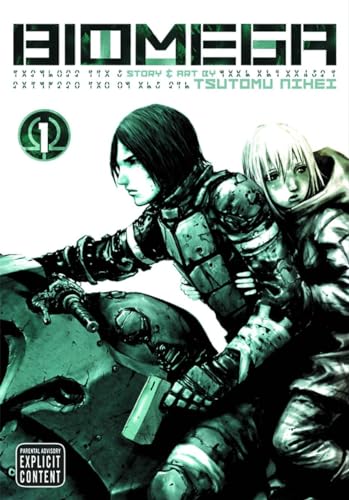
Biomega
Yu's review of Biomega — Tsutomu Nihei's six-volume sci-fi where a synthetic agent named Zoichi Kanoe rides a virus-eaten Earth, hunting humans immune to the N5S plague while a talking grizzly bear named Kozlov fights at his side.

Sci-Fi / Drama
Galaxy Express 999
Galaxy Express 999 follows Tetsuro Hoshino, a young boy who boards the legendary space train 999 toward a planet where he can receive a free mechanical body — accompanied by the mysterious Maetel — and encounters, on each planet the train stops at, a different meditation on what it means to be human and whether eternity is worth what it costs.

Sci-Fi / Drama
Hyakuoku no Hiru to Senoku no Yoru
Hyakuoku no Hiru to Senoku no Yoru is Moto Hagio's manga adaptation of Ryu Mitsuse's celebrated science fiction novel — following the collapse of civilizations across billions of years, centered on figures from different historical periods who are drawn toward a single question: what is the nature of creation, and who is responsible for it?
Sci-Fi
Gin no Sankaku
Gin no Sankaku follows characters trapped across multiple timelines by a silver triangle that connects them — a complex, demanding sci-fi work by Moto Hagio that uses time loop mechanics to explore the weight of memory and the impossible arithmetic of rescue and loss.
Written by
Yu
Manga Enthusiast from Japan
I grew up in Japan and manga literally saved me during a tough time in elementary school. My English isn't perfect, but my love for manga is real — and I want to share it with you.
Disclosure: This post contains affiliate links. As an Amazon Associate, I earn from qualifying purchases at no extra cost to you.