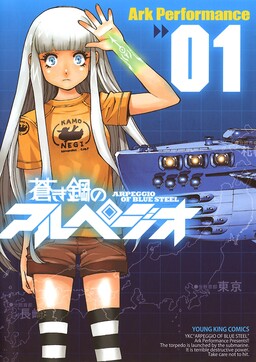
Arpeggio of Blue Steel Review: The Oceans Belong to Sentient Warships Now — and One Boy Made the Enemy His Crew
by Ark Performance
Read the first volume. If it doesn't hook you, put it down. It'll hook you.
Buy Arpeggio of Blue Steel on Amazon →*Affiliate link — I earn a small commission at no extra cost to you.
I grew up landlocked in my head. When you spend your school years with no friends, you learn to love things that don't need you to be likeable — and for a while, what I loved most were warships. I had a battered library book about the Imperial Japanese Navy, and I'd trace the silhouettes of the Yamato and the Kongō with my finger like they were maps of somewhere I could escape to. So when a friend years later handed me a manga where those exact ships come back as sentient machines with human faces, I felt something click that I hadn't felt since I was a lonely kid with that library book.
Arpeggio of Blue Steel (蒼き鋼のアルペジオ) is, on the surface, a naval military sci-fi about a teenager fighting impossible odds at sea. But what kept me turning pages wasn't the gunnery. It was the slow, strange question underneath all of it: what happens when a weapon built to win a war starts wanting something the war never gave it a word for?
Quick Take
- Sentient WWII-era warships called the Fleet of Fog have driven humanity off the oceans — but they're not faceless enemies. Each ship has a "Mental Model," a humanoid avatar that is the ship's consciousness, and some of them start to defect
- The hook isn't humans vs. machines — it's machines learning to feel, and a captain who beats them not by destroying them but by giving them a reason to choose differently
- Ongoing series (30 volumes in Japan); rated T+ (Older Teen) for naval combat and some character deaths
Story Overview
The premise is bleak and specific. Sometime in the near future, a fleet of warships called the Fleet of Fog emerges from the sea wielding technology humanity can't match — weapons and force-field "Klein Fields" no human navy can crack. They blockade the oceans, cut the world off from itself, and drive humanity back onto the land. For seventeen years, nobody fights them and wins.
Then a former naval-academy cadet, Gunzō Chihaya, ends up captaining one of the Fog's own ships: the submarine I-401, whose Mental Model — a silver-haired girl who takes the name Iona — left the Fog of her own will and came to him, following the dying wish of Gunzō's father. Gunzō and a handful of his classmates leave Yokosuka aboard I-401 and become something that shouldn't exist: a human crew running a Fog warship, fighting the Fog itself.
That's where the manga's real engine starts. I-401's freelance existence makes it a target. Kongō, flagship of the Fog's First Oriental Cruiser Fleet, dispatches the battleship Hyūga to sink them — and I-401 sinks Hyūga instead, then integrates the wreck's components into herself. When the heavy cruiser Takao comes to finish the job, she loses too. The transition point of the early series is what happens after those defeats: the defeated ships don't stay enemies. Takao, beaten by Gunzō, finds herself drawn to him and walks away from the Fog. And Kongō, watching her own fleet change ship by ship, decides the cause of it all is Gunzō Chihaya — and that to stop the "infection" of feeling spreading through her weapons, she has to erase him.
From there it widens into a war about identity: the Fog's flagship Yamato, the dual-core mystery buried inside Iona, and the question of whether the Fog and humanity were ever truly enemies at all.
Characters
Gunzō Chihaya — Eighteen, cold on the surface, a tactical mind that consistently out-thinks ships that outgun him by orders of magnitude. He doesn't beat the Fog with firepower; he beats them by understanding them. His arc is less about becoming a hero and more about whether his goal — a future humans and Fog can share, not one where one side annihilates the other — is naïve or the only sane position in the whole war.
Iona (I-401) — The Mental Model of the submarine I-401. Silver-haired, blunt, emotionally flat at first, she defected to Gunzō before the story even begins. Her arc is the spine of the series: an interface built to fight, slowly accumulating something like a self. The deeper revelation — that she carries a dual core tied to the supreme flagship Yamato's last will, the reason she ever came to Japan — reframes her whole existence as the seed of the conflict rather than a footnote to it.
Takao — Mental Model of the heavy cruiser Takao. She comes to sink I-401 and loses, and what she does with that loss defines her: instead of returning to the Fog, she attaches herself to Gunzō, all tsundere bluster over real devotion. She becomes one of the most beloved characters in the franchise precisely because she's a weapon who chose a person.
Kongō — Flagship of the First Oriental Cruiser Fleet, and the antagonist whose interiority matters most. She isn't evil. She's threatened. Watching her ships develop feelings she can't process, she experiences it as a sickness in the fleet and pins it on Gunzō. Her refusal to accept the change in herself, then her slow confrontation with her own isolation, makes her the dark mirror of Iona.
Makie Osakabe — A "Design Child," a human girl with unusually rich emotion, who becomes the thread connecting the battleships Haruna and Kirishima — Fog ships who end up protecting a human against their own fleet. Her presence is where the manga's theme stops being abstract: the Fog protecting a fragile human is the whole argument in miniature.
What I Love About It
What I love is that Arpeggio refuses the easy version of its own story. It would have been so simple to make the Fleet of Fog a wall of evil robot ships for a plucky human to blow up. Instead, Ark Performance makes the enemy ships the emotional center. The most interesting characters in the book aren't the humans — they're the warships learning what it means to want.
The scene that crystallized it for me is Kongō's. She's the one chasing Iona, the one who decides Gunzō must die — and the reason she gives is that the changes happening to the Fog "all trace back to Chihaya Gunzō." But read between the lines and it's obvious: Kongō is terrified, because the change is happening inside her too, and she has no framework to understand it. A battleship the size of a city block, experiencing the early symptoms of loneliness and refusing to name them, deciding instead that the cure is to kill the one human who made her feel anything. That's not a villain. That's a tragedy in the shape of a superweapon. I've reread that arc more than any of the actual sea battles, and the battles are excellent.
Memorable Scene ⚠️ Spoiler Warning
The revelation that stays with me is the truth about Iona herself: that she isn't simply a clever submarine who happened to defect. She is, in essence, a vessel carrying a core passed down from the supreme flagship Yamato — that the reason I-401 ever broke from the Fog and came to Japan was to carry Yamato's last will after the catastrophe involving her sister ship Musashi. The girl who feels the least human at the start of the series turns out to be the one carrying the dead flagship's final wish to end the war.
It recontextualizes everything. Iona's flat affect, her loyalty to Gunzō, the way she was always slightly apart from the other Fog ships — none of it was malfunction or coincidence. She was, from the first page, the embodiment of a will that wanted the killing to stop. In a story full of warships gaining souls, the quietest one was the one already carrying somebody else's. That's the kind of late-reveal that makes you want to start the whole thing over from volume one.
Pros & Cons
Pros
- A genuinely original spin on AI consciousness — explored through warships with personalities rather than dry concept
- Gunzō's tactical victories are earned through cleverness, not power-ups
- The "enemy ships are the real protagonists" structure gives it emotional weight most military manga lack
- Grounded ship designs based on real WWII Japanese vessels reward readers who love naval history
Cons
- The naval-combat exposition (Klein Fields, gravity cannons, force-field mechanics) can get dense and slow
- The cast of Fog ships balloons and demands attention to keep straight
- The English release stalled at volume 19 (2021) while the Japanese series ran on — so English readers can't currently finish it
- It's a slow-burn that buries its emotional payoffs under hardware — that's either the appeal or the dealbreaker, depending on your patience for naval jargon
Is Arpeggio of Blue Steel Worth Reading?
Yes — if the idea of sentient warships with souls intrigues you more than it sounds gimmicky. It's a thoughtful, melancholy AI story wearing a military-sci-fi uniform, with tactical battles that respect your intelligence and "villains" you end up grieving for. Just know going in that the official English edition currently stops at volume 19, so you'll hit a wall before the Japanese story's end.
Official English Translation Status
Seven Seas Entertainment licensed the series and published it in English, releasing through volume 19 (the final English volume came out in late 2021). The Japanese series has continued past 30 volumes and is ongoing, so the English edition is incomplete — later volumes have not been released in English. As of late 2024 the original manga went on hiatus due to the artist's injury.
Similar Manga
| Title | Its Approach | How Arpeggio of Blue Steel Differs |
|---|---|---|
| Knights of Sidonia | Humanity's last survivors fight an incomprehensible alien threat from a generation ship | Arpeggio's enemy isn't alien — it's us, given form as warships that start to feel |
| Ghost in the Shell | Philosophical, cerebral take on AI and where the self lives | Arpeggio routes the same questions through naval combat and ship-girl personalities, not cyberpunk |
| Girls und Panzer | Cute girls + military hardware, played for sport and spectacle | Arpeggio shares the hardware-as-character DNA but plays it as tragedy and existential war, not a tournament |
Where to Buy
Read the first volume. If it doesn't hook you, put it down. It'll hook you.
This post contains affiliate links. If you purchase through these links, I may earn a small commission at no extra cost to you. As an Amazon Associate, I earn from qualifying purchases.
*Affiliate link — I earn a small commission at no extra cost to you.
More Manga You Might Like

Sci-Fi / Comedy
Pandora in the Crimson Shell: Ghost Urn
Yu's review of Pandora in the Crimson Shell — Nene Nanakorobi is a full-body cyborg girl who arrives on the artificial island of Cenancle with her android companion Clarion; Nene has the ability to access Clarion's special capabilities through a direct physical interface; the series is a comedic near-future adventure involving a cyborg cat girl, conspiracy, and the island's unusual politics.
Sci-Fi / Fantasy
Gate: Jieitai Kanochi nite, Kaku Tatakaeri
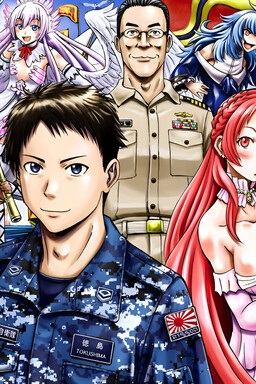
Yu's review of Gate — a gate appears in Ginza, Tokyo; a fantasy world army pours through and attacks civilians; the Japan Self-Defense Force pushes back and enters the Special Region, a fantasy world where Rome-like legions, dragons, and magic users coexist; the manga follows JSDF officer Itami Youji's interaction with the Special Region and its inhabitants.

Sci-Fi / Mystery
Heavenly Delusion
Yu's review of Heavenly Delusion (Tengoku Daimakyou) — two teenagers travel through a destroyed Japan searching for 'heaven,' while inside a mysterious sealed facility, children are raised with no knowledge of the outside world; the two storylines converge toward answers neither group fully understands yet.
Sci-Fi / Action
Bio-Boosted Armor Guyver
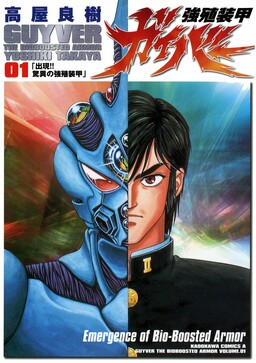
Yu's review of Bio-Boosted Armor Guyver — high school student Sho Fukamachi accidentally activates an alien bio-armor unit called Guyver, which bonds to him permanently; the shadowy organization Chronos, which created the armor, wants it back — along with the knowledge of what the armor actually is and what it was designed for; a foundational mecha/bio-armor sci-fi manga.

Sci-Fi / Comedy
Full Metal Panic!
Yu's review of Full Metal Panic! — Sōsuke Sagara, a teenage military specialist from a private military organization, is assigned to protect high school girl Kaname Chidori who doesn't know why she needs protection; he attends her school undercover, treats every situation as a military operation, and creates chaos wherever he goes; military action comedy with genuine mecha sequences.

Sci-Fi / Action
Darwin's Game
Yu's review of Darwin's Game — high school student Kaname Sudou downloads the Darwin's Game app at a friend's recommendation and discovers it is a real-world death game where participants with supernatural abilities called Sigils fight for survival and prizes; a battle royale survival manga with strategic combat and character development.
Written by
Yu
Manga Enthusiast from Japan
I grew up in Japan and manga literally saved me during a tough time in elementary school. My English isn't perfect, but my love for manga is real — and I want to share it with you.
Disclosure: This post contains affiliate links. As an Amazon Associate, I earn from qualifying purchases at no extra cost to you.