
Kaguya-sama: Love Is War Review: The Smartest Romance Manga Ever Written
by Aka Akasaka
Read the first volume. If it doesn't hook you, put it down. It'll hook you.
Buy Kaguya-sama: Love Is War on Amazon →*Affiliate link — I earn a small commission at no extra cost to you.
Quick Take
- Two geniuses in love refuse to confess — because "the one who confesses loses" — and spend 28 volumes plotting against each other
- The funniest romance manga ever written, with a genuine emotional payoff that earns every joke that came before
- One of the few romance manga where the ending is completely satisfying
Who Is This Manga For?
Kaguya-sama is for you if:
- You love smart, character-driven comedy that rewards attention
- You want a romance that's more about psychological chess than dramatic misunderstandings
- You're looking for something that's reliably funny in every chapter
- You want a complete story with a genuine, emotionally satisfying ending
Content Warnings & Age Rating
Age Rating: T (Teen) Content Warnings: Mild language, mild suggestive humor, later volumes deal with serious family trauma themes
The series is overwhelmingly comedic in the early volumes and gradually adds emotional weight. The tone shift is handled well. Appropriate for teens and above.
Yu's Rating
| Category | Score |
|---|---|
| Story Depth | ★★★★☆ |
| Art Style | ★★★★☆ |
| Character Development | ★★★★★ |
| Accessibility for Non-Japanese Readers | ★★★★★ |
| Reread Value | ★★★★★ |
Story Overview
Miyuki Shirogane is the student council president of Shuchiin Academy, one of Japan's most prestigious schools. He is the top student in his year, universally respected, and completely in love with the student council vice president, Kaguya Shinomiya.
Kaguya Shinomiya is the heir to one of Japan's most powerful families. She is brilliant, accomplished, and completely in love with Miyuki Shirogane.
Neither will admit it. Because love is a battlefield, and the one who confesses first has revealed their weakness. They are geniuses. They have too much pride. They would rather construct elaborate psychological operations to make the other confess than simply say what they feel.
This premise — which should run out of steam in two volumes — sustains 28 volumes of increasingly inventive comedy because Akasaka understands that the joke isn't just "two idiots won't talk to each other." The joke is about pride, vulnerability, and the specific way that being very smart can make you very stupid about love.
Characters
Miyuki Shirogane — The son of a working-class family who clawed his way to the top through pure effort. His academic excellence is not natural genius — it's desperate, sustained work. His feelings for Kaguya are genuine, and his fear of rejection is completely understandable given where he comes from.
Kaguya Shinomiya — Raised in a cold, achievement-obsessed family environment that left her emotionally isolated. Love, for Kaguya, is unfamiliar territory that she has only encountered through manga and television, and she approaches it with the same intense analytical focus she applies to everything else. The gap between her calculation and her actual emotions is the funniest thing in the series.
Chika Fujiwara — The student council secretary and one of the greatest comedy characters in manga. She is the chaos element that disrupts every carefully laid plan. Her famous recorder practice chapter — where she teaches Miyuki to play recorder for a week to increasing horror — is legendary.
Yu Ishigami — The treasurer, initially a minor character who becomes one of the series' most affecting. His arc in the later volumes deals with serious themes around isolation, reputation, and what happens when you act honorably in a situation where no one believes you.
Art Style
Akasaka's art is clean and expressive, particularly strong in comedic facial expressions. The series uses visual gags extensively — exaggerated reactions, dramatic internal monologue visualizations, and visual punchlines that work independently of the dialogue.
The art improves significantly over 28 volumes. The later chapters, particularly during the emotional payoff sequences, are drawn with much more nuance and care than the early comedy chapters.
Cultural Context
Shuchiin Academy is a proxy for Japan's actual elite private school system. The social dynamics — families who have attended for generations, the weight of institutional prestige, the intense pressure to perform — are drawn from real Japanese educational culture.
Confessing feelings carries specific cultural weight in Japan that differs from Western contexts. Public romantic gestures, formal confessions (kokuhaku), and the explicit acknowledgment of feelings are significant social acts. The seriousness with which the characters treat "who confesses first" is not as absurd in Japanese cultural context as it might seem to Western readers.
The Shinomiya family dynamic — Kaguya's cold, distant family who regard emotion as weakness — reflects real anxieties about upper-class Japanese family culture and the emotional costs of social performance.
What I Love About It
There is a chapter called "Chika's Rap." I will not spoil it. It is the funniest thing I have read in manga, and it arrives completely without warning.
But what I actually love about this series is something less funny: the moment, near the end, where Kaguya has to reckon with the fact that her entire strategy — her entire approach to love as a game to be won — has been a way of avoiding something much simpler and much scarier.
The series earns that moment by being funny for 25 volumes first. By the time it asks you to take Kaguya's feelings seriously, you already do.
What English-Speaking Fans Say
Kaguya-sama has a very devoted Western fanbase that arrived largely through the anime adaptation, which is considered one of the best romantic comedies in anime. The manga is praised for doing something the genre rarely achieves: maintaining comedy quality over a long run while building toward a genuinely satisfying emotional payoff.
Common praise: the comedy never gets old, Chika is universally beloved, the final arc is one of the best romance conclusions in manga.
Common criticism: the serious arcs in the second half (particularly around Ishigami) feel like a tonal shift some readers found jarring.
Memorable Scene ⚠️ Spoiler Warning
Kaguya's confession.
After 27 volumes of neither character being able to say the thing they both know is true, Kaguya finally breaks. Not strategically. Not as part of a plan. She simply can't not say it anymore.
The build-up across dozens of chapters — every failed scheme, every moment of almost — makes it land with enormous weight. Because you have been waiting for this for so long, in a series that kept making you laugh while you waited, and when it finally arrives it's real.
Similar Manga
If you liked Kaguya-sama, try:
- Monthly Girls' Nozaki-kun — Similar comedy structure, manga artist as protagonist, similarly sharp humor
- Horimiya — Different tone, more direct romance, similarly good character work
- Wotakoi: Love Is Hard for Otaku — Adult romance between nerds, similar smart comedy sensibility
- Nagatoro — More one-sided teasing dynamic, similar comedic rhythm
Reading Order / Where to Start
Start from Volume 1. The comedy builds on established character dynamics, and the emotional payoff in the final volumes only works because of the investment made in the early ones.
Official English Translation Status
Status: Complete English Volumes: 28 (all volumes available) Translator: VIZ Media Translation Quality: Excellent — the comedy translates well
Pros & Cons
Pros
- The funniest sustained comedy in manga — reliably excellent for 28 volumes
- One of the best romance payoffs in the genre
- Complete, 28 volumes, satisfying ending
- Chika Fujiwara is one of the greatest comedy characters ever written
Cons
- The serious tonal shift in later volumes surprises some readers
- The premise requires accepting some suspension of disbelief about why these geniuses won't just talk
- Not much action or plot momentum — this is a character comedy first
Format Comparison
| Format | Volumes | Price per vol. (approx.) | Best for |
|---|---|---|---|
| Paperback (individual) | 28 vols | ~$10–12 | Collecting |
| Kindle | 28 vols | ~$7–9 | Quick read |
Where to Buy
Read the first volume. If it doesn't hook you, put it down. It'll hook you.
This post contains affiliate links. If you purchase through these links, I may earn a small commission at no extra cost to you. As an Amazon Associate, I earn from qualifying purchases.
*Affiliate link — I earn a small commission at no extra cost to you.
More Manga You Might Like

Romance / Comedy
Kaguya-sama: Love Is War
Aka Akasaka's 28-volume romantic comedy (2015–2022) about Miyuki Shirogane and Kaguya Shinomiya, two student council officers at Japan's most elite high school who are both in love and both certain that whoever confesses first loses. Complete in English from VIZ Media.

Romance / Comedy
Toradora!
Yu's review of Toradora! — a delinquent-looking boy and a tiny, terrifying girl make a deal to help each other confess to the other's best friend, and discover they had the wrong target all along.

Romance / Comedy
Kaichou wa Maid-sama!
Yu's review of Kaichou wa Maid-sama! — Misaki Ayuzawa is the strict student council president of a recently co-ed school; she secretly works at a maid cafe to support her family; when the most popular boy at school, Usui Takumi, discovers her secret, he keeps it — and keeps showing up at her workplace across 18 volumes.
Romance / Comedy
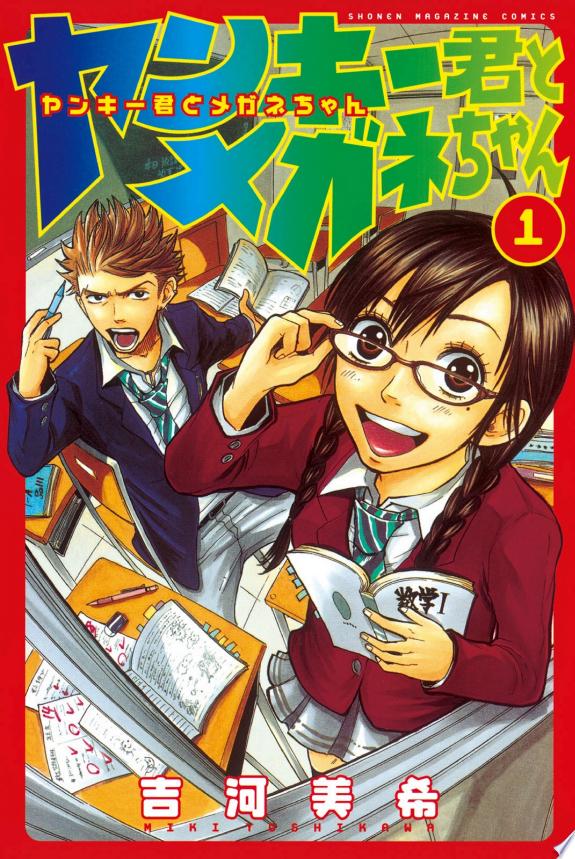
Yankee-kun to Megane-chan
Yankee-kun to Megane-chan follows Daichi Shinagawa, a delinquent who wants to be left alone, and Hana Adachi, the class representative with a secret — a comedy about two people who are both performing a role they didn't choose.

Romance / Comedy
Yuri Is My Job!
Yu's review of Yuri Is My Job! — Hime Shiraki's entire identity is performing perfect femininity for public approval; working at Liebe Girls Academy café requires her to act out romantic yuri relationships with her coworkers for customers; her assigned partner Mitsuki hates her genuinely, and Hime begins to develop feelings that are not performance.

Romance / Comedy / Supernatural
Yamada-kun and the Seven Witches
Yu's review of Yamada-kun and the Seven Witches — Ryu Yamada is a failing delinquent; Urara Shiraishi is the top student; when they fall down stairs together and accidentally kiss, Yamada discovers he has switched bodies with her; this supernatural power connects to seven witches in their school and to a larger mystery about their student council.
Written by
Yu
Manga Enthusiast from Japan
I grew up in Japan and manga literally saved me during a tough time in elementary school. My English isn't perfect, but my love for manga is real — and I want to share it with you.
Disclosure: This post contains affiliate links. As an Amazon Associate, I earn from qualifying purchases at no extra cost to you.