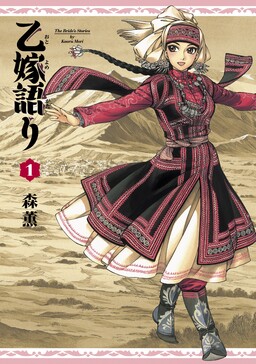
A Bride's Story Review: The 20-Year-Old Who Married a 12-Year-Old, and Stayed Because She Wanted To
by Kaoru Mori
Read the first volume. If it doesn't hook you, put it down. It'll hook you.
Buy A Bride's Story on Amazon →*Affiliate link — I earn a small commission at no extra cost to you.
I almost didn't open this one. A twenty-year-old bride and a twelve-year-old husband — I read that premise and my whole body tensed up. I'm Japanese, I grew up on manga, but even I thought "this is going to be uncomfortable in a way I won't be able to defend to anyone." I put it off for years.
When I finally read Volume 1, the thing that disarmed me wasn't a speech about the period or a disclaimer. It was a rabbit. Amir rides out, shoots a rabbit clean off the steppe with a bow, brings it home, butchers it, cooks it for the family, and then sews the fur into a lined vest for Karluk so he won't be cold. In a few quiet pages Kaoru Mori told me everything: this isn't a romance about who wants whom. It's about a capable adult woman deciding, on her own terms, to take care of a household and the boy in it. I stopped bracing and started looking. I haven't stopped looking since.
Quick Take
- The most beautiful manga being published, full stop — Mori's embroidery, textiles, horses, and Central Asian architecture are drawn with a craftsperson's obsession, not a stylist's shortcuts
- An anthology of brides along the Silk Road: Amir and Karluk anchor it, but the lens moves to twin brides, a widow, a shy embroideress, and an English researcher passing through
- T (Teen): the 20/12 age gap is the historical setup, not a romanticized fantasy — the relationship develops slowly and the series treats it with care, not titillation
Story Overview
The series opens near the Caspian Sea in the late 19th century, as Russian imperial expansion presses on the region. Amir Halgal, twenty years old, arrives from a semi-nomadic tribe to marry into the settled Eihon family. Her husband, Karluk, is twelve. By the customs of her people she is almost too old to be a bride; by the customs of his town the gap is unusual the other way. The early chapters are domestic and observational — Amir hunting, cooking, riding, embroidering, slowly finding her footing in a house full of strangers while Karluk quietly works out what being a husband to someone so much more capable even means.
The turning point comes when Amir's own family, the Halgals, decides they made a bad trade. A better alliance has appeared, and they want her back as a bargaining chip — her brother Azel leads the effort. Amir refuses to go. The Eihon family, who could have handed her over, instead declare she is theirs now and ride out to defend her. What had been a gentle slice-of-life suddenly has men on horseback and a real fight. It's the moment the series shows its teeth: this world treats women as commodities, and the drama is whether the people around Amir will treat her as a person.
After that storm passes, the series widens. Henry Smith, an English researcher cataloguing the region's customs and language, becomes a traveling thread who carries us to new households: the boisterous twin brides Laila and Leily on the Aral Sea, the widow Talas, and the shy, fierce young embroideress Pariya. Each bride gets a self-contained portrait, and together they build a picture of a whole region rather than one couple's happy ending.
Characters
Amir Halgal — The reason the premise works. She is an expert archer and horsewoman, a hunter, a cook, and an embroideress, and she brings all of it to a marriage she chooses to honor. Her arc isn't "learning to love" — it's deciding, when her own blood comes to drag her back into the marriage market, that she belongs where she is. She stays. That choice is the spine of the whole series.
Karluk Eihon — Twelve, earnest, and very aware that his wife can out-ride, out-shoot, and out-work him. His arc is the patient one: not racing to "catch up" to Amir but growing into someone who can stand beside her, including literally standing his ground when her family comes. Mori draws his maturing with affection rather than mockery.
Henry Smith — The English ethnographer whose curiosity gives the anthology its connective tissue. As he travels and documents, he meets Talas, a widow, and their slow, complicated bond becomes one of the series' major later threads — eventually pulling toward England and Ankara.
Pariya — A sharp-tongued, painfully shy young woman whose feelings outrun her ability to express them. Her embroidery and her bread-baking carry the emotions she can't say out loud. Her arc — fumbling toward a betrothal she desperately wants but can barely admit to — is some of the warmest material in the run.
The twins, Laila and Leily — Married off to two brothers, inseparable and chaotic, scheming to stay close. Their arc is the comic high point and one of the most charming extended sequences in the series.
What I Love About It
The embroidery and the craft. When Amir or Pariya works a needle, Mori doesn't summarize it — she draws the patterns full-page, the protective motifs, the cultural meaning stitched into a tunic so it will guard the wearer from illness. Amir embroiders a tunic for Karluk loaded with these protective designs; later, in the women's gatherings, you watch patterns get handed down from grandmother to granddaughter, memory carried in thread. I came in caring nothing about textiles. I came out genuinely moved by a vest made of rabbit fur and a row of stitches meant to keep a boy from getting sick.
What makes it land is that the craft is never decoration — it's how these women speak. Pariya, who can't say a kind word without it coming out barbed, says everything through bread and needlework. Amir, asked to prove she belongs, doesn't argue; she hunts, she cooks, she sews. Mori built a series where love and loyalty are physical labor, drawn with the patience they deserve. That's rare, and the art is good enough to make you feel the hours in every panel.
Memorable Scene ⚠️ Spoiler Warning
The Halgal raid in Volume 2. Amir's family rides in to take her back — she's worth more elsewhere now — and for the first time the manga's gentleness drops away. Amir refuses. And then the Eihons, the settled farming family who took in this strange older bride, get on their horses and ride out to fight for her. The shock of it is the point: you've spent a volume thinking these mild townspeople will fold, and instead they declare Amir is family and mean it with bows drawn. Karluk, twelve years old, plants himself in that. After all the quiet rabbit-hunting and stitching, watching the household physically refuse to let Amir be traded away is the moment the series earns its whole premise — she isn't property, and the people who love her will bleed to prove it.
Pros & Cons
Pros
- The finest art in modern manga — embroidery, horses, and architecture rendered with genuine craft knowledge
- The historical Central Asian setting is unusual and meticulously researched
- The anthology structure lets each bride's story be complete and distinct
- Ongoing for over fifteen years with no drop in quality
Cons
- The main Amir/Karluk thread develops slowly and recedes for long anthology detours
- The 20/12 age-gap setup requires historical framing some readers will still find uncomfortable
- The dense visual detail rewards slow reading — speed-readers will miss the entire point
The pacing is deliberate and the art demands you linger. That's either the whole appeal or a dealbreaker, depending on how you read.
Is A Bride's Story Worth Reading?
Yes — it's one of the essential manga of the last fifteen years regardless of which genre you usually reach for. If you value art and want a historical setting you've never seen in manga before, nothing else comes close. Just know going in that it's slow, anthology-shaped, and built to be savored rather than raced through.
Content Warnings & Age Rating
Age Rating: T (Teen) Content Warnings: Historical arranged marriage with a significant age gap at setup (20-year-old bride, 12-year-old husband); period violence including an armed clan conflict; depiction of women being treated as marriage bargaining chips
The age-gap premise is historically contextualized, not romanticized in a modern sense — the relationship develops slowly and with restraint, and the series is openly critical of how its world commodifies women.
Yu's Rating
| Category | Score |
|---|---|
| Story Depth | ★★★★★ |
| Art Style | ★★★★★ |
| Character Development | ★★★★★ |
| Accessibility for Non-Japanese Readers | ★★★★☆ |
| Reread Value | ★★★★★ |
Cultural Context
A Bride's Story (Otoyomegatari) began in Enterbrain's Fellows! magazine in 2008, continued in its successor Harta, and later moved to Kadokawa's Aokishi. Mori researched the 19th-century Central Asian Silk Road setting extensively — the clothing, the architecture, the embroidery motifs, the marriage customs — and it shows on every page. The series won the 7th Manga Taishō (2014) and a prize at the Angoulême International Comics Festival, and it functions as a genuine portrait of a specific historical region as much as a story.
Similar Manga
| Title | Its Approach | How A Bride's Story Differs |
|---|---|---|
| Emma | Same author; Victorian-England historical romance with craft-level detail | A Bride's Story trades the drawing room for the steppe and goes anthology-wide rather than following one couple |
| Vinland Saga | Historical fiction with comparable research and scope | A Bride's Story centers domestic life and women's craft, not war and revenge |
| Delicious in Dungeon | Same Harta magazine; obsessive, loving attention to a niche subject | A Bride's Story aims that obsession at real history and textiles instead of fantasy cooking |
Official English Translation Status
Yen Press publishes the English edition, with Volume 15 released in December 2025 and the series ongoing. The oversized hardcover format is the one to get — it does justice to the art.
Where to Buy
Read the first volume. If it doesn't hook you, put it down. It'll hook you.
This post contains affiliate links. If you purchase through these links, I may earn a small commission at no extra cost to you. As an Amazon Associate, I earn from qualifying purchases.
*Affiliate link — I earn a small commission at no extra cost to you.
More Manga You Might Like

Romance
Yakuza Lover
Yu's review of Yakuza Lover — Yuri Koda, a strong-willed college student who has never let anyone push her around, meets Oya, the heir to a yakuza empire; she refuses to be intimidated by him; he finds this extremely attractive; the romance that follows is adult, explicit, and specific about the complications of loving someone in organized crime.
Romance / Historical
Kaze Hikaru
Yu's review of Kaze Hikaru — Sei Tominaga disguises herself as a boy to join the Shinsengumi and avenge her family's death; she serves under Saito Hajime, who discovers her secret but keeps it; the series follows her life in the Shinsengumi through the turbulent end of the Edo period with Watanabe's unusually thorough historical research.
Romance / Fantasy
Bibliophile Princess
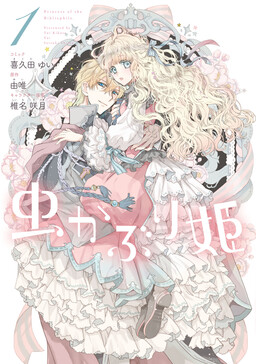
Yu's review of Bibliophile Princess — Lady Elianna Bernstein accepts a fake engagement to Crown Prince Christopher so she can read freely in the royal archive. Four years later she sees him with another woman and braces to be dumped — never once suspecting he has loved her since they were children.
Romance / Thriller
Raise wa Tanin ga Ii
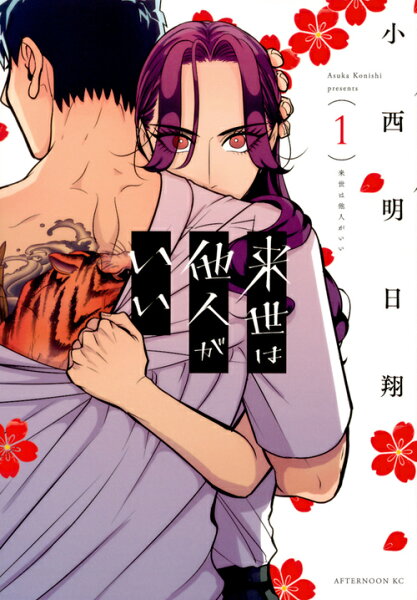
Raise wa Tanin ga Ii follows Yoshino Somei, granddaughter of a yakuza boss, who is placed in an arranged marriage with Miyama Kirishima — another boss's grandson who is terrifyingly, smilingly dangerous. Their courtship is a psychological chess match between two people who understand exactly what they're doing.
Romance / Josei
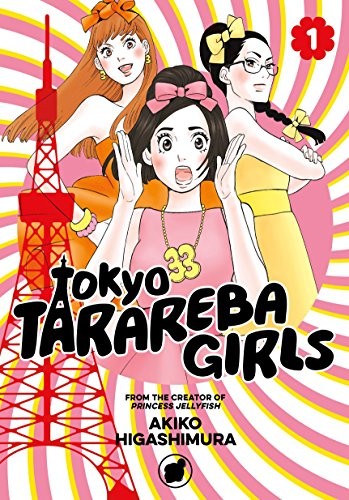
Tokyo Tarareba Girls
A review of Tokyo Tarareba Girls, Akiko Higashimura's brutally honest josei manga about three women in their thirties confronting their romantic failures.

Romance / Drama
We Were There
A high school love story that follows its couple deep into adulthood, through a four-year silence, a mother's suicide, and the slow work of finding each other again.
Written by
Yu
Manga Enthusiast from Japan
I grew up in Japan and manga literally saved me during a tough time in elementary school. My English isn't perfect, but my love for manga is real — and I want to share it with you.
Disclosure: This post contains affiliate links. As an Amazon Associate, I earn from qualifying purchases at no extra cost to you.