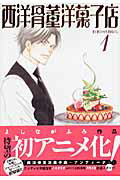
Antique Bakery Review: A Pastry Shop Where Cake Is Both Comfort and a Scar
by Fumi Yoshinaga
Read the first volume. If it doesn't hook you, put it down. It'll hook you.
Buy Antique Bakery on Amazon →*Affiliate link — I earn a small commission at no extra cost to you.
I have a thing I do that I'm not proud of: I judge a manga by how it handles food. If the cake is just there to look pretty, I lose interest fast. Antique Bakery is the opposite of that. The pastries in it are gorgeous — Yoshinaga draws them like they matter — but the whole point of the series is that one of the four men working there can't eat sweets at all, and the reason why is the darkest thing in the book. I came for a charming workplace comedy about a cake shop. I stayed because Yoshinaga had quietly buried a kidnapping survival story under all that buttercream, and I didn't see it coming until it was already in my chest.
This was the manga that made me understand what people mean when they say Fumi Yoshinaga writes "adults." Not adult content — adults. People in their thirties carrying things they've never told anyone.
Quick Take
- Fumi Yoshinaga at the height of her craft — four damaged men, one pastry shop, and dialogue so precise the people feel real.
- Won the Kodansha Manga Award (shōjo, 2002) and sold around 1.7 million copies; the live-action and anime adaptations both followed.
- Four complete volumes. Age rating: M (Mature) — BL content and a child-kidnapping backstory that gets genuinely dark in the final volume.
Story Overview
Keiichirō Tachibana, 32, is the kind of overqualified man who passed the bar and the diplomat's exam and then walked away from all of it to open a small Western pastry shop in Tokyo called Antique. He has one problem as a patisserie owner: he hates sweets. He physically can't stomach them.
To run the place he hires Yūsuke Ono, the most gifted pâtissier he could find — and the one man from his past he'd least like to see. In high school, Ono confessed his love to Tachibana, and Tachibana rejected him flatly. Ono has what the series calls "demonic charm": any man Ono is attracted to falls helplessly for him in return, gay or straight, which has gotten him fired from kitchen after kitchen as coworkers tear each other apart over him. Tachibana is the single exception — the one man immune to him — which is exactly why Ono is safe to employ.
Rounding out the staff: Eiji Kanda, 22, a former pro boxer forced to retire by detached retinas, who becomes Ono's apprentice and has a sweet tooth big enough for the whole shop; and Chikage Kobayakawa, the tall, sunglasses-wearing son of the Tachibana family's housekeeper, who looks like a yakuza enforcer and is actually a gentle, clumsy man assigned to be Tachibana's caretaker.
For most of its run the manga is a warm, funny slice-of-life about these four and the customers who pass through. But running underneath it all is Tachibana's reason for opening a cake shop he can't even taste. At nine years old he was kidnapped and held captive, fed cake every single day, and remembers almost nothing else about it. The shop is a lure — a net cast wide in the hope the man who took him will walk back through the door. In the final volume he does, or someone like him does, and the series turns briefly into something close to a thriller before settling back into the truth Yoshinaga was always heading toward: some things don't resolve, and you live anyway.
Characters
Keiichirō Tachibana — The owner, and the heart of the wound. He's competent at everything, charming with women, and completely closed off underneath. His aversion to sweets is a survival reflex from a trauma he can't consciously access. Opening the bakery is the one obsessive, irrational thing this rational man does — he's fishing for his kidnapper with éclairs. His arc isn't recovery; it's learning to hold an unhealed thing without it swallowing his whole life.
Yūsuke Ono — The genius pâtissier with the cursed charisma. Underneath the comedy of his "demonic" power is real damage: his sexuality and a lasting discomfort around women trace back to witnessing his mother's affair as a boy. Ono is the most outwardly confident character and the one most defined by being rejected — by Tachibana years ago, and by his own family for who he is. His quiet thread through the series is mending those frayed ties.
Eiji Kanda — The ex-boxer apprentice. An orphan raised in a children's home, he donated all his prize money back to the institution that raised him. He throws himself into pastry with the same single-mindedness he gave boxing. His arc closes with him confessing his fear of abandonment to Ono and then leaving for France to train seriously — the kid choosing growth over the comfort of staying.
Chikage Kobayakawa — The looming bodyguard who's actually the softest person in the shop. He wears the sunglasses for weak eyes, not menace. He's devoted to Tachibana, and over the series he falls for Ono. His ending is its own kind of grace: he moves out, deciding Tachibana has finally healed enough not to need a permanent caretaker.
What I Love About It
What I love is that Yoshinaga refuses to let the food be decoration. The central, devastating irony of Antique Bakery is that Tachibana built an entire shrine to a thing he cannot consume. He surrounds himself, every day, with the exact object his abductor used on him — cake — and turns it into bait. That's not a quirky character detail. That's a man who has decided to live inside his own trauma on purpose, daring it to come find him. I've never read another food manga where the food carries that kind of weight, where a perfect mille-feuille and a child's kidnapping share the same image.
And the tone management is masterful. This same book that contains that horror is also genuinely, laugh-out-loud funny — Ono's curse causing chaos, Kanda's bottomless appetite, Chikage's gentle uselessness. Yoshinaga never lets the darkness contaminate the warmth or the warmth cheapen the darkness. They sit side by side, the way they actually do in a real adult life. You can be making beautiful desserts with people you've grown to love and still be quietly hunting the man who broke you. The series trusts you to hold both at once.
Memorable Scene ⚠️ Spoiler Warning
In the final volume, a woman covered in bruises comes into the shop. Something in Tachibana's instinct fires, and following her leads him to her grown son — who is holding a kidnapped boy captive. In that moment a buried flashback surfaces: nine-year-old Tachibana, during his own captivity, stabbed his abductor in self-defense, and the man told him, "Leave… and forget all this!!" He obeyed so completely that he erased it.
But the part that wrecked me is what comes after. The man Tachibana believes was his actual kidnapper later walks into Antique to buy cake — and Tachibana doesn't recognize him. Years of running the shop as a trap, and when the prey finally arrives, the net is empty. The moment passes, unmarked, forever. Tachibana ends the series still having nightmares, still unable to remember, still unhealed — but able to enjoy a good day and his work. Yoshinaga earns that anticlimax. Real wounds don't give you a confrontation and closure; they give you a stranger buying an éclair while you stand there feeling nothing and everything. That's the most honest ending to a trauma story I've read in manga.
Pros & Cons
Pros:
- Yoshinaga's adult character writing at its absolute best — four people you'll remember for years.
- The food art is genuinely beautiful and thematically load-bearing, not filler.
- A complete four-volume story that balances comedy, BL, and genuine darkness without ever tipping over.
Cons:
- The English edition from Digital Manga is out of print, so physical copies can be pricey to track down.
- The deliberately unresolved ending frustrates readers who want trauma plots to pay off with closure — that's either the point or a dealbreaker depending on you.
Is Antique Bakery Worth Reading?
Yes — emphatically, if you want to see a slice-of-life food manga that's secretly one of the most quietly powerful trauma stories in the medium. Four richly written adults, real comedy, and an ending brave enough to refuse easy closure. The only real barriers are tracking down the out-of-print English volumes and accepting that the central wound never fully heals.
Who Is This Manga For?
- Readers who love Fumi Yoshinaga's adult, dialogue-driven character work (What Did You Eat Yesterday?, Ōoku).
- Anyone who wants a food manga with genuine emotional and thematic depth.
- BL-friendly readers who want characters first and romance woven in, not the other way around.
- People who can sit with a story that ends honestly rather than neatly.
Content Warnings & Age Rating
Age Rating: M (Mature) Content Warnings: BL content, child kidnapping (as backstory), a violent flashback, domestic abuse, mature themes.
The day-to-day of the series is warm and funny, but the kidnapping backstory and its final-volume climax are genuinely dark. Worth knowing going in.
Similar Manga
| Title | Its Approach | How Antique Bakery Differs |
|---|---|---|
| What Did You Eat Yesterday? by Fumi Yoshinaga | Quiet domestic food manga following a gay couple cooking dinner | Antique Bakery hides a kidnapping survival story under the same loving food detail |
| Ōoku by Fumi Yoshinaga | Sweeping alternate-history josei drama about power and gender | Antique Bakery is intimate and contemporary, four people in one small shop |
| Nana by Ai Yazawa | Adult josei drama built on flawed, fully realized characters | Antique Bakery is shorter, funnier, and structured around food rather than romance and music |
Official English Translation Status
Antique Bakery was fully published in English by Digital Manga Publishing across all 4 volumes (2005–2006). The English edition is currently out of print, so you may need to buy used or hunt secondhand copies, but the complete series did reach English readers.
Where to Buy
Read the first volume. If it doesn't hook you, put it down. It'll hook you.
This post contains affiliate links. If you purchase through these links, I may earn a small commission at no extra cost to you. As an Amazon Associate, I earn from qualifying purchases.
*Affiliate link — I earn a small commission at no extra cost to you.
More Manga You Might Like

Romance / Drama
Spring Has Come
A review of Spring Has Come, a quiet romance manga about a young woman grieving her sister and the brother-in-law she inherits a relationship with.

Romance / Drama
We Were There
A high school love story that follows its couple deep into adulthood, through a four-year silence, a mother's suicide, and the slow work of finding each other again.

Romance / Drama
Perfect World
Yu's review of Perfect World — Tsugumi Kawana reconnects with her high school crush Itsuki Ayukawa, now an architect who uses a wheelchair after a spinal cord injury; the manga follows their relationship with honest attention to the practical, emotional, and social dimensions of disability in a romantic relationship.

Romance / Drama
Paradise Kiss
Yu's review of Paradise Kiss — Yukari, a high-achieving student who has never questioned her path, is spotted by fashion students and asked to model their graduation collection; George, the designer, becomes the first person who sees who she might actually be.

Romance / Drama
Nana
Yu's review of Nana — two young women named Nana meet on a train to Tokyo and become inseparable, even as their lives move in opposite directions through love, music, and loss.

Romance / Slice of Life
Honey and Clover
Yu's review of Honey and Clover — five art school students love each other in various permutations that cannot all resolve, while each navigates the question of what their talent means and who they want to become.
Written by
Yu
Manga Enthusiast from Japan
I grew up in Japan and manga literally saved me during a tough time in elementary school. My English isn't perfect, but my love for manga is real — and I want to share it with you.
Disclosure: This post contains affiliate links. As an Amazon Associate, I earn from qualifying purchases at no extra cost to you.