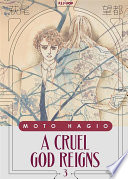
A Cruel God Reigns Review: The Manga That Shows What Surviving Actually Looks Like
by Moto Hagio
Read the first volume. If it doesn't hook you, put it down. It'll hook you.
Buy A Cruel God Reigns on Amazon →*Affiliate link — I earn a small commission at no extra cost to you.
This is not a manga you read for entertainment. You read it because some things need to be witnessed.
Quick Take
- Moto Hagio's masterwork: a precise, unflinching account of trauma and its aftermath
- Jeremy's journey from abuse to breakdown to the possibility of recovery is one of manga's most complete character studies
- Not for casual reading — this is a serious, sometimes harrowing literary work
Who Is This Manga For?
- Adult readers prepared for heavy content handled with intelligence and care
- Fans of literary fiction who want the emotional range of serious novels in manga form
- Anyone interested in the history of shoujo manga and its pioneers
- Readers who want to understand what recovery from childhood trauma actually looks like
Content Warnings & Age Rating
Age Rating: M (Mature) / 18+ Content Warnings: Child sexual abuse, physical abuse, self-harm, drug use, suicide attempts, PTSD, prostitution, explicit content involving minors in traumatic contexts
This manga does not soften what happened to Jeremy. Read with full awareness of what you're engaging with.
Yu's Rating
| Category | Score |
|---|---|
| Story Depth | ★★★★★ |
| Art Style | ★★★★★ |
| Character Development | ★★★★★ |
| Accessibility for Non-Japanese Readers | ★★★★☆ |
| Reread Value | ★★★★☆ |
Story Overview
Jeremy is an American teenager whose mother remarries a wealthy British man named Gregory. They move to England. Gregory, over the months that follow, sexually abuses Jeremy repeatedly while maintaining the public image of a loving stepfather. Then Jeremy causes Gregory's car accident — deliberately — and Gregory dies.
The story that follows is not a revenge fantasy. Jeremy is not saved by Gregory's death. He is destroyed by it — by the guilt, the trauma, the secret, the fear of being discovered, the chemical numbness he reaches for. He cannot tell anyone what Gregory did to him. He cannot process what he did to Gregory.
Ian, Gregory's biological son (now Jeremy's stepbrother), doesn't understand what's wrong with Jeremy. He knows something broke. He decides, for reasons he can't fully articulate, to stay.
What Hagio spends 17 volumes doing is showing what survival actually looks like: not triumph, not recovery-as-cure, but the small, nonlinear, often failing process of someone learning to still exist in the world after something terrible made that existence feel impossible.
Characters
Jeremy — One of the most fully realized trauma survivors in any medium. Hagio gives him the full complexity of a person who has been violated: the self-blame, the dissociation, the rage that has nowhere to go, the brief moments of something like hope. She does not flatten him into a symbol.
Ian — Jeremy's counterpart and the story's other center. He begins the series cold and suspicious, believing Jeremy caused his father's death (correctly, without knowing why). His journey toward understanding — and toward accepting what his father actually was — is equally difficult.
Gregory — Almost entirely absent after his death, present entirely through Jeremy's memory and body. The way Hagio constructs his presence in the past tense is a masterclass in how to render a monster without making him cartoonish.
Art Style
Hagio's art is classical shoujo — large expressive eyes, delicate linework, extreme emotional expressiveness. What makes it remarkable here is the restraint she exercises when the content requires it. The abuse is never depicted graphically; Hagio uses implication, negative space, and the specific quality of Jeremy's face in certain panels to communicate what happened without illustration. The result is more disturbing than explicitness would be.
Her ability to render different states of dissociation — the way Jeremy goes somewhere else when something triggers him — is striking. You understand what's happening in his mind through the visual grammar before you have words for it.
Cultural Context
Hagio is one of the founders of the "Year 24 Group" (Hana no Nijuyon-nen Gumi) — a cohort of female manga artists who in the early 1970s transformed shoujo manga from stories of passive girls into literary explorations of psychology, sexuality, and human complexity. A Cruel God Reigns is a late-career work from 1992-2001, and it represents everything that tradition built toward.
The story is set in England and America specifically. Hagio often set her serious works in Western contexts — partly to create aesthetic and emotional distance, partly because certain subjects (particularly related to sexuality and trauma) were easier to explore without the specific cultural codes of Japanese domestic life.
What I Love About It
I want to be honest: this manga is hard to read. There are chapters I had to put down. There are images I still think about years later.
What keeps me returning to it in memory is the integrity. Hagio refuses to make Jeremy's story comfortable. She refuses to make recovery a destination that arrives at volume 17. She shows the failure and the relapse and the moments where Ian reaches and Jeremy can't take the hand being offered. She shows the way trauma lives in the body even when the mind is trying to move forward.
And then she shows — carefully, without sentimentality — the small moments where things shift. Not healing as a resolution. Healing as evidence that something in Jeremy still insists on existing. That insistence is the bravest thing in the manga.
What English-Speaking Fans Say
A Cruel God Reigns has a small but deeply committed English readership. It's not casual reading, and it rarely turns up on mainstream recommendation lists. Readers who find it tend to regard it as one of the most important manga they've encountered. There's broad appreciation for Hagio's craft and for the story's refusal to simplify.
Some readers find the length (17 volumes) and density difficult to sustain. The pace is deliberate and does not provide regular moments of relief.
Memorable Scene ⚠️ Spoiler Warning
The scene where Ian finally learns the full truth of what Gregory did to Jeremy — and the way his face changes as he has to reconstruct his entire understanding of his father, his grief, and his anger — is one of the most affecting moments I've encountered in any manga. He cannot process it quickly. Hagio doesn't rush him. The silence on the page is enormous.
Similar Manga
| Title | Its Approach | How A Cruel God Reigns Differs |
|---|---|---|
| Banana Fish | Trauma, abuse, and a healing relationship | A Cruel God Reigns is more focused on internal psychological recovery than external action |
| Boys on the Run | Male vulnerability and emotional damage | A Cruel God Reigns is far more serious in its engagement with trauma |
| Nana | Emotional complexity and relationships that damage both people | A Cruel God Reigns is more clinical and literary in its approach |
Reading Order / Where to Start
Volume 1, in order. Do not skip ahead.
Be aware before you begin: this manga earns its weight but it asks a lot of you. Make sure you're in the right headspace.
Official English Translation Status
Fantagraphics Books published all 17 volumes in English. Complete. The translation is high quality. Physical copies can be found new and used.
Pros & Cons
Pros
- One of manga's most fully realized explorations of trauma and recovery
- Hagio's art is masterful — classical and precise
- Ian and Jeremy's relationship is earned, not given
- 17 volumes that justify every page
Cons
- Extremely heavy content; requires preparation and the right frame of mind
- The pace is deliberate to the point of being exhausting at times
- Not accessible or appropriate for younger readers
- Recovery is not triumphant — if you need catharsis, this may frustrate you
- The manga asks more of the reader emotionally than most are prepared to give
Is A Cruel God Reigns Worth Reading?
Yes — for the right reader. This is serious literary manga at the level of the best prose fiction about trauma. It is not comfortable and does not try to be. If you can engage with it on its own terms, it is genuinely important work.
Format Comparison
| Format | Pros | Cons |
|---|---|---|
| Physical | Best for sustained reading; feels like holding a book | Heavy volumes |
| Digital | Easier to pause and return to | — |
| Omnibus | No omnibus available | — |
Where to Buy
Read the first volume. If it doesn't hook you, put it down. It'll hook you.
This post contains affiliate links. If you purchase through these links, I may earn a small commission at no extra cost to you. As an Amazon Associate, I earn from qualifying purchases.
*Affiliate link — I earn a small commission at no extra cost to you.
Written by
Yu
Manga Enthusiast from Japan
I grew up in Japan and manga literally saved me during a tough time in elementary school. My English isn't perfect, but my love for manga is real — and I want to share it with you.
Disclosure: This post contains affiliate links. As an Amazon Associate, I earn from qualifying purchases at no extra cost to you.