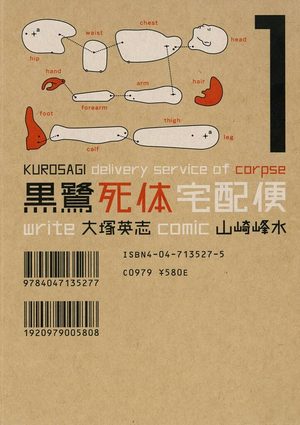
The Kurosagi Corpse Delivery Service Review: Dead People Have Unfinished Business, and Five Students Help Them Finish It
by Eiji Otsuka / Housui Yamazaki
*Affiliate link — I earn a small commission at no extra cost to you.
Quick Take
- Five students with supernatural abilities find unburied dead and help them reach their final destination — the premise is dark and the execution is darkly funny
- One of manga's most distinctive blends of horror, comedy, and social commentary
- The editorial notes in the Dark Horse English edition are genuinely educational about Japanese mortuary and forensic practices
Who Is This Manga For?
- Readers who want horror that is also genuinely funny and occasionally educational
- Fans of episodic mystery with consistent ensemble characters
- Anyone interested in Japanese attitudes toward death and the dead
- Readers who can handle graphic corpse imagery in service of a story with genuine heart
Content Warnings & Age Rating
Age Rating: M (Mature) Content Warnings: Graphic depictions of bodies in various states of decay and death; the series is fundamentally about corpses and this is not minimized; some episodes involve violent deaths depicted in detail
This is not for sensitive readers. The content is integral to the premise.
Yu's Rating
| Category | Score |
|---|---|
| Story Depth | ★★★★☆ |
| Art Style | ★★★★☆ |
| Character Development | ★★★☆☆ |
| Accessibility for Non-Japanese Readers | ★★★★☆ |
| Reread Value | ★★★★☆ |
Story Overview
Five graduates of a Buddhist university, unable to find conventional employment with their degrees, form the Kurosagi Corpse Delivery Service. They use their individual abilities — Kuro's communication with the dead (through a puppet on his hand), Makino's embalming skills, Numata's dowsing ability to find bodies, Yata's channeling, and Sasaki's hacking — to locate unclaimed bodies and deliver them to where the deceased wanted to go.
Each episode is a case. A body is found. Its circumstances are investigated. Its unfinished business — the thing that kept it from resting — is resolved. The resolution is not always peaceful, and the social circumstances that produced the unclaimed dead are always examined.
The series is simultaneously horror, dark comedy, and social commentary on Japanese issues around suicide, poverty, lonely death (kodawari shinitachi), the elderly, and the mechanisms that fail people before they die.
Characters
Kuro Karatsu — His ability to hear the voices of the dead makes him the team's primary interface with their clients. He is the series' conscience — the one most affected by what they find.
Keiko Makino — The embalmer whose technical knowledge is both practically useful and the source of the series' most educational content about mortuary practice.
Yuji Yata — Channels an alien who speaks through him; the alien's commentary on human behavior is the series' most consistently absurdist comedy element.
Tetsuro Sasaki — The hacker whose internet skills are how the team finds jobs and navigates the gap between the dead and the bureaucratic systems that didn't serve them.
Ao Numata — Whose corpse-finding ability (using a forked stick like water-divining) is the team's search engine.
Art Style
Yamazaki's art handles the corporeal content with remarkable specificity — the bodies are drawn with mortuary accuracy that supports the series' educational notes. The character designs are distinctive enough to support a large number of episodic guest characters. The horror imagery, when it appears, is effective precisely because the art is controlled rather than excessive.
Cultural Context
The series engages directly with Japanese social issues: the "lonely death" phenomenon, where elderly people die alone and are not found for weeks; Japan's historically low rate of organ donation; the stigma around suicide; the economic conditions that leave some people unclaimed when they die. Each case is a specific comment on a specific Japanese social reality.
What I Love About It
The editorial notes. The Dark Horse edition includes extensive notes explaining the Japanese cultural, legal, and practical context for each episode — what the mortuary laws actually say, what the specific social phenomenon being referenced actually is, what historical event is being discussed. The notes turn the reading experience into something genuinely educational without disrupting the story.
What English-Speaking Fans Say
Western readers consistently describe this as the most intellectually substantive horror manga they have encountered. The social commentary is praised for its specificity — these are not generic dark observations but precisely targeted criticisms of systems that fail real people. The dark humor is cited as essential to making the content bearable.
Memorable Scene ⚠️ Spoiler Warning
The episode involving a kodawari case — a man who died alone in his apartment and was not discovered for months — and what his last request actually is, demonstrates the series' ability to find genuine pathos inside extreme darkness.
Similar Manga
- Monster — Social commentary, mystery, dark tone
- Homunculus — Supernatural ability intersecting with social reality
- Goodnight Punpun — Social isolation, dark psychology
- Master Keaton — Episodic mystery, educational cultural content
Reading Order / Where to Start
Volume 1 — the team and premise establish across the first two chapters.
Official English Translation Status
Dark Horse Comics has published 15 volumes. The series is ongoing in Japan.
Pros & Cons
Pros
- Unique premise executed with genuine skill
- Dark comedy and horror coexist effectively
- The editorial notes are a genuine value-add
- Social commentary is specific and meaningful
Cons
- The M rating is fully earned — the corpse imagery is graphic
- Not for readers with sensitivity to death and decay imagery
- Episodic structure means limited long-term character development
Format Comparison
| Format | Notes |
|---|---|
| Individual Volumes | Dark Horse; includes extensive editorial notes |
| Digital | Available |
Where to Buy
Get The Kurosagi Corpse Delivery Service Vol. 1 on Amazon →
This post contains affiliate links. If you purchase through these links, I may earn a small commission at no extra cost to you. As an Amazon Associate, I earn from qualifying purchases.
*Affiliate link — I earn a small commission at no extra cost to you.
Written by
Yu
Manga Enthusiast from Japan
I grew up in Japan and manga literally saved me during a tough time in elementary school. My English isn't perfect, but my love for manga is real — and I want to share it with you.
Disclosure: This post contains affiliate links. As an Amazon Associate, I earn from qualifying purchases at no extra cost to you.