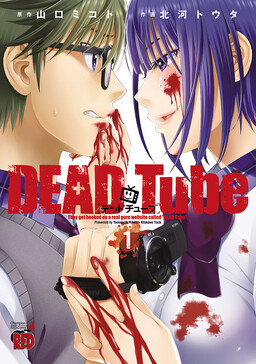
Dead Tube Review: The Manga Where the Camera Never Stops, No Matter What It's Pointed At
by Mikoto Yamaguchi (story), Touta Kitakawa (art)
Read the first volume. If it doesn't hook you, put it down. It'll hook you.
Buy Dead Tube on Amazon →*Affiliate link — I earn a small commission at no extra cost to you.
I have a rule about reading manga late at night: nothing that follows me into the dark. Dead Tube broke that rule. I told myself I'd read one volume to see what the fuss was, and I ended up sitting in my kitchen at 2 a.m., lights on, not because a single page was scary in the jump-scare sense, but because of a feeling that crept up slowly — the feeling of a camera that won't look away. That's the whole engine of this series. Someone hands you a lens and says "don't stop recording, no matter what," and you spend the rest of the story watching a teenager learn exactly how far that promise can be pushed.
I want to be honest before anything else: this is one of the most extreme manga I've put on this site. I'm not recommending it to most of you. But it is a real, ongoing, widely-read horror thriller in Japan, and if you've already decided you can handle it, I'd rather you go in knowing what it actually is than have it ambush you.
Quick Take
- A pure transgressive horror-thriller built on one nasty hook: an underground video site where the participant with the lowest view count pays for every crime everyone else commits
- The appeal is the escalation and the camera-as-complicity idea, not subtle character work — though Machiya's slow numbing is more interesting than the gore suggests
- Age rating: 18+. Graphic violence, gore, sexual violence, and disturbing content run through the entire series. Treat the content warnings as literal, not decorative
Content Warnings & Age Rating
Age Rating: 18+
Content Warnings: This series contains graphic murder, torture, gore, and depictions of sexual violence as a recurring element — not as background, but as the core content the story is built to deliver. There is also frequent nudity and psychological cruelty. If any of these are a hard line for you, this is not your manga, and that's a completely reasonable place to stop.
Do not hand this to a younger reader, and don't pick it up casually because the premise sounds like a clever death game. The premise is clever. The execution is deliberately ugly.
Story Overview
Tomohiro Machiya is a quiet second-year at Gyōtoku Academy and the cameraman of the film club. One day Mai Mashiro — a star of the swim team and one of the most beautiful girls in school — pulls him aside with a strange request: film her for two full days, around the clock, and agree to one condition. No matter what happens, he cannot stop recording.
He says yes. He films her at school, at home, through dinner and sleep. Then, on the second day, Mashiro brings along a male classmate named Yamamoto for what looks like a date — and without warning beats him bloody with a collapsible metal baton while Machiya, frozen, keeps the camera rolling. She pays him five million yen, then tells him the next subject is the film club's president, who is supposedly going to kill himself in five days.
That's when the floor drops out. Machiya learns this footage is for Dead Tube, an underground site where users upload videos and earn money by view count. The catch is the engine of the whole series: the participant whose video gets the fewest views has to cover everyone's expenses and take the legal responsibility for the crimes committed on camera. Lose, and you don't just lose — you absorb the consequences of every murder you filmed.
From there the series runs in escalating arcs: a survival scenario trapping participants on an island with a serial killer, a stretch where Machiya turns predator and hunts other users to climb the rankings, a clash with a self-righteous rival faction called the Justice Men, and eventually a revelation about who actually built Dead Tube that reframes Machiya's whole involvement. It is long and ongoing — 28 volumes as of 2026 — and it does not get gentler.
Characters
Tomohiro Machiya — He starts as the audience surrogate: an ordinary kid who is horrified by violence and keeps filming only because he's too shocked to stop. His arc is the actual reason to read this. The camera becomes a buffer between him and what he's seeing, and the further in he goes, the more that buffer becomes the person. He's a genuinely gifted cameraman, and the series keeps suggesting that the talent and the detachment are the same thing — that to film this well, part of him has to stop flinching.
Mai Mashiro — The girl who recruits him, and the most dangerous person in most rooms. She kills with almost no visible empathy, her weapon of choice the collapsible baton from that first encounter. The one exception is Machiya — she's fixated on him, convinced he's the only one who can capture her on camera the way she wants to be seen. Her affection is not reassuring; it's another kind of trap.
Hanae Miwa — A classmate of Machiya's who gets pulled into the orbit of Dead Tube. She's the closest thing to a moral anchor: she reacts to violence the way a normal person would, and a lot of her role is trying to keep Machiya tethered to who he used to be. Whether she can is one of the series' running tensions.
Saki Mizuno — A film-society member who turns out to be coldly profit-driven, eventually working with Machiya and Mashiro to produce their videos. She's a useful mirror: where Hanae represents conscience, Mizuno represents the logic of the platform itself — just optimize, just get the views.
What I Love About It
If I'm being a fair reader, the thing that actually works here is the idea of the camera as complicity, and the series commits to it harder than I expected. The opening request — "don't stop filming, no matter what" — sounds like flavor text until Mashiro caves a classmate's skull in and you realize the promise was the trap. Machiya didn't agree to witness a murder; he agreed in advance to keep recording one, before he knew it would happen. The horror isn't the baton. It's that he already said yes.
What kept me reading past the shock value was watching that idea do work on Machiya himself. Early on, the lens is how he survives — if he's filming, he's a step removed, an observer instead of a participant. But Dead Tube is smart enough to know that the camera doesn't actually protect you; it implicates you. Every video Machiya makes is evidence that he chose the footage over the person in front of it. The series is at its best when it stops being a gore delivery system and sits in that specific discomfort: the slow realization that the person who records everything and stops nothing has, quietly, become one of them. That's a real horror idea, and it's the reason this series has stuck around for 28 volumes when a lot of shock-horror burns out in three.
Memorable Scene ⚠️ Spoiler Warning
The scene that defines the whole series is still that first "win" in volume one — Mashiro and Yamamoto's date. Machiya thinks he's filming a couple. The pacing lulls you the same way it lulls him; it reads like the awkward, almost sweet beat the story owes you before things go wrong. Then Mashiro swings the baton, and the page doesn't cut away, because Machiya doesn't cut away — because he promised he wouldn't. The blood, Yamamoto going down, and the unbroken viewfinder framing all land at once. She pays him five million yen like it's a transaction, and casually names the next target: a man scheduled to die in five days.
It works because the manga makes you complicit in the exact way it makes Machiya complicit — it sets up a "normal" scene specifically so the camera will still be rolling when it turns. After that, every quiet moment in the series carries a low hum of dread, because you've been taught that the calm exists only to make sure someone's recording when it breaks. Later, the revelation about who actually created Dead Tube recontextualizes Machiya's whole entanglement, but it's that early baton swing that teaches you how to read the rest of the book.
Pros & Cons
Pros
- A genuinely strong central idea — the camera as complicity — that the series actually develops rather than just decorating
- Machiya's gradual numbing gives the gore a spine; he's a more interesting protagonist than the premise promises
- Long, ongoing run (28 volumes) with consistent escalation and a real mystery underneath the violence
Cons
- The extremity is the point, not a side effect — sexual violence and torture are recurring, not occasional
- Thematic depth is real but secondary; if you want restraint or subtext over shock, you'll bounce off it
- No licensed English edition, so accessibility for English readers is limited
- This genuinely won't work for everyone — and for a lot of readers, that's not a flaw to push through, it's a signal to walk away
Is Dead Tube Worth Reading?
If you actively seek out extreme transgressive horror and you want a death-game premise with a sharper-than-average central idea — the camera that can never stop, the loser who pays for everyone's crimes — then yes, Dead Tube delivers exactly that, with an ongoing run that keeps escalating. For everyone else, the content is a hard wall, and there's no shame in deciding this one isn't for you. I'd put it firmly in the "know yourself first" category.
Official English Translation Status
There is currently no licensed official English edition of Dead Tube. The series is published in Japan by Akita Shoten under the Champion RED imprint (28 volumes and ongoing as of 2026), and a French edition exists via Delcourt-Tonkam, but there is no English-language publisher. The Japanese print and digital releases are the only legitimate way to read it for now.
Similar Manga
| Title | Its Approach | How Dead Tube Differs |
|---|---|---|
| Gantz | Forced survival game with extreme violence and a hidden system controlling players | Dead Tube ties the violence to performance and audience views, making the reader part of the complicity |
| Doubt | Death-game horror driven by paranoia and who-can-you-trust tension | Dead Tube is less whodunit, more about a protagonist who slowly stops being horrified |
| Deadman Wonderland | Survival-violence framed as spectacle for a paying audience | Dead Tube makes the spectacle the whole point and the protagonist the one holding the camera |
Where to Buy
No English release yet. That just means you find it before everyone else does.
Find Dead Tube on Amazon.co.jp →
There's no licensed English edition, so the Japanese print and digital release is the only legitimate way to read it.
This post contains affiliate links. If you purchase through these links, I may earn a small commission at no extra cost to you. As an Amazon Associate, I earn from qualifying purchases.
*Affiliate link — I earn a small commission at no extra cost to you.
Reading Guides
More Manga You Might Like

Horror / Survival
Alice in Borderland
Yu's review of Alice in Borderland — a survival horror manga where a directionless young man and his friends are pulled into a deserted Tokyo and forced to clear deadly games rated by playing cards, slowly uncovering what the Borderland actually is.

Horror / Thriller
Talentless Nana
Yu's review of Talentless Nana — at a school for students with supernatural powers, sweet transfer student Nana Hiiragi appears to be a normal girl; the series reveals in its first volume that Nana is an assassin sent to kill the students; the manga becomes a psychological thriller about Nana's mission, her growing complications, and the students who begin to suspect her.

Horror / Thriller
My Home Hero
Yu's review of My Home Hero — Tetsuo Tosu, an ordinary salaryman, discovers that his daughter's boyfriend is an abusive criminal; when he acts to protect her, he kills the man; what follows is a crime thriller about a completely ordinary person trying to conceal a murder while the dead man's yakuza connections start asking questions.

Horror / Thriller
Life Is Money
Yu's review of Life Is Money — ten strangers agree to participate in a locked-room psychological game for a prize of 100 million yen; the rule is simple but brutal: they must maintain their sanity across ten days of engineered terror; those who break lose everything.

Horror
King's Game (Ousama Game)
Yu's review of King's Game — Nobuaki transfers to a new school hoping to escape his past; his entire previous class was killed when they received orders from 'the King' via text message and anyone who disobeyed died; the new class receives the same messages; Nobuaki must watch the same horror unfold again; Renda's adaptation of Kanazawa's horror novel about a game where the King's orders must be obeyed.

Horror / Thriller
Gannibal
Daigo Agawa transfers to Kuge village — a remote mountain community in the Japanese alps — after an incident at his previous police posting. The villagers are afraid of the Goto family. A drunk old man tells Daigo the Gotos eat people. The previous officer disappeared. Masaaki Ninomiya's 13-volume rural horror (2018–2021) is being released in English by Ablaze Publishing and was adapted as a Disney+ live-action series in 2022.
Written by
Yu
Manga Enthusiast from Japan
I grew up in Japan and manga literally saved me during a tough time in elementary school. My English isn't perfect, but my love for manga is real — and I want to share it with you.
Disclosure: This post contains affiliate links. As an Amazon Associate, I earn from qualifying purchases at no extra cost to you.