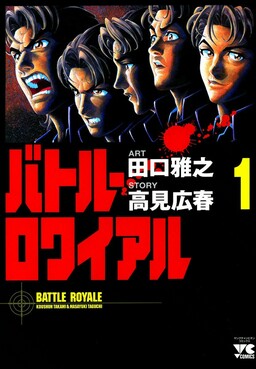
Battle Royale Review: A Class of Schoolchildren Is Dropped on an Island and Ordered to Kill Each Other
by Koushun Takami (story) / Masayuki Taguchi (art)
Read the first volume. If it doesn't hook you, put it down. It'll hook you.
Buy Battle Royale on Amazon →*Affiliate link — I earn a small commission at no extra cost to you.
Before The Hunger Games, before Squid Game, there was Battle Royale — and it is darker, angrier, and more political than anything it inspired. The premise is simple and monstrous: a class of fifteen-year-olds, kids who sat next to each other in homeroom yesterday, are told that only one of them will be allowed to leave the island alive.
What the manga does with that premise is give every single one of them a life first. That's what makes it unbearable.
Quick Take
- The original survival-competition story that influenced everything from The Hunger Games to Squid Game — bleaker and more explicitly political than its descendants
- Taguchi's manga adaptation gives each of the 42 students individual characterization, so every death lands
- Rated M (Mature); 15 volumes complete, published in English by Tokyopop
Who Is This Manga For?
- Readers who want the origin point of the death-game genre
- Fans of dystopian fiction willing to engage with extremely graphic content
- Anyone interested in the political allegory beneath the survival premise
- Readers who can handle mature, disturbing content in service of serious themes
Content Warnings & Age Rating
Age Rating: M (Mature) Content Warnings: Extreme graphic violence and child death; sexual content and sexual violence; torture; psychological horror — 41 of the 42 students die, many in graphic detail
This is one of the most graphically intense manga in English publication. Take the warnings seriously.
Yu's Rating
| Category | Score |
|---|---|
| Story Depth | ★★★★★ |
| Art Style | ★★★★☆ |
| Character Development | ★★★★★ |
| Accessibility for Non-Japanese Readers | ★★★★☆ |
| Reread Value | ★★★☆☆ |
Story Overview
The Republic of Greater East Asia is a totalitarian state that runs a secret program: each year, randomly selected junior-high classes are taken to isolated locations, fitted with explosive collars, given a random weapon each, and forced to kill one another until a single survivor remains. The official justification is military research. The real purpose is terror — a demonstration that the state owns its citizens' children utterly, and that no one can stop it.
Third-year Class B of Shiroiwa Junior High is selected. Forty-two students. They wake on an island, are told the rules, and watch the first demonstrations of what the collars do to anyone who refuses or lingers in a forbidden zone. Then they are released into the island, one by one.
The manga tracks the whole class as the situation fractures them. Some students start hunting immediately. Some refuse to play and try to organize resistance. Some break down; some find unexpected courage; some are murdered by people they trusted minutes earlier. The nominal protagonists are Shuya Nanahara, a boy who clings to the belief that human connection can survive the program, and Noriko Nakagawa, whom he's trying to protect — but their survival is never guaranteed, and the manga refuses to treat anyone as safe. Across fifteen volumes it builds toward an escape attempt and a confrontation with the system itself.
Characters
Shuya Nanahara — The closest thing to a hero, defined by his refusal to accept the program's core premise: that surviving requires killing. His optimism is tested against forty-one classmates reaching very different conclusions about the same impossible situation.
Shogo Kawada — A transfer student who has survived a previous program. His hard-won knowledge of how the game works, and his guarded reasons for helping Shuya and Noriko, make him the story's most compelling figure.
Kazuo Kiriyama — The antagonist whose violence is efficient, emotionless, and essentially motiveless. He kills the way a machine would, and that absence of any comprehensible reason makes him far more frightening than a hateful villain would be.
Mitsuko Souma — A girl whose brutal survival strategy is rooted in a backstory of abuse the manga depicts in full, making her one of the adaptation's most tragic and disturbing figures.
Art Style
Taguchi's art is detailed and frequently, deliberately excessive — the violence is rendered with a specificity that goes beyond the original novel's prose. Crucially, his character designs make each of the 42 students individually recognizable, which is what allows the reader to track the whole class through the chaos and feel each loss.
Cultural Context
Battle Royale began as Koushun Takami's 1999 novel, which was rejected by publishers for years over its content before becoming a phenomenon. In Japan, the political allegory — a fascist state using children as instruments to demonstrate its power — was read as commentary on wartime militarism and the obedience demanded by authoritarian systems. Western readers often approach it primarily as survival fiction, but the political anger runs much deeper than the genre it spawned.
What I Love About It
The breadth of it. Forty-two students, and the manga is determined to give each of them a real life before it ends them — a backstory, a crush, a specific fear, a reason someone will miss them. Students who die early have enough characterization that their deaths register as deaths rather than statistics. That ambition — to make every death in a story about mass death actually mean something — is exactly what separates Battle Royale from the imitators that took its premise but not its conscience.
Memorable Scene ⚠️ Spoiler Warning
The lighthouse sequence — a group of girls who have holed up together, trying to trust one another and survive as a unit, destroyed from within when fear and a single misunderstanding turn their fragile alliance into a chain-reaction massacre in a single room. It is the manga's clearest statement of its thesis: the program's true weapon isn't the collars or the weapons, it's what terror does to trust. Watching a safe haven dissolve into mutual slaughter because the system has made everyone unable to believe anyone is the most horrifying thing in the series, precisely because no villain is present — just frightened kids.
Similar Manga
| Title | Its Approach | How Battle Royale Differs |
|---|---|---|
| Alice in Borderland | Death games in an emptied city, puzzle-focused | Alice is more cerebral; Battle Royale is more brutal and political |
| Gantz | Recurring forced combat against aliens | Gantz is sci-fi spectacle; Battle Royale is grounded political tragedy |
| Btooom! | Adults in a bomb-based survival game | Btooom! is genre thrills; Battle Royale is angrier and more allegorical |
Reading Order / Where to Start
Volume 1 — the program's setup and the introduction of Class B establish everything.
Official English Translation Status
Tokyopop published the complete 15-volume run in English. (Tokyopop's original line is defunct; check the used and secondary market, though later collected editions have circulated.)
Pros & Cons
Pros
- Gives 42 students real characterization — an extraordinary structural achievement
- The political allegory adds genuine depth beyond survival thrills
- Complete, with a real confrontation with the system
- Its influence on global pop culture is unmatched
Cons
- The content warnings are serious — the violence and sexual violence are extreme
- The graphic excess goes beyond what some readers will find productive
- Out-of-print editions can be hard to track down — that's the cost of its age
Is Battle Royale Worth Reading?
Yes, with eyes open — it's the origin of an entire genre and far more politically serious than its successors, but it is genuinely brutal. If you can handle the content, the breadth of characterization makes it devastating in a way the imitators never matched.
Where to Buy
Read the first volume. If it doesn't hook you, put it down. It'll hook you.
This post contains affiliate links. If you purchase through these links, I may earn a small commission at no extra cost to you. As an Amazon Associate, I earn from qualifying purchases.
*Affiliate link — I earn a small commission at no extra cost to you.
Reading Guides
More Manga You Might Like
Horror / Survival
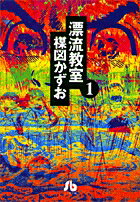
The Drifting Classroom
Yu's review of The Drifting Classroom — a Japanese elementary school and all its students and teachers are suddenly transported to a desolate future Earth; the children must survive without adult leadership as food runs out and monsters appear.
Horror
MW
Yu's review of MW — Yuki Michio is a beautiful, charming, amoral man who survived exposure to a chemical weapon as a child; the event destroyed his conscience; he works toward mass destruction while maintaining the appearance of a successful society member; a priest who loves him tries to hold him back; Osamu Tezuka's 1976 thriller about a man without conscience.
Horror / Thriller
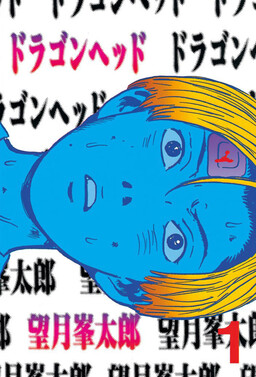
Dragon Head
Yu's review of Dragon Head — a school-trip train derails inside a mountain tunnel and three classmates crawl out into a Japan destroyed by an unexplained cataclysm. Minetaro Mochizuki's 10-volume survival horror about fear itself, the thing that breaks people faster than the disaster does.
Horror / Thriller
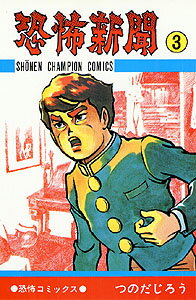
Kyofu Shinbun
Kyofu Shinbun follows Kichi Taira, a middle school student who begins receiving a supernatural newspaper delivered only to him — a newspaper that reports events before they happen, including deaths, and whose receipt shaves years from his own lifespan with each issue.
Horror / Survival
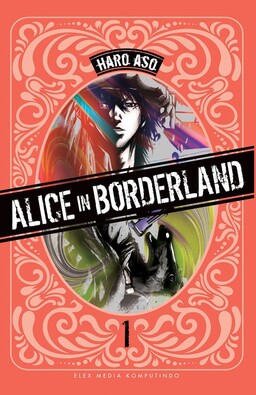
Alice in Borderland
Yu's review of Alice in Borderland — a survival horror manga where a directionless young man and his friends are pulled into a deserted Tokyo and forced to clear deadly games rated by playing cards, slowly uncovering what the Borderland actually is.
Horror / Thriller
Starving Anonymous
Yu's review of Starving Anonymous — passengers on a bus wake up in a facility where they discover the horrifying truth about what they're being used for.
Written by
Yu
Manga Enthusiast from Japan
I grew up in Japan and manga literally saved me during a tough time in elementary school. My English isn't perfect, but my love for manga is real — and I want to share it with you.
Disclosure: This post contains affiliate links. As an Amazon Associate, I earn from qualifying purchases at no extra cost to you.