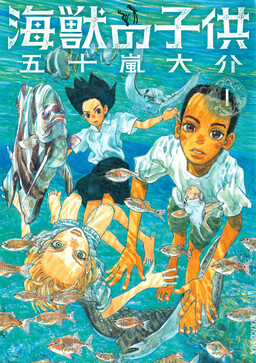
Children of the Sea Review: The Manga That Stops Trying to Explain Itself — And Soars Because of It
by Daisuke Igarashi
Read the first volume. If it doesn't hook you, put it down. It'll hook you.
Buy Children of the Sea (Kaijuu no Kodomo) on Amazon →*Affiliate link — I earn a small commission at no extra cost to you.
I read most of Children of the Sea on a night ferry, which feels too perfect, but it's true. I'd brought volume one to kill time on the crossing, and somewhere out on the dark water — engine humming, no land in any direction — I hit the pages where Ruka first watches Umi move through the aquarium tank like he belongs there more than the fish do. I put the book down and went out on deck. The sea at night is just a black absence with sound. And I remember thinking: this is a manga that knows what that feels like, the bigness you can't see the edges of.
I want to be honest with you up front. Children of the Sea is not a manga that hands you an ending. The last two volumes stop explaining themselves almost entirely, and a lot of readers close volume 5 frustrated. I didn't. I closed it shaking a little. So this review is partly me trying to tell you which kind of reader you are before you spend money on it.
Quick Take
- Daisuke Igarashi's marine art is, to me, the most technically astonishing depiction of the ocean in any manga — and that's not hyperbole, it's the whole point of the book
- The story starts as a grounded mystery and gradually dissolves into something closer to experiential, wordless art in its final volumes
- 5 volumes, complete in English from VIZ Signature; rated T+ (Older Teen) for abstract, philosophical, and occasionally unsettling content
Story Overview
Ruka Azumi is a middle-schooler who's bad at saying what she feels. In the first chapter she gets benched from her summer handball club after she hurts a teammate in a flash of anger — so summer vacation stretches out in front of her with nowhere to belong, not at home, not at school. She drifts to the aquarium where her father works.
There she meets Umi — a boy who was raised in the ocean by dugongs, who is more comfortable in the water than out of it. Soon she meets his counterpart, Sora, who is frailer, sharper-tongued, and whose body seems to be quietly failing on land. The boys are under the watch of an oceanographer, Jim, and a brilliant, restless researcher named Anglade who is convinced the boys are connected to something enormous.
Then the engine of the plot turns over: all across the world, fish are abandoning their habitats, vanishing in impossible numbers, the ocean gathering itself around something. Sora disappears and comes back carrying a meteorite — a fragment that the sea life of the entire planet is migrating toward. The researchers call what's coming a "rehearsal" and a "main event." Nobody will say plainly what the main event is. That refusal isn't evasion on Igarashi's part — it's the spine of the book. By volume 5 the story has left ordinary narrative behind and become a birth: a "festival" in which Ruka, Umi, and Sora are not bystanders but participants.
Characters
Ruka Azumi — Our way in. She comes from a family line of ama (free-diving women), so the sea is in her blood whether she likes it or not. Her arc isn't "girl learns to be nicer" — it's a girl who can't put feelings into words being handed a role in something cosmic that also can't be put into words. She becomes the one human chosen to carry the meteorite, and in the climax she's the vessel through which the rebirth happens. Her growth is measured by how much of the inexplicable she's willing to hold inside herself without demanding it make sense.
Umi — The boy raised by dugongs, bright and open and instinctive. He's the warmth of the book. By the end, his physical body is not the point of him; he and Sora are revealed to be less "people" than they are aspects of a single process the ocean is enacting.
Sora — Umi's sharper, sicklier counterpart. He's the one whose body can't hold together on land, and his disappearance and return with the meteorite is the hinge of the back half. Sora is the cost the story pays before its rebirth — he passes the meteorite to Ruka and then loses his physical form.
Anglade and Dede — Anglade is the genius researcher chasing the boys' meaning through astronomy and obsession; Dede is the old woman, half-mystic, who tells Ruka that "the sea is a woman's specialty." Between them they frame the book's two ways of approaching mystery — the scientific and the intuitive — and the manga refuses to declare a winner.
What I Love About It
Igarashi's ocean. I keep coming back to this because it's not a side dish, it's the meal. Most manga draws water as a flat tone or a few speed lines. Igarashi draws it as something alive and incomprehensible — pages where the page itself dissolves into shoals of fish, plankton, light scattering through depth, the eye of a whale the size of a building. He researched real marine biology, real questions about collective animal behavior and how little humans actually understand deep-ocean ecology, and you feel that rigor under every spread. The art isn't decorating the story. The art is the argument: that the sea is older and stranger than human narrative can contain.
What I love most is how the craft and the theme become the same thing. As the story moves toward its climax, Igarashi lets the panels stop behaving like storytelling and start behaving like the ocean — full pages where you're not "reading" so much as floating. A lesser artist would have lost me there. Because the linework had earned my trust over four volumes, I let it carry me. That's the rare experience this book offers: a manga that asks you to stop demanding answers and just look, and then makes looking feel like the answer.
Memorable Scene ⚠️ Spoiler Warning
The "festival" in volume 5. Sora, dying, passes the meteorite to Ruka through a kiss before he loses his physical form. Then Ruka is swallowed — taken inside a whale — and the page erupts into a flood of memory and galactic imagery: the swirls and eddies of the sea turning, panel by panel, into the spirals of galaxies, a meteorite's voice warning her that what she sees with her own eyes is hers alone to interpret. When she surfaces back toward Umi, he takes the meteorite — the "seed" — and Ruka tries to stop him from swallowing it, experiencing a rush of his memories as she does. Umi shrinks down to a child, and Ruka places the meteorite into his mouth herself. Seed and egg combine. The rebirth completes. When it's over, Ruka wakes alone in the ocean, and Umi and Sora are gone in any bodily sense.
It is, deliberately, a 2001: A Space Odyssey kind of ending — overwhelming and wordless and refusing to translate itself. The first time I reached it I genuinely didn't know what I had just read. The second time I understood that not knowing was the gift. The whole book had been telling me the sea doesn't owe me a plot.
Pros & Cons
Pros
- Marine art that is, technically, in a class of its own
- A grounded, emotionally legible opening that earns the abstract finale
- Real scientific curiosity woven through the mysticism
- Complete and self-contained at 5 volumes
Cons
- The final volumes deliberately withhold conventional resolution
- The abstract climax will read as pretentious or empty to some
- It demands patience and rereading
The back half is either the most daring thing you've read in manga or a frustrating non-ending — and which one it is depends entirely on you. This won't work for everyone, and that's honest, not a hedge.
Is Children of the Sea Worth Reading?
If you want manga as visual art and you're willing to sit with mystery instead of demanding a tidy explanation, this is one of the most extraordinary books VIZ has ever printed in English — yes, absolutely worth it. If you read primarily for plot resolution and clear character payoffs, the final volumes will likely leave you cold, and you should know that going in.
Who Is This Manga For?
- Readers who want manga as visual and philosophical art, not just entertainment
- Anyone drawn to the ocean, marine biology, and the limits of human understanding
- Fans of literary, ambiguous speculative fiction (think 2001, Annihilation, Mushishi)
- Anyone who wants a manga that genuinely looks and feels like nothing else
Content Warnings & Age Rating
Age Rating: T+ (Older Teen) Content Warnings: Abstract and philosophical sequences in the later volumes; mild mature content; themes of loss and disappearance; the ocean rendered as a beautiful but overwhelming, non-human force.
Nothing exploitative or graphic — the "maturity" here is thematic and emotional, not violent.
Yu's Rating
| Category | Score |
|---|---|
| Story Depth | ★★★★★ |
| Art Style | ★★★★★ |
| Character Development | ★★★★☆ |
| Accessibility for Non-Japanese Readers | ★★★★☆ |
| Reread Value | ★★★★★ |
What English-Speaking Fans Say
English-language readers consistently single out Igarashi's marine art as unlike anything else available in translation, and the 2019 Studio 4°C anime film brought a wave of new readers to the manga. The recurring split in reviews is exactly the one I describe: many call the ending a profound, 2001-like meditation on the sea as the source of life, while others find its refusal to resolve frustrating and vague. Both reactions are fair — and both, in a way, are responses Igarashi seems to have designed for.
Similar Manga
| Title | Its Approach | How Children of the Sea Differs |
|---|---|---|
| Mushishi | Nature and the supernatural as quiet, episodic mystery | Children of the Sea builds toward one vast, abstract, cosmic event rather than self-contained tales |
| Nausicaä of the Valley of the Wind | Ecological epic with a clear narrative and heroine | Igarashi's book trades plot mechanics for sensory, wordless immersion |
| Blue Period | Art and perception as the subject itself | Children of the Sea is about the limits of human understanding, not artistic ambition |
Official English Translation Status
VIZ Media released all 5 volumes in English under its VIZ Signature literary imprint. The series is complete and available in print and digital. There is no missing material — what you can buy in English is the whole story.
Where to Buy
Read the first volume. If it doesn't hook you, put it down. It'll hook you.
This post contains affiliate links. If you purchase through these links, I may earn a small commission at no extra cost to you. As an Amazon Associate, I earn from qualifying purchases.
*Affiliate link — I earn a small commission at no extra cost to you.
More Manga You Might Like
Fantasy
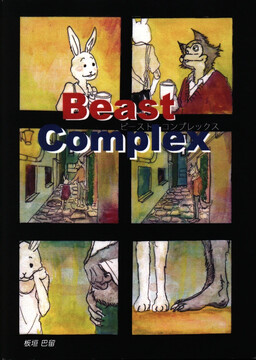
Beast Complex
Yu's review of Beast Complex — Paru Itagaki's short-story collection set in the Beastars world. A lion sent to coax a grieving bat back to school, a burnt-out camel journalist and a wolf, a crocodile chef and a gazelle assistant. The anthology that became Beastars.
Fantasy / Romance
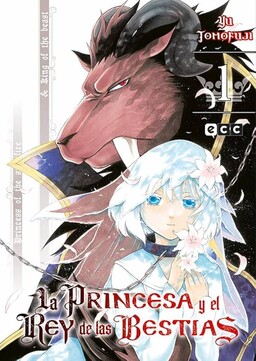
Sacrificial Princess and the King of Beasts
Yu's review of Sacrificial Princess and the King of Beasts — Sariphi is a human girl offered as a sacrifice to the Beast King Leonhart, who is expected to devour her; instead of pleading for her life, she asks to spend the remaining time as his companion; Leonhart, bewildered by her response, agrees.
Fantasy / Shoujo
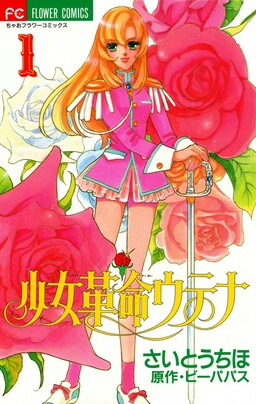
Revolutionary Girl Utena
Yu's review of Revolutionary Girl Utena — Utena Tenjou, who decided as a child to become a prince rather than a princess, attends Ohtori Academy and becomes drawn into its secret dueling system; the winner of the duels wins possession of Anthy Himemiya, the Rose Bride; a surrealist fairy tale manga about power, freedom, and who gets to be the subject of a story.
Fantasy
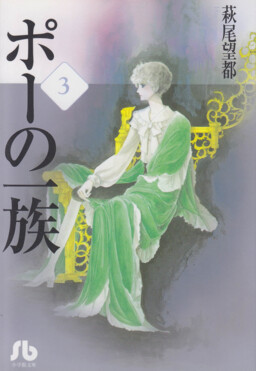
Poe Clan
Yu's review of Poe Clan — Edgar is a vampire child, eternally young, moving through European history across several centuries; his vampire existence means watching everyone he cares for age and die while he remains unchanged; Moto Hagio's foundational vampire manga, originally published in 1972.
Fantasy / Mystery
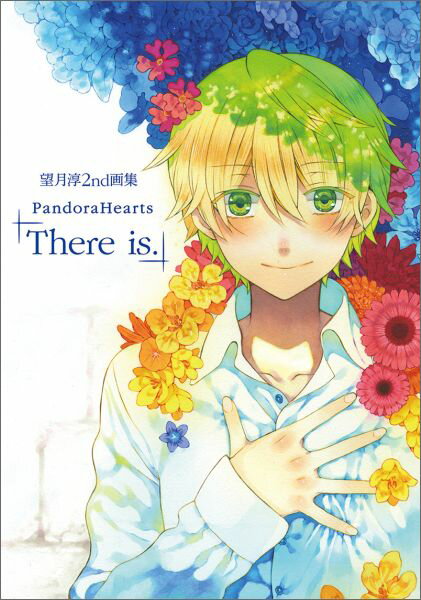
Pandora Hearts
Yu's review of Pandora Hearts — a nobleman's son is cast into a prison dimension called the Abyss on his fifteenth birthday, returns with a powerful chain partner, and unravels a conspiracy that rewrote the history of his world.

Fantasy
Spice and Wolf (Manga)
Yu's review of the Spice and Wolf manga — traveling merchant Kraft Lawrence finds Holo the Wise Wolf hidden in his cart; she is a wolf deity who was the harvest god of a village for centuries; she wants to go north to her homeland; Koume's adaptation of Hasekura's beloved light novel about economics, religion, and two people who are good at pretending they don't need each other.
Written by
Yu
Manga Enthusiast from Japan
I grew up in Japan and manga literally saved me during a tough time in elementary school. My English isn't perfect, but my love for manga is real — and I want to share it with you.
Disclosure: This post contains affiliate links. As an Amazon Associate, I earn from qualifying purchases at no extra cost to you.