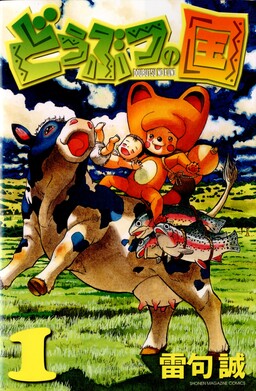
Animal Land Review: A Human Baby in a World of Animals Grows Up to Challenge the Law of Predation
by Makoto Raiku
Read the first volume. If it doesn't hook you, put it down. It'll hook you.
Buy Animal Land on Amazon →*Affiliate link — I earn a small commission at no extra cost to you.
Makoto Raiku's follow-up to Zatch Bell asks a question that sounds simple and turns out to be difficult: can you change a world's fundamental law through understanding alone? The law in question is predation. The agent of change is the only being in the world who can talk to everyone.
The question takes fourteen volumes to answer, and the answer is not simple.
Quick Take
- A philosophically ambitious shonen that asks whether a world built on predation can be changed — and uses a human in an animal world to pose the question with genuine seriousness
- Raiku's follow-up to Zatch Bell with similar emotional ambition but more thematic weight
- Rated T (Teen); 14 volumes complete, winner of the 37th Kodansha Manga Award for Best Children's Manga
Who Is This Manga For?
- Readers who want shonen adventure with genuine philosophical substance
- Anyone interested in animal-world fantasy where the predator-prey dynamic is taken seriously rather than treated as background
- Fans of Makoto Raiku's work in Zatch Bell who want his more thematically serious follow-up
- Readers who want complete medium-length adventure with emotional depth
Content Warnings & Age Rating
Age Rating: T (Teen) Content Warnings: Predator-prey violence; deaths of animal characters including sympathetic ones; philosophical content about the nature and limits of communication; standard shonen action violence
The animal violence and the deaths of named characters make this more emotionally demanding than typical shonen. T rating is accurate.
Yu's Rating
| Category | Score |
|---|---|
| Story Depth | ★★★★★ |
| Art Style | ★★★★☆ |
| Character Development | ★★★★☆ |
| Accessibility for Non-Japanese Readers | ★★★☆☆ |
| Reread Value | ★★★★☆ |
Story Overview
Humans are extinct. Animals survive with their instincts and their species-specific communication — raccoon dogs speak to raccoon dogs, wolves speak to wolves, and never to each other. The fundamental law: predators eat prey.
A tanuki named Monoko finds a human infant — she cannot understand him and he cannot understand her, but she takes him in and names him Taroza. Over seven years, something unusual emerges: Taroza can understand and speak to every animal species. He is the only being in the world who can.
What he does with this ability — his insistence that the law of predation does not have to be the final word — drives the conflict. He builds a village where different animal species coexist, working toward the dream of universal harmony. The world resists. Predators need to eat. The biology of the situation is not simply solved by communication or goodwill.
As the series progresses, Taroza encounters other humans who survived: Capri, raised by lions; Jyu, a troubled boy with his own relationship to violence; Giller, an antagonist who wants to destroy rather than bridge. The culminating discovery — the Eternity Fruit, a biotechnologically created food consumable by both carnivores and herbivores, developed by a deceased human from an earlier era named Quo — is the series' proposed solution. Whether that solution is real, stable, and sufficient is what the final volumes work through.
Characters
Taroza — A shonen protagonist whose central quality is determination applied to a genuinely hard philosophical problem. He is not the strongest or the fastest. He is the only one who can talk to everyone, and he refuses to use that ability only to manage rather than to change.
Monoko — The tanuki who raised Taroza. Her relationship with him — unable to communicate at first, then gradually developing genuine understanding — is the series' foundational model for what the world could be.
Kurokagi — A protective lynx who becomes one of Taroza's closest allies. His role in the early volumes establishes what predator-prey friendship looks like when it actually works.
Giller — The series' antagonist, a human who represents the opposing philosophy: that the world of animals should be destroyed rather than transformed. His presence forces Taroza to defend not just his village but his argument.
Riemu — A human girl raised by gorillas, the fourth of the surviving humans Taroza encounters. Her perspective — shaped by life among a species with their own hierarchies and strengths — adds another variation to the series' central question about what understanding across species actually means.
Art Style
Raiku's art handles the animal cast with genuine attention to species-specific movement — raccoon dogs move differently from wolves from birds, and this visual distinction extends to the action sequences. The battle scenes are dynamic and varied. The emotional climaxes, which Raiku earned a reputation for in Zatch Bell, are deployed with similar precision here.
Cultural Context
Animal Land ran in Bessatsu Shōnen Magazine from October 2009 to February 2014. It won the 37th Kodansha Manga Award for Best Children's Manga in 2013 — an award that recognized not just the adventure content but the philosophical substance. Raiku's work consistently engages with questions about what power is for and whether natural law can be changed through will and connection.
The Eternity Fruit as a solution to the predator-prey problem is a science-fiction resolution to a philosophical question — a reminder that some problems need not just understanding but technology. This is unusual in shonen manga and reflects Raiku's willingness to take the question seriously rather than resolve it through pure emotional determination.
What I Love About It
The series takes seriously that communication is not the same as harmony. Taroza can speak to every animal — but that does not mean every animal agrees with him, needs what he's offering, or can act on understanding even when it exists. The predator-prey dynamic is biological. Wolves need food. Understanding the prey's experience does not change the hunger.
Watching Taroza grapple with the limits of his own ability — that the gift of universal communication is necessary but not sufficient — is shonen manga engaging with an actually hard problem, and it is rare.
Memorable Scene ⚠️ Spoiler Warning
The revelation of the Eternity Fruit — a food source created by a deceased human named Quo through biotechnology, consumable by both carnivores and herbivores — reframes everything Taroza has been working toward. The answer to the predator-prey problem was not wisdom or will alone. A previous human had already worked on it. The solution exists but requires finding, understanding, and distributing it. Taroza's idealism was necessary; it was also insufficient on its own. The series is honest about both.
Similar Manga
| Title | Its Approach | How Animal Land Differs |
|---|---|---|
| Beastars | Animal-world predator-prey dynamics in different register | Beastars is darker and more about individual psychology; Animal Land is about changing the world |
| Zatch Bell | Raiku's earlier work, similar emotional climaxes | Zatch Bell is about individual battles; Animal Land is about rewriting natural law |
| Nausicaä of the Valley of the Wind | Philosophical ambition about nature at similar scale | Nausicaä is a masterwork; Animal Land is more accessible but similarly serious |
Reading Order / Where to Start
Volume 1 — Monoko, the infant Taroza, and the animal world's structure are established immediately.
Official English Translation Status
Kodansha USA published the complete 14-volume English series.
Pros & Cons
Pros
- Philosophical ambition is genuine and taken seriously throughout
- Animal cast is emotionally effective — the named characters matter
- Raiku's emotional climaxes are well-earned
- Complete at 14 volumes with a real conclusion
- Kodansha Manga Award recognition reflects genuine quality
Cons
- Predator-prey violence and animal character deaths may be difficult for some readers
- The philosophical content occasionally feels heavy-handed
- The English publication may be out of print or limited availability
- The resolution requires accepting a speculative biotechnology premise
Is Animal Land Worth Reading?
Yes — especially for readers who loved Zatch Bell and want Raiku's more thematically serious work. The philosophical ambition is real, the emotional climaxes are earned, and the answer the series gives to its central question is more honest than most manga would attempt.
Where to Buy
Read the first volume. If it doesn't hook you, put it down. It'll hook you.
This post contains affiliate links. If you purchase through these links, I may earn a small commission at no extra cost to you. As an Amazon Associate, I earn from qualifying purchases.
*Affiliate link — I earn a small commission at no extra cost to you.
More Manga You Might Like
Fantasy
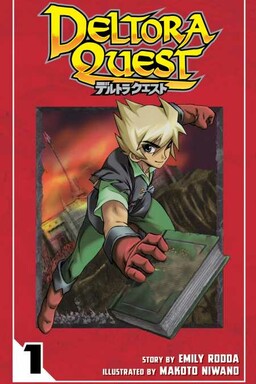
Deltora Quest
Yu's review of Deltora Quest — Makoto Niwano's manga adaptation of Emily Rodda's Australian fantasy novels. Lief, Barda, and the wild forest girl Jasmine cross the corrupted land of Deltora to reclaim the seven stolen gems of the Belt of Deltora from the guardians who hoard them, before the Shadow Lord's grip becomes permanent. A shonen battle-manga reading of a children's quest classic, complete in 10 volumes.

Fantasy / Action
Solo Leveling
Yu's review of Solo Leveling — Sung Jinwoo is the weakest hunter in a world where gates to dungeons have opened and hunters fight the monsters within; after a near-fatal mission, he receives a mysterious system that allows only him to grow stronger — endlessly, without limit.
Fantasy / Action
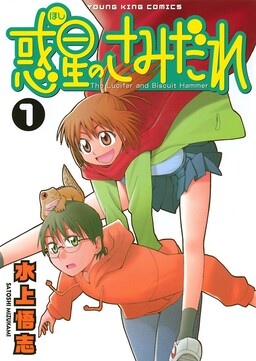
Lucifer and the Biscuit Hammer
Yu's review of Lucifer and the Biscuit Hammer — Yuuhi Amamiya, a university student who doesn't care about much of anything, is told by a lizard that he is a 'Beast Knight' destined to save the world; he's more interested in the plan of Princess Samidare to save the world herself — so she can destroy it after.
Fantasy / Action
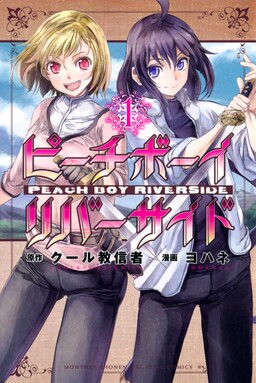
Peach Boy Riverside
Yu's review of Peach Boy Riverside — Princess Sally Salami leaves her sheltered life to see the world; she encounters Mikoto, a young man with the power to destroy oni, who is driven by hatred; Sally's compassion and Mikoto's hatred are placed in constant tension as they navigate a world where the line between humans and monsters is not clear.
Fantasy / Action
Four Knights of the Apocalypse
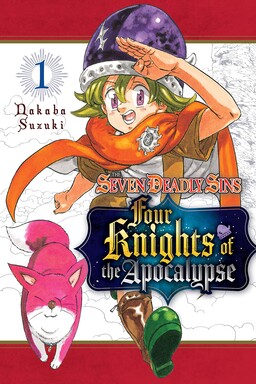
Yu's review of Four Knights of the Apocalypse — Percival has grown up on a mountain kept from the outside world by his grandfather; a stranger with power kills his grandfather and sets him on a journey; a prophecy identifies him as one of the Four Knights of the Apocalypse whose arrival will destroy Camelot — or perhaps save it.
Action / Fantasy
Buster Keel!
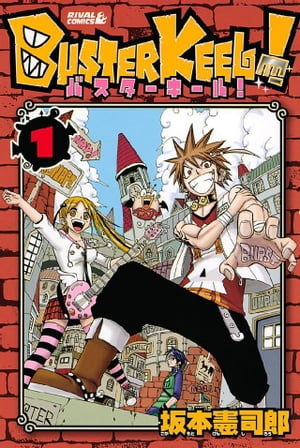
A review of Buster Keel!, Kenshirou Sakamoto's 12-volume Monthly Shonen Rival fantasy about a boy who is secretly a cursed Dragon Ape, the melody mage who travels with him, and the beast-taming guild world they fight through.
Written by
Yu
Manga Enthusiast from Japan
I grew up in Japan and manga literally saved me during a tough time in elementary school. My English isn't perfect, but my love for manga is real — and I want to share it with you.
Disclosure: This post contains affiliate links. As an Amazon Associate, I earn from qualifying purchases at no extra cost to you.