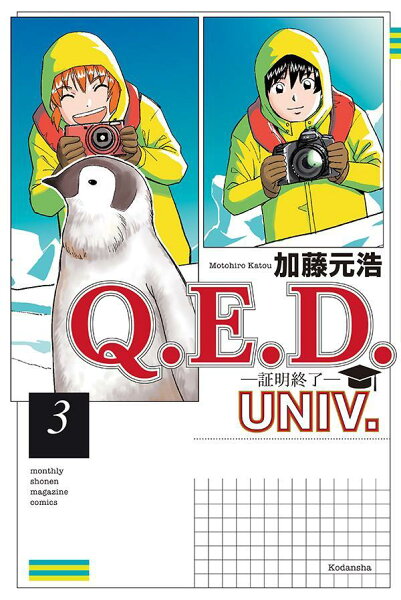
Q.E.D. Review — A 15-Year-Old MIT Graduate Solves Mysteries the Way Mathematicians Solve Proofs
by Motohiro Katou
Read the first volume. If it doesn't hook you, put it down. It'll hook you.
Buy Q.E.D. on Amazon →*Affiliate link — I earn a small commission at no extra cost to you.
I'm bad at math. I was never going to be the kid solving olympiad problems on a chalkboard. What I love about Q.E.D. is that it lets me feel, for the length of each chapter, like I'm sitting next to the kid who would have — and that he is patiently showing me how he does it.
That's a rare thing for a manga to do. Most "genius protagonist" manga ask you to be impressed. Q.E.D. asks you to follow along.
Quick Take
- The most intellectually rigorous mystery manga in current publication. Solutions are logical proofs, not dramatic reveals
- Touma Sou is a 15-year-old MIT graduate who returned to Japan for normal adolescence and got mysteries instead
- Age rating: T (Teen) — mystery violence and death are present but never graphic
Is Q.E.D. Available in English?
The short answer: mostly no. Only the first 2 volumes of the original 50-volume run were translated into English, by Del Rey in 2005–2006. The release stopped after volume 2 and the manga's intellectual register didn't find its market in the US at the time. Those 2 volumes are out of print and collectors' items.
No license has been confirmed for the remaining 48 volumes or for the sequel series Q.E.D. iff (2015–) and Q.E.D. UNIV. (2025–) as of 2026. For English readers who want to continue past volume 2, the practical options are reading in Japanese or relying on scanlation.
This is genuinely one of the great untranslated mystery manga. A future license remains possible but is not currently announced.
What Is Q.E.D. About?
Touma Sou is fifteen years old. He completed his undergraduate degree at MIT (Massachusetts Institute of Technology) and a master's-level project at age fourteen. He is, by any reasonable measure, one of the most gifted students MIT has ever produced. He could continue his graduate work. He could take a research position at any institution that would let him.
Instead, Touma returns to Japan and enrolls in a normal Tokyo high school. He wants the experience he never had — adolescence among peers, school clubs, lunch breaks, the rhythm of being a teenager. His parents, who do not appear in the manga, support this choice.
Touma's classmate is Kana Mizuhara, a cheerful, athletic, ordinary girl whose father is a police inspector. Kana befriends Touma immediately. Kana also has a strange property: she keeps finding herself near crimes. A murder at her uncle's company. A theft at a museum she's visiting. A locked-room mystery at a country inn. Touma, who cannot refuse a problem that needs solving, is dragged into each one.
The series unfolds across 50 volumes (plus the ongoing sequel Q.E.D. iff). Each volume contains 1–2 self-contained mysteries. The mysteries range from:
- Locked rooms (the genre's classic problem)
- Impossible alibis (everyone has one; everyone is wrong)
- Mathematical/logical puzzles (some volumes feature an actual proof or paradox as part of the case)
- Code-breaking (cryptography, hidden messages, mathematical sequences)
- Historical mysteries (cold cases, locked documents, generational secrets)
- Computer science / programming cases (Katou is the rare mystery writer who handles technical content correctly)
The title — Q.E.D. — is Latin for quod erat demonstrandum: "which was to be demonstrated." It is the phrase mathematicians traditionally write at the end of a completed proof. The Japanese subtitle is 証明終了 (shoumei shuuryou): "proof complete." The title is the manga's whole thesis. Touma does not solve mysteries through intuition. He proves the solution.
Honkaku Mystery: What That Means
Q.E.D. is one of the most committed examples of honkaku (本格, "orthodox") mystery fiction in current Japanese manga. The honkaku tradition has rules:
- All evidence must be available to the reader. The detective cannot solve the case using information the reader doesn't have
- The solution must be logically derivable. Intuition and coincidence are forbidden
- No supernatural elements. Everything must have a rational explanation
- The fairness rule — by the end of the case, the reader should theoretically have been able to reach the same conclusion as the detective
Motohiro Katou follows these rules with unusual strictness. Q.E.D.'s mysteries are puzzles for the reader as much as for Touma. Each case includes the moment — clearly marked — when all the necessary information has been provided and the reader is invited to solve the mystery before Touma reveals his proof.
This is rare in mystery manga. Most "mystery" manga (Detective Conan, Kindaichi Case Files) operate on a softer convention where solutions involve dramatic revelations. Q.E.D. is one of a small group (alongside parts of Detective School Q and some recent honkaku revival series) that holds to the strict tradition.
Who Is This Manga For?
- Mystery readers who like solving along
- Math/science enthusiasts who want their interests reflected in the fiction they read
- Detective Conan fans who want a more intellectually demanding alternative
- Honkaku tradition readers (Agatha Christie, Ellery Queen, John Dickson Carr) — Q.E.D. belongs in your library
- Self-contained chapter fans — each volume can be read alone
Content Warnings & Age Rating
Age Rating: T (Teen) — 13+ Content Warnings: Mystery violence (mostly off-page); occasional death (rendered without gore); some mathematical/logical content that may be dense for non-math readers; no sexual content; no profanity
The T rating is generous. Q.E.D. is one of the cleanest mystery manga in terms of content. The puzzles are the heaviest element.
Story Overview
The structure is episodic with light continuity. Each volume's mysteries are self-contained. The recurring characters (Touma, Kana, Kana's father Inspector Mizuhara, Touma's MIT acquaintances) develop slowly across the run.
Across 50 volumes, recurring patterns emerge:
- The Mizuhara Family arc: Cases involving Kana's father's investigations
- The Loki Touma arc: A pair of cases involving Touma's mysterious MIT classmate Loki — a recurring character with a tangential relationship to the manga's more elaborate plots
- The historical cases: Various mysteries set in or connecting to pre-modern Japan or historical Europe
- The mathematics-focused cases: Volumes where a specific theorem, paradox, or computation is integral to the solution
The series ended at volume 50 (2015). The sequel — Q.E.D. iff — picks up directly, with the same protagonists, and is ongoing.
Characters
Touma Sou — The rare manga genius whose intelligence is demonstrated rather than declared. Touma's reasoning is rendered on the page — readers can follow his thought process step by step. He is not socially perfect; he has the introvert's distance from ordinary teenage life, but Katou writes him as a real person rather than a savant stereotype. He has friends. He has interests outside math. He likes Kana, in the manga's gentle understated way.
Kana Mizuhara — Touma's classmate and the manga's emotional anchor. Athletic, cheerful, not academically brilliant in the way Touma is, but observant and morally clear in ways that often matter to the cases. Kana is not a damsel; she frequently provides the key observation that lets Touma close his proof. Their relationship is implicitly romantic across the long run but never made explicit; both characters remain teenagers throughout the original 50 volumes.
Inspector Mizuhara — Kana's father, a Tokyo Metropolitan Police inspector. The recurring official figure who provides Touma access to cases and the occasional warning about the line between solving mysteries and being a vigilante.
Loki Touma — An MIT classmate of Touma's who recurs across the series. Loki is a different kind of mind from Touma — more theatrical, more willing to manipulate the situation. His occasional appearances are some of the series' most memorable cases.
Art Style
Katou's art is clean, functional, and built for clarity rather than flourish. Character designs are distinguishable but not flashy. Action sequences (where they appear) are competent. The art's primary virtue is visual clarity in mystery scenes — when the manga needs to show a floor plan, a piece of evidence, a sequence of events, the panel composition delivers. This matters because Q.E.D. is fair-play mystery: the reader has to be able to see what Touma sees.
Some readers find the art dated (the manga ran from 1997 to 2015). The early volumes especially have a 1990s shoujo-magazine-adjacent style that has aged in specific ways. The art is consistent and serves the function it's built for.
Cultural Context
Motohiro Katou is a respected mystery manga author within Japanese honkaku circles. His other major work, C.M.B. Shinra Hakubutsukan no Jiken Mokuroku (2005–ongoing), uses a similar structure with a different protagonist (Shinra Sakaki, a 14-year-old who runs a museum) and occasionally crosses over with Q.E.D.
Q.E.D. ran in Monthly Shonen Magazine for 18 years (1997–2015). Its long run is a sign of its consistent niche audience — the manga never broke into Detective Conan-scale popularity, but it sustained a devoted readership across two decades.
The series engages with real mathematics and real computer science at a higher level than peer mystery manga. Several cases feature actual proof techniques, real algorithms, or real historical mathematical problems. Readers with math/CS backgrounds report that the technical content is correct — rare in mystery fiction.
What I Love About It
The chapter where Touma teaches Kana what a proof is.
I won't say which volume. Somewhere in the early run, after several cases where Touma has solved the mystery by "proving" his answer, Kana asks him to explain what he means by that. They are sitting in the school courtyard. Touma has nothing to draw with except his notebook.
What follows is a small lesson — six or seven pages — where Touma walks Kana through what a mathematical proof is, why it differs from a guess or a hypothesis, and what it means to be certain of something in a logical sense. He uses small examples. He draws diagrams. He does not condescend. Kana asks reasonable questions; Touma answers them as if she is capable of understanding, which she is, because his explanation is good.
By the end of the chapter, Kana understands what Touma means when he says he has proven a solution. The mystery genre's conventions — "the detective reveals the answer in a dramatic monologue" — have been quietly replaced by something more rigorous. The detective demonstrated the answer, and the reader (through Kana) saw the demonstration.
What I love is what this chapter does for the rest of the series. From this point on, every time Touma solves a case, the reader is meant to follow along in the same way Kana did — and the cases are constructed to make that following possible. The manga has invited the reader into the proof structure. The cases become collaborative rather than performative.
That's the gift Katou gave me as a non-math reader. I don't have Touma's mind. But Q.E.D. taught me, gently, what it might be like to think the way he thinks — for the length of a chapter — and that was a small but real expansion of what reading mystery manga can do.
What English-Speaking Fans Say
Q.E.D. has a small but devoted English-language fan community. The 2005–2006 Del Rey release built initial awareness, but stopped after only 2 volumes. Reddit and MAL discussions of the manga focus on:
- The intellectual rigor of the mysteries (universally praised)
- The slow-burn Touma-Kana relationship (loved by long-term readers, occasionally frustrating to new readers who want resolution)
- The fairness of the mystery construction (cited as exceptionally strict by honkaku fans)
- The art style (divisive; some readers find it dated)
The manga is consistently recommended in English-language threads about "mystery manga that respects the reader."
Memorable Scene ⚠️ Light Spoiler
The case involving the Goldbach conjecture.
Without spoiling specifics: somewhere in the middle volumes, Katou writes a case where the Goldbach conjecture — a famous unsolved problem in number theory — is integral to the mystery's solution. The case is not "Touma solves the Goldbach conjecture" (the conjecture remains unsolved as of 2026). The case uses the conjecture's structure to construct a coded message that has been hidden for decades.
What makes the case memorable is how Katou handles the math. He doesn't condescend. The conjecture is explained accurately. The properties Touma uses to crack the code are real properties. Readers with math backgrounds can verify the work. Readers without math backgrounds can follow Katou's careful explanation.
The case ends with Touma writing the equivalent of Q.E.D. on the chalkboard — proof complete. The case has been solved using real mathematics, in a real mystery manga, for a real reader audience. That moment is the manga's whole project in one chapter.
Similar Manga
| Title | Its Approach | How Q.E.D. Differs |
|---|---|---|
| Detective Conan | Long-running mystery manga, dramatic reveals | Conan is dramatic; Q.E.D. is rigorous. Detective Conan asks "who did it"; Q.E.D. asks "can you prove it" |
| Kindaichi Case Files | Locked-room mystery with gothic atmosphere | Kindaichi is theatrical; Q.E.D. is mathematical |
| Detective School Q | Group-of-students mystery, episodic | School Q is more ensemble; Q.E.D. is more procedural |
| C.M.B. Shinra (Katou's other series) | Same author, museum setting | Same authorial style, different protagonist; cross-overs exist |
Reading Order / Where to Start
Volume 1. Each volume is self-contained but the character relationships develop across the run.
For new English readers: the Del Rey volumes 1–2 give you a taste; beyond that, the rest of the series is currently only available in Japanese.
Official English Translation Status
Only 2 volumes of Q.E.D. were released in English (Del Rey, 2005–2006) before the line was discontinued. Those volumes are now out of print. The remaining 48 volumes of the original series, the sequel Q.E.D. iff, and Q.E.D. UNIV. have not been licensed in English as of 2026.
Pros & Cons
Pros
- One of the most intellectually rigorous mystery manga ever made
- 50 self-contained volumes — enormous content library
- Long-running, well-regarded across two decades in Japan
- Fair-play mysteries respect the reader's intelligence
- Touma is a well-constructed genius character
Cons
- The art is functional rather than flashy; some readers find it dated
- Character development is slow; the Touma-Kana romance never resolves on-page
- Some mathematical content may be dense for non-math readers
- The strictly logical, math-adjacent mystery style is an acquired taste. It won't land for everyone, especially readers who want dramatic reveals.
Is Q.E.D. Worth Reading?
If you have any interest in serious mystery fiction or in math/science as it appears in popular culture and you can read Japanese, yes. For English readers, the manga is currently only accessible as 2 out-of-print Del Rey volumes — a frustrating gap that may close in the future but hasn't yet.
Format Comparison
| Format | Notes |
|---|---|
| Physical English (Del Rey, 2005–2006) | Only volumes 1–2; out of print; collector's item |
| Japanese | All 50 volumes of the original series; sequels Q.E.D. iff (ongoing 2015–) and Q.E.D. UNIV. (2025–) available in Japan |
| English digital | Not currently licensed for volumes 3–50 or the sequels |
Where to Buy
No new English release yet. That just means you find it before everyone else does.
This post contains affiliate links. If you purchase through these links, I may earn a small commission at no extra cost to you. As an Amazon Associate, I earn from qualifying purchases.
*Affiliate link — I earn a small commission at no extra cost to you.
More Manga You Might Like

Action / Mystery
Detective School Q
Detective School Q follows Kyu Renjou, a boy with extraordinary observational instincts, as he enrolls in the legendary Dan Detective School — and alongside four classmates with extraordinary individual skills, works to become the school's first Q Class.

Action / Mystery
Ron Kamonohashi: Deranged Detective
Ron Kamonohashi is a brilliant detective whose deductions cause murderers to take their own lives. He can only work through Totomaru Isshiki, a young Tokyo detective whose physical intervention stops the deaths Ron's deductions set in motion. Akira Amano (Katekyo Hitman Reborn!) brings her eccentric character energy to mystery manga.

Action / Comedy
Assassination Classroom
Yu's review of Assassination Classroom — 21 volumes about a class of underachievers assigned to kill their alien teacher before he destroys the Earth. The funniest manga about murder, and the most moving manga about being seen by a teacher who refused to write you off.

Mystery / Thriller
Kindaichi 37-sai no Jikenbo
A review of Kindaichi 37-sai no Jikenbo — 18 volumes in Kodansha's Evening and Comic Days from January 2018 to November 2024. Hajime Kindaichi returns as a 37-year-old salaryman who cannot stop finding murder.

Action / Superhero
My Hero Academia
Yu's review of My Hero Academia — a superhero manga that asks a genuinely hard question: what does it cost to be the kind of person who saves others? Complete at 40 volumes, and one of the most emotionally layered shonen series of its generation.

Action / Comedy
Medaka Box
Yu's review of Medaka Box — Medaka Kurokami is elected student council president with 98% of the vote and wants to answer every student's problems using the school suggestion box; the manga begins as school comedy and transforms into a meta-commentary on shonen manga tropes.
Written by
Yu
Manga Enthusiast from Japan
I grew up in Japan and manga literally saved me during a tough time in elementary school. My English isn't perfect, but my love for manga is real — and I want to share it with you.
Disclosure: This post contains affiliate links. As an Amazon Associate, I earn from qualifying purchases at no extra cost to you.