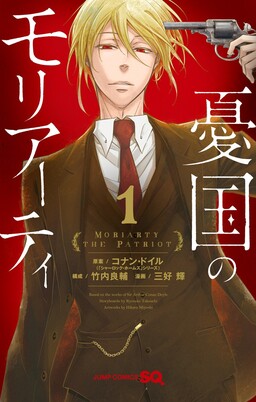
Moriarty the Patriot Review — A Villain Whose Moral Logic You'll Have to Argue With
by Ryousuke Takeuchi / Hikaru Miyoshi
Read the first volume. If it doesn't hook you, put it down. It'll hook you.
Buy Moriarty the Patriot on Amazon →*Affiliate link — I earn a small commission at no extra cost to you.
I went to a Sherlock Holmes exhibit in Tokyo a few years ago. There was a corner dedicated to Moriarty, mostly Doyle's brief original sketches — a few lines about a "Napoleon of crime" and not much else. That's all Doyle gave us. A name, a reputation, a death at the Reichenbach Falls.
Moriarty the Patriot is what happens when two manga authors decide that empty space is the most interesting thing in the canon. They fill it with a person.
Quick Take
- Sherlock Holmes's archenemy reimagined as the protagonist — and the reframe is taken seriously enough that you'll have to actually argue with his ideology, not just dismiss it
- Part 1 is complete; Part 2 began serialization in Jump Square in December 2024 — VIZ is on volume 18 in English
- Age rating: T (Teen) — themes are dark (murder, class violence) but visual content is restrained
What Is the Age Rating for Moriarty the Patriot?
Viz Media rates the English release T (Teen) — 13+, and that rating is accurate.
What's in the manga:
- Murder, frequently: William engineers deaths throughout the series, but the violence is almost always implied or off-panel. People fall, are shot in silhouette, or die in ways the panel cuts away from
- Thematic darkness: the series depicts Victorian class abuse — including the abuse of orphans, the exploitation of the poor by aristocrats, and the corruption of officials — directly enough that younger readers may find it heavy
- No sexual content: there are romantic undertones around several characters but nothing explicit
- Some action violence: the later volumes have proper fight scenes between Holmes, Moriarty, and antagonists. These are kinetic but not graphic
Compared to other Jump Square titles, Moriarty the Patriot is roughly on par with Black Butler in tone and significantly less graphic than Tokyo Ghoul. Most 13+ readers can handle it. Younger readers may struggle with the moral weight rather than the visual content.
For parents/teachers: the actual question with this series is whether your reader can sit with the idea that a charismatic, sympathetic protagonist is also a serial murderer with an ideology — and whether they're ready to argue with him.
Plot Summary: What Is Moriarty the Patriot About?
William James Moriarty and his brother Louis are orphans. A noble family — the Moriartys — adopts them, along with another orphan, Albert. The adoption isn't an act of charity. It's a calculated move by the Moriarty patriarch, who wants intellectual heirs to make up for his disappointing biological son.
William sees the noble family from inside: their cruelty toward staff, their casual abuse of the orphans they brought in, the systematic violence of the British class hierarchy. He makes a decision. The class system will not be reformed. It will be destroyed.
His method is intelligence. He constructs elaborate scenarios where the people who benefit from class abuse — aristocrats who exploit tenants, officials who take bribes, men whose status shields them from consequence — die in ways that look accidental, suicidal, or unsolvable. Their deaths look like justice from below. They are, in fact, William Moriarty.
The series follows three phases:
- The Moriarty operation builds — William, his brother Albert, and his brother Louis assemble a network. Cases are episodic. Each case is one piece of London corruption William removes
- Sherlock Holmes arrives — a young detective with the same observational gift as Moriarty, who immediately notices that someone deliberate is behind a pattern of impossible deaths
- The endgame — William's actual long-term plan reveals itself, and it is bigger and stranger than the reader expected. The series builds toward the bridge scene Doyle promised over a century ago
Sherlock Holmes in Moriarty the Patriot
Holmes shows up in volume 5. He arrives differently than the Doyle version — younger, more chaotic, with a violin and a roommate problem and a brilliant mind that has been waiting for an actual opponent.
The manga makes a specific choice about Holmes that I think is the right one: he is treated as Moriarty's equal in observation. He sees what William sees. He understands the class system, the corruption, the way Britain works. He has chosen a different response. The series is not "good detective vs evil mastermind." It's "two people with the same diagnosis arguing about the cure."
Their first real meeting — on the Noahtic, a luxury ship where a case has been engineered — is the moment the series locks. Holmes is the one passenger who realizes the case is being arranged from behind the scenes. He looks across the deck, sees a young man watching him, and the recognition is mutual.
The other Holmes brother: this manga includes Mycroft Holmes (canon) and adds Sherrinford Holmes, an eldest Holmes brother Doyle never confirmed but who appears in some Sherlockian apocrypha. Sherrinford in this manga is a House of Lords figure, embedded in the establishment Moriarty wants to dismantle. His existence adds a Holmes-family political layer that Doyle never wrote.
Who Is This Manga For?
- Sherlock Holmes fans who want a fresh angle on the canon without a cynical inversion
- Readers who like morally complicated protagonists — William is not redeemed and not condemned
- Historical fiction fans who appreciate Victorian England rendered with actual texture
- Completionists — Part 1 (the original main story) reaches a real ending; Part 2 is a continuation that just began
Content Warnings & Age Rating
Age Rating: T (Teen) — 13+ Content Warnings: Murder as a political method (frequent, mostly off-panel); Victorian class abuse depicted directly; orphans abused by aristocrats (foundational backstory); the series asks whether ideologically motivated killing is justifiable and refuses to give a clean answer
Story Overview
The series structures itself in three movements that I'll lay out without spoiling the specific events.
Volumes 1–4 are William's operation building. We see his backstory — the adoption by the original Moriartys, what he did at age fourteen that established who he was going to be, the assembly of his crew (Albert in MI6, Louis managing the estate, Sebastian Moran as enforcer, Fred Porlock as their face in society). Cases are stand-alone moral problems: each villain is unpunishable by law, and William finds a way to remove them.
Volumes 5–9 are the Holmes-Moriarty period. The series gains a second protagonist whose perspective is fundamentally different. Holmes investigates cases William has engineered. The two men begin to read each other. The middle of the series is, in some ways, an extended chess game — but the stakes aren't just winning, they're whether William's plan will succeed before Holmes can stop him.
The final arc is the endgame. William's real plan emerges. It is not "destroy aristocrats one by one." It is something larger and more theatrical — a single act designed to permanently change British society. The cost he has calculated to himself is total. The series moves toward the Reichenbach equivalent Doyle promised, and it gets there with weight.
Characters
William James Moriarty — The protagonist's most distinctive feature is that he is right about everything he observes and wrong about exactly one fundamental thing. The series lets him be right. It also shows what being right costs him as a person — what he does to himself by becoming the agent of the world he wants to make. His final volumes are some of the loneliest writing in manga.
Sherlock Holmes — Younger, more chaotic, more emotional than Doyle's. He arrives at observations through bursts of pattern recognition rather than William's cold construction. He's also the one character in the series who can read William without being defeated by him. The friendship-rivalry that develops is the manga's emotional spine.
Albert James Moriarty — The older adopted brother. Operates inside MI6, providing William with intelligence and cover. Albert's role is morally the most uncomfortable: he believes in William's vision, but he also enables crimes William commits. He carries the question "if you believe the ends justify the means, why aren't you the one with the knife?"
Louis James Moriarty — The younger biological brother who manages the estate and the household. Often quiet, frequently the moral conscience of the operation. The series treats him with care; some of its best small character moments are about Louis.
Sebastian Moran, Fred Porlock, Jack Renfield — William's operational crew. Each gets their own backstory arc. Moran in particular gets weight.
Sherrinford Holmes — The eldest Holmes brother (apocryphal in Doyle, present in this manga). A House of Lords figure who is one of the institutions William's plan targets.
Art Style
Hikaru Miyoshi's art is precise and restrained. Victorian London is rendered with enough specificity that period readers can identify specific London locations, but Miyoshi doesn't overload panels. Character designs are expressive without exaggeration — William, Albert, Louis, and Holmes are all visually distinct and visually compelling. The series uses two-page spreads with discipline; when one appears, it's for a moment the series has earned.
Cultural Context
Conan Doyle wrote Moriarty into existence to kill Sherlock Holmes. Moriarty appears in only two original stories. He is more a function than a character. Takeuchi and Miyoshi take that emptiness and ask: what kind of person would have to exist to be Sherlock Holmes's mirror?
The Victorian England they construct is the real one — class abuse documented in Engels, the specific texture of London poverty, the rigidity of the House of Lords as an institution. This is not steampunk pastiche. It's research-driven historical fiction wrapped around a Doylean premise.
What I Love About It
The bridge scene at the end. I won't tell you what happens on it — anyone who knows the Doyle canon already knows the rough shape — but the way this manga arrives at the bridge is one of the things I keep thinking about.
The series has spent many volumes positioning William as someone who has calculated everything. His plan, his costs, his ending. Holmes, meanwhile, has spent many volumes becoming the only person in the world who can read William entirely. The bridge scene is what happens when those two facts collide.
What's specifically beautiful is what William says before the moment that the audience has been waiting for. It's a line about being seen. Not about ideology, not about justice, not about Britain. About being seen by one specific person, finally, after a life spent making himself unreadable to everyone else. Holmes says one thing back. It is correct in the way only the right reader's response can be correct. And then the panel turns.
That's why this manga is great. It spent many volumes building a protagonist whose entire structure was "I am alone because I have to be," and then it earned a moment where he isn't.
What English-Speaking Fans Say
Western Sherlock Holmes fans, in particular, take this manga seriously. The Doyle Society and Sherlockian communities have engaged with it in essay-length analyses. The general consensus in English manga spaces is that it's one of the best villain-protagonist series of the last decade and that the ending sticks the landing.
The most common complaint is pacing — the early volumes are episodic and some readers find them slow before Holmes arrives. Once Holmes is in, the series has very few detractors.
Memorable Scene ⚠️ Spoiler Warning
The Whitely / White Knight Case in volume 4. William, having just removed a particularly cruel aristocrat, is confronted by his brother Louis with a question. Louis asks, gently, whether William believes he will be punished — by God, by history, by himself — for what he is doing. The series has been building toward this question.
William answers. He doesn't ask for forgiveness. He doesn't claim he is morally clean. He says he expects to be condemned and that he has accepted the condemnation as part of the cost. Louis listens. Louis does not absolve him.
The panel composition during this conversation is what makes it. William is framed in shadow. Louis is framed in lamplight. The series is showing you, visually, that the moral weight of the operation is not equally distributed. William has chosen to be the one who bears it, and Louis is the one watching him bear it.
That scene is the moral architecture of the series in one conversation. The bridge scene at the end is the consequence of this conversation, played out in full.
Similar Manga
| Title | Its Approach | How Moriarty the Patriot Differs |
|---|---|---|
| Monster (Urasawa) | A morally complex antagonist hunted across Europe | Monster is psychological horror; Moriarty is political tragedy. Different registers, similar moral weight |
| Bungou Stray Dogs | Literary historical figures recontextualized | BSD is a battle-shonen with literary cameos; Moriarty is serious historical fiction with battle-shonen craft |
| Black Butler | Victorian England with mystery and aristocracy | Black Butler is gothic and ironic; Moriarty is sincere and political |
Reading Order / Where to Start
Volume 1. The Moriarty backstory is laid out from the beginning and you need it to understand what William becomes.
Official English Translation Status
Viz Media has published 18 volumes in English in print and digital as of 2026, with remaining Part 1 volumes scheduled through 2026. Part 1 of the manga has reached its ending. Part 2 began serialization in Jump Square in December 2024 and continues; no English license for Part 2 has been announced yet.
Pros & Cons
Pros
- One of the best villain-as-protagonist series in current manga, full stop
- Holmes is handled with care and earns his arrival
- Genuinely engages with the historical period rather than using it as wallpaper
- The ending lands; many volumes of buildup pay off
Cons
- The first 3–4 volumes are episodic and some readers want Holmes immediately
- Moral ambiguity is the point — readers who want clear right and wrong won't find it
- The Doyle canon adds depth but isn't required; non-Holmes readers may miss some references
Is Moriarty the Patriot Worth Reading?
Yes. Especially if you have any interest in Sherlock Holmes or in morally complex protagonists. The series takes a one-line villain from a century-old story and builds a person around him who you will argue with after closing the last volume.
Format Comparison
| Format | Notes |
|---|---|
| Physical (Viz) | 18 volumes available in English as of 2026. Standard tankoubon size |
| Digital | Available via Viz Media and major digital storefronts |
| Omnibus | Not available |
Where to Buy
Read the first volume. If it doesn't hook you, put it down. It'll hook you.
This post contains affiliate links. If you purchase through these links, I may earn a small commission at no extra cost to you. As an Amazon Associate, I earn from qualifying purchases.
*Affiliate link — I earn a small commission at no extra cost to you.
More Manga You Might Like
Mystery / Historical
Young Miss Holmes
A review of Young Miss Holmes, the manga about Christie Holmes — Sherlock's clever niece — who solves mysteries in Victorian London.

Action / Historical
The Elusive Samurai
A review of The Elusive Samurai by Yusei Matsui, following a young noble who survives the fall of the Kamakura shogunate through unmatched evasion skills.
Action
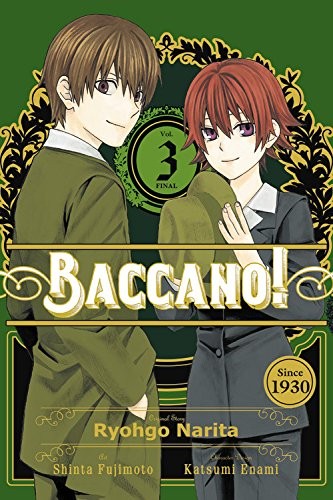
Baccano!
A review of the Baccano! manga by Shinta Fujimoto — the 3-volume Young Gangan adaptation of Ryohgo Narita's Grand Punk Railroad arc, where immortals, gangsters, and a bloody urban legend collide aboard the 1931 Flying Pussyfoot express.

Action / Comedy
Zom 100: Bucket List of the Dead
A review of Zom 100: Bucket List of the Dead — 15 volumes in Monthly Sunday GX. Akira Tendo spent three years being worked to death at a black company; when the zombie apocalypse starts, his first thought is relief that he doesn't have to go to work; he makes a list of 100 things to do before becoming a zombie. The most original zombie premise in years. VIZ Media's English edition is complete.

Action / Historical
Vagabond
Yu's review of Vagabond — a manga about the historical Miyamoto Musashi's journey to become the greatest swordsman alive, and his gradual understanding that invincibility is not the same as wisdom. Visually the most beautiful manga ever published.

Action / Fantasy
Sengoku Youko
Yu's review of Sengoku Youko — in Sengoku-era Japan, a powerful spirit girl travels with a timid human boy seeking to create a world where humans and youkai can live in peace.
Written by
Yu
Manga Enthusiast from Japan
I grew up in Japan and manga literally saved me during a tough time in elementary school. My English isn't perfect, but my love for manga is real — and I want to share it with you.
Disclosure: This post contains affiliate links. As an Amazon Associate, I earn from qualifying purchases at no extra cost to you.