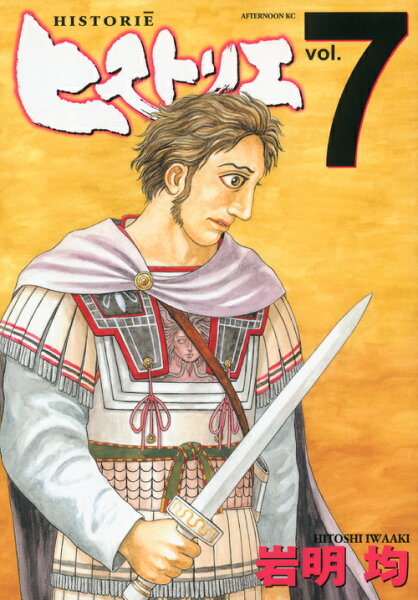
Historie Review — Hitoshi Iwaaki's Ancient Greek Epic About the Slave Boy Who Became Alexander the Great's Secretary
by Hitoshi Iwaaki
Read the first volume. If it doesn't hook you, put it down. It'll hook you.
Buy Historie on Amazon →*Affiliate link — I earn a small commission at no extra cost to you.
I have been reading Historie since I was a teenager. I read each new volume when it comes out, every two or three years, and I have learned to be patient with the gaps. Hitoshi Iwaaki is over 60 years old. He works slowly. He has said publicly that he intends to finish the manga but cannot promise when.
This is one of the great works of historical manga. It is also one of the most patience-testing reading experiences in current publishing. Both things are true.
Quick Take
- Hitoshi Iwaaki's ongoing historical epic (2003–present). 12 volumes in over 20 years. Iwaaki is the creator of Parasyte
- About Eumenes of Cardia — the real historical figure who served as personal secretary to Alexander the Great and became one of the Diadochi (Successors) after Alexander's death
- Age rating: M (Mature) — graphic violence, slavery depicted realistically, sexual content, ancient-world atrocities
What Is Historie About?
Eumenes of Cardia (エウメネス) was a real Greek figure born around 362 BCE. Historical sources record him as Macedonian King Philip II's secretary, then Alexander the Great's chief personal secretary (γραμματεύς), and later one of the Diadochi who fought over Alexander's empire after the conqueror's death in 323 BCE. He was known for his unusual social position — a Greek (not Macedonian) at Macedonia's highest court, a man of letters in a culture that prized military prowess.
Historie is Iwaaki's fictional treatment of Eumenes' life from childhood through (eventually, presumably) his service to Alexander and beyond.
In Iwaaki's version:
- Eumenes is born to a wealthy Cardian family
- A series of revelations in adolescence reveal that he is actually adopted — born to Scythian slaves. He has been raised as a Greek nobleman but is genetically a barbarian by Greek standards
- The discovery shatters Eumenes' social position. He becomes a slave himself, then escapes, then begins building a new life using his extraordinary intelligence
- The manga's current published volumes (1–12) cover his childhood, the discovery of his origins, his years as a slave and then a free traveler, his time at Philip II's court in Macedonia, and his initial encounters with the young Prince Alexander
The Eumenes Iwaaki writes is a genius. His intelligence is not generic protagonist competence — it is specific, observational, multilingual, mathematical. Iwaaki shows Eumenes thinking. The manga's most affecting sequences are often Eumenes working through a problem (military strategy, political maneuvering, personal crisis) with the reader watching his reasoning unfold across panels.
The young Prince Alexander appears around volume 6 onward. Iwaaki's Alexander is psychologically complex — possibly bipolar, possibly something else, certainly not a simple historical hero. The Eumenes-Alexander relationship that the manga is slowly developing is the work's emotional engine.
Why Is Historie So Slow?
This is a top question among manga readers, so let me address it.
The publication pace:
- Started 2003 in Monthly Afternoon
- 12 volumes in 23 years averages out to about one volume every two years
- The schedule was originally monthly but became bi-monthly around 2013
- Long hiatuses (sometimes 6+ months) are now standard
- Iwaaki has stated publicly that he works slowly because he wants the work to be "right"
The reasons:
- Hitoshi Iwaaki is over 60 years old and works with deliberate slowness
- The manga requires extensive historical research that Iwaaki conducts personally
- Each volume's art is drawn with full attention; Iwaaki does not employ a large assistant team
- The author has cited health issues at various points
- The manga's complexity (multiple languages, real history, large cast) demands time
For new readers: the current 12 volumes are 23 years of work. Each volume is substantial. The investment per volume is real. Whether the manga will conclude is uncertain; Iwaaki has indicated he intends to finish but has not committed to a timeline.
The January 2026 announcement of a TV anime adaptation has generated renewed interest in the manga and may push publication slightly. The adaptation's release date is not yet confirmed.
Who Is This Manga For?
- Historical fiction readers with patience for slow-developing epics
- Hitoshi Iwaaki fans — Parasyte readers who want his other masterwork
- Ancient history enjoyers — the manga is the most historically literate manga about Alexander's era currently in print
- Kingdom / Vinland Saga readers who want even more grounded historical material
- Readers comfortable with bi-annual publication and a possibly unfinished series
Content Warnings & Age Rating
Age Rating: M (Mature) — 18+ Content Warnings: Graphic violence including battles, executions, and the realistic violence of the ancient world; slavery depicted with historical accuracy (Eumenes is enslaved for a portion of the manga); sexual content including some involving teenagers in period-appropriate context; depictions of antiquity-era cruelty (pirates, war atrocities, ritual violence)
The M rating is earned. Iwaaki does not sanitize the ancient world.
Characters
Eumenes of Cardia — The protagonist whose specific quality is observational intelligence applied to historical circumstances. Iwaaki writes him as the reader's anchor in a foreign and violent world. Eumenes is not a warrior protagonist; he is a clerk, a translator, a tactician, a man whose primary weapon is his mind. The manga's most affecting moments are often Eumenes thinking visibly on the page.
Hieronymus (ヒエロニュモス) — Eumenes' childhood friend and adopted brother in his Cardian family. The relationship between them is the manga's primary early emotional thread.
Philip II of Macedon — The historical king. Iwaaki's depiction is faithful to historical sources while filling in psychological detail. Philip's recognition of Eumenes' intelligence becomes the engine of Eumenes' rise.
Alexander (the Prince) — Iwaaki's most ambitious character. Alexander appears as a young teenager who is clearly going to become one of history's greatest figures, and who is also clearly disturbed in specific ways the manga is slowly unpacking. The Alexander-Eumenes relationship is being built carefully.
Recurring secondary cast — Various Macedonian nobles, slaves, soldiers, and political figures who populate Eumenes' world. Iwaaki distinguishes them with care; the cast is large but manageable.
Art Style
Hitoshi Iwaaki's art is deliberately uncommercial and visually distinctive. The character designs lean toward realism with specific stylistic choices that some readers find off-putting at first. Eumenes' face has been drawn with the same specific shape for 12 volumes; readers learn to read his expressions across that face.
The historical detail is exceptional. Costumes, architecture, weapons, ships, and military formations are rendered with research-based accuracy. The manga's battle sequences (rare but significant) are drawn with attention to actual ancient combat methods.
The pacing of Iwaaki's panels is unusually patient. The manga lets scenes breathe in ways most action manga do not. This is part of what makes the slow publication pace feel justified; the manga is dense per page in ways that reward re-reading.
Cultural Context
Hitoshi Iwaaki is one of the most respected manga creators of his generation. Parasyte (寄生獣, 1988–1995, 10 volumes) is his most famous work — a horror manga about alien parasites that infect humans, widely considered one of the greatest sci-fi horror manga ever made. Parasyte ranks alongside Devilman, Akira, and Berserk in the canon of essential seinen.
Historie is Iwaaki's stated "masterwork" — the project he has been building toward across his career. He moved to Historie shortly after completing Parasyte. He has indicated in interviews that he intends Historie to be his final major work.
The manga's status as "the unfinished masterpiece" has been a fact of Japanese manga discourse for over a decade. The community has accepted that Historie will be completed when it is completed, if it is completed.
What I Love About It
The Sinope sequence.
I won't spoil specifics. Somewhere in the early-to-middle volumes (after Eumenes has been enslaved and is now traveling), the manga takes Eumenes to Sinope, a major Greek city-state on the Black Sea coast. Eumenes spends several volumes in this city, building a new life, demonstrating his intelligence in ways that change the trajectory of his story.
The Sinope sequence is what Historie is at its best. The city is rendered with documentary care. The political dynamics are historically grounded. Eumenes' specific maneuvering — figuring out who in the city to ally with, how to demonstrate his usefulness, what to conceal about his origins — is shown rather than told. We watch him think. We watch him observe. We watch him make decisions.
What I love about this sequence is what Iwaaki refuses to do. He could turn Eumenes' rise into a fantasy of competence — the genius outsider triumphs against the small-minded establishment. Instead, Iwaaki shows the actual work: the small steps, the wrong turns, the alliances that don't pay off, the patient accumulation of social capital that someone in Eumenes' position would have actually had to do. The manga respects Eumenes' intelligence enough to show it as labor rather than as magic.
I have read this sequence multiple times. It rewards re-reading. There are details in the Sinope volumes that I noticed only on the third or fourth pass — small visual setups for plot turns that arrive volumes later.
That is the gift of Historie. It is dense in a way most current manga is not. Each volume is fewer pages than most modern manga and is doing more work per page. The slow publication is part of how it can be that dense; Iwaaki is taking the time to make every panel matter.
I will keep reading Historie for as long as Iwaaki keeps publishing it.
What English-Speaking Fans Say
Historie has a small but extremely devoted English-language fan base. Kodansha Comics' release of the manga (currently 11 volumes in English) brought the work to a wider audience after years of fan-translation-only access. English manga critics consistently rate Historie among the best seinen of the 21st century.
The most common discussion in English fan spaces: the publication pace and whether the manga will finish. The community has largely accepted the bi-annual schedule. The January 2026 anime announcement has renewed hope for both publication acceleration and adaptation.
Memorable Scene ⚠️ Light Spoiler
Eumenes' first private conversation with young Alexander.
The manga has been building toward this meeting for many volumes. Eumenes has arrived at Philip II's court. Alexander is a teenager — by all reports brilliant, troubled, intermittently terrifying. The reader knows what Alexander will become. The manga has been preparing the reader for who he is.
Their first sustained conversation — the moment when Eumenes and Alexander actually talk to each other rather than passing each other in the court — is one of the manga's quietest set pieces. Iwaaki draws it with care. No swords. No politics. Two intelligent young men talking about something specific.
What makes the scene work is what Eumenes notices about Alexander. The prince is not stable. The prince has something inside him that will, the historical record confirms, eventually conquer most of the known world. Eumenes sees it. He sees enough to know what he is in the room with.
The manga then cuts away. The next chapter continues other business. The meeting Eumenes had with Alexander has happened and is over and the manga refuses to dramatize it further. The reader is left with the small significant moment, and the knowledge that this is the beginning of a relationship that will define both men's lives.
That restraint is Iwaaki at his best. The future is enormous. The past is enormous. The present moment is two people in a room having a conversation that quietly mattered. The manga trusts us to feel the weight without underlining it.
Similar Manga
| Title | Its Approach | How Historie Differs |
|---|---|---|
| Vinland Saga (Yukimura) | Historical epic, Viking era | Vinland is more violent and faster-paced; Historie is more cerebral |
| Kingdom (Hara) | Historical epic, Warring States China | Kingdom is more action-driven; Historie is more political |
| Berserk (Miura) | Dark fantasy with similar slow pacing | Berserk is fantasy; Historie is history. Same patience |
| Parasyte (Iwaaki) | Same author, horror | Parasyte is shorter and contemporary; Historie is the lifetime project |
Reading Order / Where to Start
Volume 1. The 12 volumes form a continuous narrative; do not skip.
For Iwaaki newcomers: read Parasyte (10 volumes, complete) before Historie. Parasyte is a stronger introduction to Iwaaki's craft and the contained narrative allows you to evaluate whether you want to commit to Historie's open-ended structure.
Official English Translation Status
Kodansha Comics publishes Historie in English. As of 2026, 11 volumes are available in English; volume 12 (the most recent Japanese release) is pending English release. The Kodansha edition is well-produced.
Parasyte is fully available in English (10 volumes, complete) from Kodansha Comics.
The January 2026 anime adaptation has been announced but no release date is confirmed.
Pros & Cons
Pros
- One of the great historical manga of the 21st century
- Iwaaki's craft is at its peak
- Eumenes is one of seinen's most carefully written protagonists
- The historical detail is research-based and respect-worthy
- Kodansha's English translation is high quality
Cons
- Bi-annual publication pace; may never conclude
- 12 volumes in 23 years is a real reader commitment
- Slow even by historical-fiction standards
- The deliberate, dense pacing is an acquired taste. It won't land for everyone, especially readers used to faster manga.
Is Historie Worth Reading?
Yes — if you can accept the pace. The 12 published volumes are among the best in current seinen publishing. The unfinished status is genuinely concerning but the journey so far is worth the time.
For impatient readers: wait for completion (which may be never) or skip.
Format Comparison
| Format | Notes |
|---|---|
| Physical (Kodansha Comics) | 11 volumes available in English; volume 12 pending |
| Digital | Available via Kodansha digital, Kindle |
| Japanese | 12 volumes available in Japan |
| Anime | Announced January 2026; no release date |
Where to Buy
Read the first volume. If it doesn't hook you, put it down. It'll hook you.
This post contains affiliate links. If you purchase through these links, I may earn a small commission at no extra cost to you. As an Amazon Associate, I earn from qualifying purchases.
*Affiliate link — I earn a small commission at no extra cost to you.
More Manga You Might Like

Action
Baccano!
A review of the Baccano! manga by Shinta Fujimoto — the 3-volume Young Gangan adaptation of Ryohgo Narita's Grand Punk Railroad arc, where immortals, gangsters, and a bloody urban legend collide aboard the 1931 Flying Pussyfoot express.

Action / Drama
Rainbow: Nisha Rokubō no Shichinin
Yu's review of Rainbow — six juvenile delinquents are sent to a brutal reformatory in 1955 Japan and placed in Cell 6, where they bond with their cellmate Rokurouta Sakuragi, a former boxer who teaches them what it means to survive with dignity.

Action / Drama
Young Black Jack
A review of Yoshiaki Tabata and Yugo Okuma's Young Black Jack — 16 volumes in Weekly Young Champion. Young Hazama Kuroo — the future Black Jack — as a medical student in 1960s Japan, performing extraordinary surgeries in an era of political upheaval and moral complexity. No official English edition.

Action / Historical
Souten Kouro
A review of Souten Kouro, the manga about the Three Kingdoms era that makes Cao Cao the protagonist — the villain of most versions — and argues he was the era's greatest mind.

Historical / Drama
Samurai Executioner
Yu's review of Samurai Executioner — set in Edo-period Japan, this seinen series follows the official executioner of Edo as he navigates his role at the edge of society and justice.

Action / Historical
The Elusive Samurai
A review of The Elusive Samurai by Yusei Matsui, following a young noble who survives the fall of the Kamakura shogunate through unmatched evasion skills.
Written by
Yu
Manga Enthusiast from Japan
I grew up in Japan and manga literally saved me during a tough time in elementary school. My English isn't perfect, but my love for manga is real — and I want to share it with you.
Disclosure: This post contains affiliate links. As an Amazon Associate, I earn from qualifying purchases at no extra cost to you.