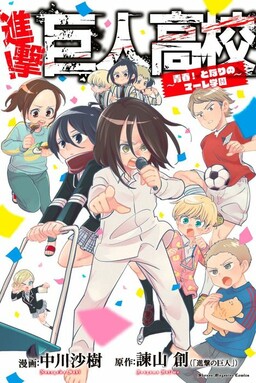
Attack on Titan: Junior High Review: The Parody Where Eren's Real Enemy Is a Stolen Cheeseburger
by Saki Nakagawa (original by Hajime Isayama)
Read the first volume. If it doesn't hook you, put it down. It'll hook you.
Buy Attack on Titan: Junior High on Amazon →*Affiliate link — I earn a small commission at no extra cost to you.
I read Attack on Titan during a stretch of my life when I was reading nothing but heavy things. Isayama's main series was relentless — people I cared about kept dying in the time it took to turn a page, and I needed a break from it without leaving the world behind. That's how I found Junior High. I picked up the first omnibus expecting a cheap cash-in. Instead I laughed out loud on the train, alone, at a panel of Eren screaming at a wall because a Titan ate his lunch. I'm a little embarrassed by how much I needed that.
What surprised me is that the joke only lands if you love the original. This isn't a parody that mocks Attack on Titan. It's a parody that knows it so well that it can rebuild every grim beat as a school gag and have it click. Saki Nakagawa drew this with the source material open on the desk, and you can feel it.
Quick Take
- An official parody that works because it translates the main series accurately — every dark element of Attack on Titan has a school equivalent that lands as a joke
- Eren's stolen cheeseburger replacing his murdered mother is the central gag, and it keeps paying off across all 5 English omnibus volumes
- Pure fan comedy for Attack on Titan readers — rated T (Teen), much lighter than the source
Story Overview
Eren Yeager and Mikasa Ackerman enter Titan Junior High, a school where humans and Titans share the same campus, separated into two divisions. The catch: the Titans keep eating the humans' lunches. On Eren's first day, the Colossal Titan — who is also the school principal — eats his cheeseburger right in front of him. In the main series, the Colossal Titan kicking down Wall Maria leads to Eren's mother being eaten. Here, the exact same silhouette towers over the school and takes a cheeseburger steak instead. That swap is the entire engine of the book.
So Eren declares war. His main-series rage — "I'll destroy every last one of them" — survives intact, just redirected at lunch thieves. He and Armin found a secret, unapproved club to fight back, which is the school version of the Survey Corps being a doomed military branch nobody respects. Over the run, the gags move through the standard school calendar: a sports day, a fireworks festival, a culture festival, a human-versus-Titan volleyball match, even a Titan rock band. Nothing has stakes, and that's the point — Nakagawa takes a series defined by stakes and removes every one of them.
The structure isn't a single plot so much as a loop: a main-series tragedy gets identified, then defused into a gag. The pleasure is recognition. You spend the whole book going "oh, that's the that scene," and the precision of the translation is the joke.
Characters
Eren Yeager keeps his entire personality and loses his entire reason for it. He's still hot-blooded, still screaming about freedom and revenge, still ready to throw himself at a Titan twenty times his size — except now it's over a cheeseburger. The comedy is that nothing about how he acts changes; only the cause shrinks to nothing.
Mikasa Ackerman retains her superhuman strength and her single-minded devotion to Eren, here reframed as a middle-school crush she's in deep denial about. Separated from Eren, she gets visibly depressed. Her arc is the romance the main series never had time for, played for gentle laughs.
Levi is the standout. In the main series he's humanity's strongest soldier, a figure of terrifying competence. In Junior High he's a third-year who runs the secret underground Survey Club and is reputed to be the strongest man in the world — able to knock out a Titan with one slap of a paper fan (harisen). His canonical cleaning obsession is dialed up into a full personality: he breaks into people's rooms over untidiness and punishes anyone who fails to sort the trash.
Sasha Blouse finally gets to be the glutton with no consequences. In the original, her appetite is tragic background texture; here, in a world where nobody dies, she's free to spend the whole series thinking about food. Armin stays the sickly tactician, often drawn with a futon over his head, still doing strategic analysis — now for lunch-recovery operations.
What I Love About It
The thing I keep coming back to is the cheeseburger swap, because it's a real piece of craft, not a lazy gag. Nakagawa identified the single most traumatic image in Attack on Titan — the Colossal Titan's hand appearing over the wall, the moment everything goes wrong for Eren — and asked: what if the worst thing it took was lunch? The principal being the Colossal Titan, the lunch being a cheeseburger steak Eren actually cares about, his vow of revenge surviving word-for-word — every layer maps cleanly onto a scene I'd read as horror.
What makes it more than a one-line joke is that it commits. Eren's lunch-rage carries the same intensity as his main-series death-rage, and the disproportion never stops being funny because Nakagawa never lets Eren in on it. He is dead serious about a cheeseburger for five omnibus volumes. That sustained straight-face is the whole reason the book works, and it's why I trust this parody more than the dozens of unofficial ones — it understood the original well enough to keep the engine and only swap the fuel.
Memorable Scene ⚠️ Spoiler Warning
The cheeseburger rescue. The Colossal Titan principal opens the roof of the gym, and it's revealed that the school itself is sitting inside the principal's lunchbox — he lifts the lid like a god and takes the cheeseburger stand. Eren, refusing to lose his lunch a second time, gets himself swallowed going after it. His classmates watch in horror as he disappears into the Titan's mouth.
Then the Titan spits him back out — and Eren stands up, battered, holding one rescued burger over his head in triumph. It's a direct, deliberate parody of the main series' most shocking reveals about what's inside Titans, rebuilt so the only thing at stake is whether a twelve-year-old gets his lunch back. I remember laughing and also being a little impressed at how exactly it traced the shape of a scene that, in the original, had made my stomach drop.
Pros & Cons
Pros
- The translations of Attack on Titan's darkest beats into school gags are consistently, surgically clever
- Characters stay recognizable — Levi, Sasha, and Mikasa get more room, not distorted versions
- Genuinely funny rather than just referential
- Complete and self-contained at 11 Japanese volumes / 5 English omnibus
Cons
- It does not function at all without Attack on Titan familiarity — every joke is a reference
- No standalone story; the structure is a loop of gags, not an arc
- Some running gags repeat past their welcome
- This is fan comedy first — if you wanted any of the original's weight, it's the opposite, and that's either the appeal or a dealbreaker depending on you
Is Attack on Titan: Junior High Worth Reading?
If you've read Attack on Titan and want to spend more time with that cast in a world where nobody dies and Eren's worst enemy is a stolen cheeseburger, yes — it's the best of the spin-offs and it's genuinely funny. If you haven't read the main series, skip it entirely; there's nothing here for you yet.
Similar Manga
| Title | Its Approach | How Attack on Titan: Junior High Differs |
|---|---|---|
| Assassination Classroom | A school where killing the teacher is the curriculum, played for comedy and heart | Junior High is pure parody of an existing dark series, with no original stakes of its own |
| My Hero Academia: Team-Up Missions | An official spin-off putting a serious shonen cast in a lighter register | Junior High strips the stakes entirely and rebuilds tragedy as slapstick, rather than keeping the action |
| Daily Lives of High School Boys | Plotless, gag-driven school comedy that works on its own | Junior High needs you to know the source — its humor is recognition of the original |
Reading Order / Where to Start
Read at least the first several volumes of Attack on Titan first — ideally enough to have met Levi, Sasha, and the Colossal Titan. The more of the original you know, the more of the jokes land. After that, Junior High reads fine in publication order from omnibus 1.
Official English Translation Status
Kodansha USA published the complete series in English as 5 omnibus volumes (collecting all 11 Japanese tankōbon, released 2-in-1 with the final volume as a 3-in-1). The English release is complete and in print.
Where to Buy
Read the first volume. If it doesn't hook you, put it down. It'll hook you.
This post contains affiliate links. If you purchase through these links, I may earn a small commission at no extra cost to you. As an Amazon Associate, I earn from qualifying purchases.
*Affiliate link — I earn a small commission at no extra cost to you.
More Manga You Might Like
Action
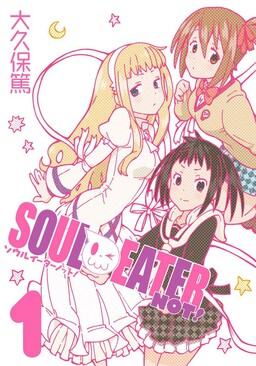
Soul Eater NOT!
Yu's review of Soul Eater NOT! — a spinoff set in the same Death Weapon Meister Academy as Soul Eater, following Tsugumi Harudori, a new student who is a weapon but not yet a skilled one; she must choose between two potential meisters — the calm Meme and the earnest Anya — while navigating first-year academy life.
Action / Comedy
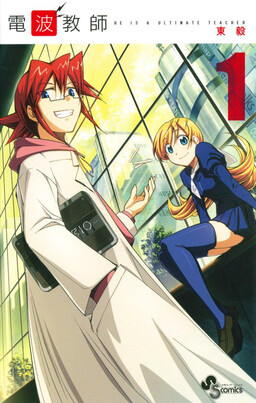
Ultimate Otaku Teacher
Yu's review of Ultimate Otaku Teacher — Junichiro Kagami is Japan's greatest physicist and also a complete shut-in otaku who only leaves his room for anime and manga; when his sister forces him to become a teacher at her school, he discovers that his otaku knowledge and online gaming skills provide unusual solutions to student problems.
Action
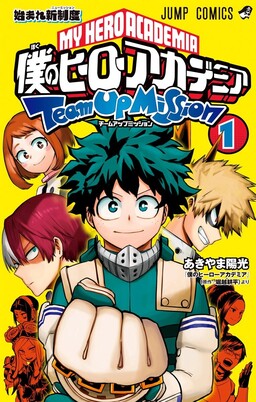
My Hero Academia: Team-Up Missions
Yu's review of My Hero Academia: Team-Up Missions — a spinoff series featuring U.A. students paired with professional heroes from different agencies for joint training missions; lighter in tone than the main series, focused on character interactions and comedy.
Action
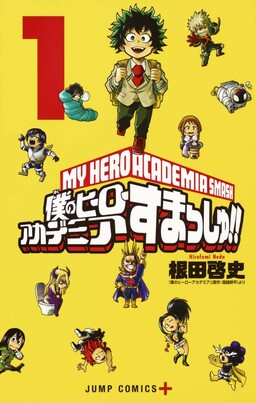
My Hero Academia: Smash!!
Yu's review of My Hero Academia: Smash!! — the official comedy spin-off of My Hero Academia; Deku, All Might, Bakugo, and the entire cast of UA High reimagined as gag manga characters; Hirofumi Neda's parody of Kohei Horikoshi's hero universe that finds every possible comedy angle in the source material.
Action / Comedy
The Fable
Yu's review of The Fable — Akira (codename 'The Fable') is considered the deadliest assassin in Japan; his boss orders him to take a year off and live as an ordinary person without killing anyone; the comedy of an extraordinarily dangerous man trying and mostly succeeding at being normal while the criminal world swirls around him.
Action / Comedy
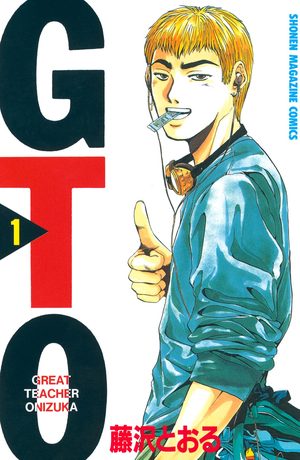
GTO: Great Teacher Onizuka
Yu's review of GTO: Great Teacher Onizuka — Eikichi Onizuka is a 22-year-old former gang leader and virgin who becomes a middle school teacher at an elite private school; what he lacks in academic credentials he compensates for with an absolute refusal to give up on any student.
Written by
Yu
Manga Enthusiast from Japan
I grew up in Japan and manga literally saved me during a tough time in elementary school. My English isn't perfect, but my love for manga is real — and I want to share it with you.
Disclosure: This post contains affiliate links. As an Amazon Associate, I earn from qualifying purchases at no extra cost to you.